Child Tax Credit Outreach Requested by US Department of Education

We recognize that many families are still struggling financially from the pandemic and that the Child Tax Credit is an important opportunity to help them cover their expenses, especially as kids prepare to return to school. We’re engaging with the Treasury and White House to help enroll eligible families in the Child Tax Credit, with a particular focus on families that may not usually file taxes and may be in deep need of financial support. To do that, we are offering training to frontline workers and community organizations that could help sign people up. Experts estimate the new Child Tax Credit has the potential to cut child poverty in half. It provides the largest child tax credit ever and historic relief to the most working families ever ($3,000 per child 6-17 years old and $3,600 per child under 6 years old).


We’d like to follow-up on conversations you had with the White House to work with your members to offer training for those on the frontlines of the work you’re doing so they have the resources and information to spread the word about the Child Tax Credit and so they can directly help people enroll.  We have organized an information session on Thursday, September 2 at 11:00am PT for PTA members and school personnel in the targeted outreach areas:

Los Angeles

San Bernardino

Riverside

San Diego

Orange

Sacramento


Information session attendees will learn more about the Child Tax Credit and how their school personnel can help members of their community enroll in this historic program.  Register in advance for this meeting:   https://www.zoomgov.com/meeting/register/vJItd-ytqzouGZ1t89hlrGevJHGrkZfHEUM

Eleven Ways to Draw a Crowd to Your PTA Meetings

By Heather Ippolito, Vice President for Family Engagement

PTA units are always asking our state leaders “How can we get more people to attend our association meetings and events?” The Leadership Services and Family Engagement commissions teamed up and found some really great strategies to help answer this question that you might want to try in the upcoming school year.*

  1. Have snacks.
  2. Partner with the school to offer childcare.
  3. Offer translation and interpretation services so that EVERY parent can participate in your meeting. (Note: You also need to invite them in their home language.)
  4. Play music as they enter to give the room a fun atmosphere — we know PTA meetings aren’t boring, but other parents might have that impression.
  5. Have opportunity drawings for all in attendance. You can give away spirit wear, homework passes, or gift cards that have been donated by local businesses. 
  6. Incorporate a student performance as part of your meeting. Parents love to see their kids sing, dance, show off that poster or project they’ve been working on, etc.
  7. Give a homework pass to every parent who attends. Work with your school principal on this particular incentive to make sure that every teacher is on board with this incentive.
  8. Provide parent education at your meeting. We have seen success with inviting the local library to talk about reading programs, the sheriff to talk about bullying or biking safety, or even asking your principal to share about different issues impacting parents. This is a great chance to work with the organizations in your community since they often offer free programs that families will find useful.
  9. Bring in guest speakers. Your guests can either be entertaining or educational, but oftentimes a new name can draw a large audience.  
  10. Pair your meeting with another event. You could have your meeting right before the Family Math Night on campus or at the bowling alley before Family Bowling Night — either way you are far more likely to draw a crowd.
  11. Finally, really think about the time and location of your meeting. Are you meeting at a time that’s good for you, or a time that is good for your families? Is your meeting location convenient? Many units think the school is the only place for a meeting, but we do have other options. We can meet at a park, the library, a community center, or other places where our parents frequent. Really be intentional in asking our families the best times and places to meet.

*Note: We know that this year may still have a combination of in-person, virtual, and hybrid events and meetings. Many of these ideas can be adaptable to your particular needs.

To return to the blog homepage, click here.

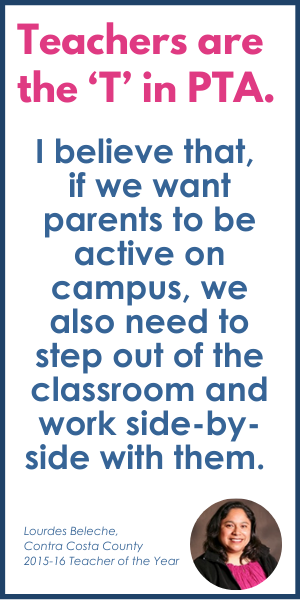
PTA Membership: Teacher is Our Middle Name

By the Membership Services Commission

In the PTA universe, we know how important our teachers are! Having the teachers and administrators at your school join your PTA and participate in your programs is a great way to encourage children and families to join as well. A collaborative partnership among all the adults at the school is one of the best ways to strengthen communication between families and schools. 

So as you plan and promote your PTA membership campaign this back-to-school season, encouraging teachers to join PTA should be one of the focal points. (And don’t forget other school staff as well.)

We’ve put together a list of ideas and some helpful tools to help you get teachers on board. 

  • TALK with teachers about the value of PTA. Provide breakfast or a snack for teachers and use the opportunity to discuss the value of PTA at your school. Back-to-School night can also be a good opportunity to speak with both teachers and parents about supporting PTA.
  • SHARE information about PTA’s Continuing Education Scholarships. PTA offers scholarships to teachers, school nurses, counselors and volunteers to continue their education.
  • REMIND teachers and staff about PTA’s advocacy work. PTA is much more than a local fundraising group for your school –  we are an advocacy organization focused on student success!
  • ENLIST the support of your principal. A principal’s encouragement for teachers to join PTA can go a long way.
  • OFFER incentives to join. Award teachers and staff with a lunch or celebration when 100 percent teacher membership is reached, or offer teachers who join reimbursements for classroom supplies.

Questions about running your PTA membership campaign? Contact us at membership@capta.org.

To return to the blog homepage, click here.

Family Engagement: A Hot Back-to-School Topic

As the summer ends, many workshops, webinars, and virtual conferences are preparing educational leaders, teachers, and parents for the return to school.  Our Family Engagement Team has attended several of them. 

Here are some of the take-aways:

  • We can no longer move forward with families on the sidelines of education.  The pandemic brought families into the classrooms as learning went virtual and parents were forced to monitor/assist with their child’s learning.  Now that these lines of communication and collaboration between our schools and our families have been opened it is critical that we continue on this path.
  • We have spoken for years about the impact of family engagement on students (higher test scores, better attendance, etc.) but we need to mention the impact of family engagement on families as a whole.  Dr. Karen Mapp sites the following things that parents experience as a result of being involved on their child’s school campus:  
    • Their role perception shifts from just a “mom” or “dad” to a “teacher”, “mentor”, or “expert”
    • They gain confidence in their ability to shape and influence their child’s learning
    • They have an increased sense of accountability and begin to advocate for all children
    • They become empowered to take on new challenges– that could include serving on district committees, running for school board, etc. 
  • Family engagement is not a program but a practice— something that every school, administrator, and teacher needs to embrace so that our children can be the best they can be.  Families must be part of the team of experts.
  • Families are as vital to student success as school climate and teachers. A 20-year study from schools in Chicago found there are 5 essential supports for successful schools:  leadership (administration), professional capacity, parent/community ties, student-centered learning climate, instructional guidance (professional development). 
  • Social and emotional learning (SEL) is of particular importance this year. SEL has been a huge topic in most of the workshops about returning to school.  If you want more information to understand just what SEL entails and how families play a major role in social and emotional learning, watch this five-minute video from the Collaborative for Academic, Social, and Emotional Learning (CASEL).

To return to the blog homepage, click here.

The CDC is Asking You to Help Raise Awareness About Immunizations

By Mary Perry

Vaccinations are a hot topic right now, thanks of course to COVID-19. But long before the current pandemic the Centers for Disease Control (CDC) designated August as National Immunization Awareness Month. 

To help schools and families make sure every child starts school healthy and immunized this fall, we are sharing a wealth of resources created by the CDC especially for school communities.


GO BACK TO SCHOOL HEALTHY AND IMMUNIZED

An unfortunate result of the pandemic is that many children missed check-ups and recommended childhood vaccinations. CDC and the American Academy of Pediatrics (AAP) recommend every child continues to receive recommended vaccinations during the COVID-19 pandemic.

These are challenging times, but you have the power to help keep your child healthy.

Making sure that your child sees their doctor for well-child visits and recommended vaccines is one of the best things you can do to protect your child and community from serious diseases that are easily spread.

The CDC has prepared great information for both adults and kids about Covid-19 vaccines specifically:

In addition, be sure to check out and share this comprehensive guide to well-child visits and recommended vaccines.

To return to the blog homepage, click here.

Standard #1: Welcoming all families into the school community

By Heather Ippolito, VP for Family Engagement

Earlier this month we introduced the PTA National Standards for Family-School Partnerships on the blog. You can view that article by clicking here.  Today we are going to dig a little deeper into the first standard:  

Welcoming All Families Into the School Community

As your local unit begins to think about your back to school events consider these five tips for being as inclusive as possible in welcoming ALL families:

  1. On forms and paperwork remember to be inclusive in your language.  Instead of asking for names of “moms and dads” you can ask for names of parents, caregivers, or guardians.  Asking parents for their preferred pronouns is also a great idea!
  2. Create a “Welcome Packet” for new families.  Include coupons for local businesses, maps of the community, a copy of the school newsletter, how to find the school and PTA on social media, and a list of ways parents can get involved at your school including but not limited to:  
    • School Site Council (SSC), 
    • English Learner Advisory Committee (ELAC), 
    • Parent Teacher Association (PTA), 
    • Parent Advisory Council (PAC) and other school or district committees.  
  3. Don’t forget to include a way to join your PTA!   Every time a new family enrolls the school office staff can give them the welcome packet.
  4. PTA volunteers call new families to personally invite them to the back-to-school events, offering to help them find transportation if they need it.
  5. Survey families (in their home language if possible) to see what kinds of programs they are interested in and what kinds of support they need from the school.

We want to hear from you!  What activities have you done to welcome families?  Share them with us and we might feature them here on the blog or on our social media channels– simply fill out this quick form and let us know what you’ve done to welcome schools to your campus.

To return to the blog homepage, click here.

Protecting Kids from the Academic Impact of a Lost Year

By Mary Perry, California State PTA Board of Managers

For many California children, the 2020-21 school year was a time of lost potential as one fourth of families did not have a high-speed internet connection and thousands of students did not even enroll in school. In June, Assembly Bill 104 (Gonzalez) was adopted as an emergency measure to support parents and help them protect their students from some of those impacts.

According to a press release from the bill’s author, San Diego Democrat Lorena Gonzalez, AB 104 goes into effect immediately and allows parents of students who fell behind during the last year to pursue a number of learning recovery options before the next school year begins.” California State PTA supported the bill. 

Three key things parents can do

Thanks to this newly passed emergency measure, families have several options for helping students make up for lost instructional time. Each has a specific timeline and requires that parents and students take the initiative to communicate with school officials. When state guidance refers to Local Education Agencies, or LEAs, it includes school districts, charter schools and county offices of education.  

  • Change a “D” or “F” grade to Pass/No Pass

This option requires fast action! Students enrolled in high school in the 2020–21 academic year may apply to have any letter grade replaced with a pass or no pass grade. The CA Department of Education has prepared a form that LEAs will use for this request and should have already posted on their website. In addition, they should post this list of the UC campuses and private universities that have agreed to accept transcripts with these changes. AB 104 required that all California State University (CSU) campuses accept the pass/no pass grades as well. After the LEA has posted this information and provided written notice, students have 15 days to file their grade change request.

  • Retain a student in their previous grade

This option is for students who were in any of grades kindergarten to 11th grade in 2020-21 and successfully finished less than half of their course work. Parents must file a written request with their Local Education Agency to have their student retained in the same grade for another year. The LEA, in turn, must schedule a consultation with the parent within 30 days of that request. The LEA makes the final decision on the request and must notify the parent within 10 days of the consultation. Most LEAs already have a form they use for parents related to grade retention. You should contact your school principal or district office for more information.

  • Exempt a student from local graduation requirements 

Students enrolled in their third or fourth year of high school in 2020-21 and who are not on track to graduate in four years must be offered some options. One option is to exempt them from all coursework and other requirements adopted by the LEA that are in addition to the statewide coursework requirements, which are fewer than most districts require. If necessary, LEAs must also provide these students the opportunity to complete the statewide coursework required for graduation, which may include offering a fifth year of instruction or credit recovery. Here is a quick comparison of the statewide requirements and those that make a student eligible for UC or CSU admission.

This EdSource article, part of their July 26 news update, provides additional background about AB 104. For deeper background related to education, PTA advocacy, health, community concerns, and family engagement, visit the Focus Areas section of the CA State PTA website

Follow us on social media for the latest updates on state laws, emerging issues and other information impacting California’s children and families.

To return to the blog homepage, click here.

Interview with Danni Kim, National PTA Family Engagement Whole Child Fellow

Earlier this month National PTA announced the names of four Family Engagement Fellows from across the United States. California State PTA is proud to announce that Danni Kim from Franklin Magnet PTA in First District was selected for this prestigious program.

Our Vice President for Family Engagement, Heather Ippolito, sat down with Danni and asked her about the importance of family engagement, her favorite programs to connect families to campus, and for a sneak peek into what the Fellows will be doing. She described several amazing programs implemented at her school site this past year including “Culture of Kindness” and a virtual art assembly that focused on diversity.

Click below to watch the interview:

Additional resources:

To return to the blog homepage, click here.
Summer learning ideas and resources

Learning loss during the summer months is a real concern, especially after the challenging school year we’ve had. If you’re looking for ways to keep your child’s mind active over the term break, or just want to take part in some interesting summer activities with your kids, California State PTA has got you covered!

We’ve compiled the following list of resources and ideas:

Resource Library

These items and activities from our Resource Library will help you learn how to keep your kids’ brains engaged:

These are just a few of the summery ideas and resources you’ll find in the Resource Library. Be sure to check it out by using the simple search function!

Learning Heroes

Readiness Checker: Our Education Commission found this helpful resource for parents of students in kindergarten through 8th grade. It’s a simple-to-use tool that helps you check how your child is doing in math and English language arts, based on their grade level.

Using the results of quick on-line items, it also suggests some resources that can help you and your child use a bit of time this summer to get a targeted head start on next school year.

Summer Parent-Teacher Planning Tool: The California Department of Education’s Jumpstart Toolkit: Summer Learning Program can be used in a meeting with your child’s teacher to co-create a summer learning plan. It provides ideas for two-way communication and a chance for parents and teachers to share their observations of a student’s learning.

National PTA

Help Your Student Make the Most of Their Summer (and Still Have Time for Fun): Choosing vacations over summer school can be tricky, especially after such a difficult year. A good compromise is online, self-paced courses, which allow students to take their courses with them and work on them on their own schedule. Click here to read it.

10 Non-Tech Summer Activities to Build Language, Literacy and Learning: The dog days of summer are here—and many kids have a lot more leisure time on their hands. To prevent overuse of tech devices, try these ideas for non-tech activities that are fun AND promote language, literacy and learning. Click here to read the article.

Pinterest

Bet you didn’t realize that California State PTA’s Pinterest boards are chock-full of science projects, art activities and other summer learning activities! Click here to explore.

To return to the blog homepage, click here.

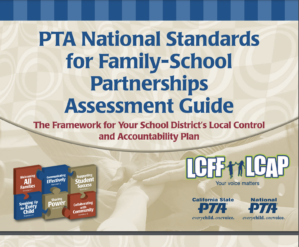
Introduction to the National Standards for Family-School Partnerships

National PTA is focused on transformative family engagement which is defined as “a shared effort of families, schools, and community leaders to advance programs, practices, and policies that empower every parent to make their child’s potential a reality.” To that end, the National Standards for Family-School Partnerships will help your school evaluate where you are in your family engagement journey and give you ideas to be more inclusive in your practices.

There are six parts to the blueprint:

  1. Welcoming all families into the school community 
  2. Communicating effectively 
  3. Supporting student success 
  4. Speaking up for every child
  5. Sharing power 
  6. Collaborating with community

Throughout the year we will be sharing with you some examples and best practices in each of these areas, but we would also love to hear from you!  What are you doing to engage families in your school, council, or district PTA? Share your great ideas by completing this form or email familyengagement@capta.org

To learn more about National PTA’s Transformative Family Engagement work, visit the Center for Family Engagement and watch this video:  

Next steps: 

  • Download the complete Guide and begin to read through it or start with the briefer summary document as an introduction.
  • Select one area of focus for your PTA to discuss at your next meeting.  Brainstorm ideas and make a plan to put one of those ideas into action at the following meeting.
  • Show the Guide to your school principal and give it to your School Site Council President.

If you missed last week’s Family Engagement Friday blog post, you can check it out here.

To return to the blog homepage, click here.