Give Your Feedback on the LCAP Template

This year, school districts will once again be developing their three-year Local Control and Accountability Plans (LCAPs). You can get more information about what the LCAP is and why it matters at https://capta.org/focus-areas/lcfflcap/.

The state is revising the template that districts use to do this important work, and they have asked California State PTA to help them get parents’ opinions about the changes. If you have been part of your school or district planning process, your feedback is particularly important.

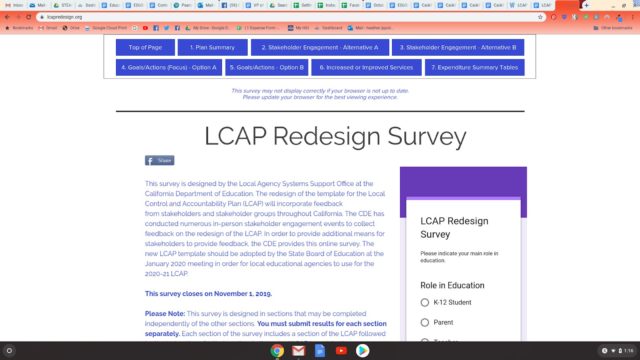
The Department of Education has put together an on-line survey that can be accessed here: https://www.lcapredesign.org/. The deadline for completing the survey is November 1. The State Board is required to adopt a revised LCAP template at their January meeting.

The survey – like the LCAP itself – is quite comprehensive but is presented in sections. You can choose to review every LCAP section or only those you are most interested in. We hope you’ll take a few minutes to give your reactions.

October is Principal Appreciation Month

October is Principal Appreciation Month. Site administrator support is a key component to PTA success– and the principal is a large part of that! Here are some tips for forming a stronger relationship with your site administrator:

  • Set a positive, collaborative and respectful tone.
  • Make sure you have consistent, two-way communication.
  • Work with your school–you are part of the team to make your school successful.
  • Attend training yourself and bring your site administrator.
  • Don’t forget that your principal is part of your team.

For more information including a self assessment for principals and unit leaders you can visit our resource page.

Breast Cancer Awareness Month

Other than skin cancer, breast cancer is the most common cancer among American women. Mammograms are the best way to find breast cancer early, when it is easier to treat and before it is big enough to feel or cause symptoms.

Each year in the United States, more than 245,000 women get breast cancer and more than 40,000 women die from the disease. See detailed statistics. Men also get breast cancer, but it is not very common. Less than 1% of breast cancers occur in men.

Most breast cancers are found in women who are 50 years old or older, but breast cancer also affects younger women. About 10% of all new cases of breast cancer in the United States are found in women younger than 45 years of age.

There are different symptoms of breast cancer, and some people have no symptoms at all. Symptoms can include—

  • Any change in the size or the shape of the breast.
  • Pain in any area of the breast.
  • Nipple discharge other than breast milk (including blood).
  • A new lump in the breast or underarm.

If you have any signs that worry you, see your doctor right away.

Some main factors that influence your risk for breast cancer include—

  • Being a woman.
  • Being older (most breast cancers are found in women who are 50 years old or older).
  • Having changes in your BRCA1 or BRCA2 genes.

Most women who get breast cancer have no known risk factors and no history of the disease in their families. There are things you can do to can help lower your breast cancer risk.

Although breast cancer screening cannot prevent breast cancer, it can help find breast cancer early, when it is easier to treat. Talk to your doctor about breast cancer screening.

https://www.cdc.gov/cancer/dcpc/resources/features/breastcancerawareness/index.htm

http://downloads.capta.org/res/BreastCancerEarlyDetectionAwarenessAndEd.pdf

Mental Health Day

World Mental Health Day is observed on 10 October every year, with the overall objective of raising awareness of mental health issues around the world and mobilizing efforts in support of mental health.

The day provides an opportunity for all stakeholders working on mental health issues to talk about their work, and what more needs to be done to make mental health care a reality for people worldwide.

Mental health in childhood means reaching developmental and emotional milestones, and learning healthy social skills and how to cope when there are problems. Mentally healthy children have a positive quality of life and can function well at home, in school, and in their communities.

Mental health is important to overall health. Mental disorders are chronic health conditions—those that go on for a long time and often don’t go away completely—that can continue through the lifespan. Without early diagnosis and treatment, children with mental disorders can have problems at home, in school, and in forming friendships. This can also interfere with their healthy development, and these problems can continue into adulthood.

Mental disorders among children are described as serious changes in the way children typically learn, behave, or handle their emotions, which cause distress and problems getting through the day.

Among the more common mental disorders that can be diagnosed in childhood are attention-deficit/hyperactivity disorder (ADHD), anxiety, and behavior disorders. Other childhood disorders and concerns that affect how children learn, behave, or handle their emotions can include learning and developmental disabilities, autism, and risk factors like substance use and self-harm.

Symptoms of mental disorders change over time as a child grows, and may include difficulties with how a child plays, learns, speaks, and acts or how the child handles their emotions. Symptoms often start in early childhood, although some disorders may develop during the teenage years. The diagnosis is often made in the school years and sometimes earlier. However, some children with a mental disorder may not be recognized or diagnosed as having one.

Childhood mental disorders can be treated and managed. There are many treatment options based on the best and most current medical evidence, so parents and doctors should work closely with everyone involved in the child’s treatment — teachers, coaches, therapists, and other family members. Taking advantage of all the resources available will help parents, health professionals, and educators guide the child towards success. Early diagnosis and appropriate services for children and their families can make a difference in the lives of children with mental disorders.

https://capta.org/focus-areas/health-safety/mental-health/

https://www.who.int/mental_health/world-mental-health-day/en/

https://www.cdc.gov/childrensmentalhealth/basics.html

Get the Lead Out

“I know many parents who had a new water bottle on their ‘back to school’ shopping list,” said Mariaelena Huizar, California State PTA Vice President of Health and Community Concerns. “We’ve got to make sure what’s going in those bottles is safe. For that reason, I’m recommending this Get the Lead Out toolkit to parents. It’s short and gives you concrete tools to work with your school and ensure safe drinking water for our children.”

Everyone agrees that our kids need and deserve safe drinking water at school. Unfortunately, most schools were built with fountains, faucets and other parts that contain lead. So far, over 2,000 water fountains and sinks in California schools have been found to leach lead into the drinking water. And since only a fraction of water fountains have been tested in the state, we are likely only scratching the surface of the problem.

The good news is that parents and school officials working together can solve this problem. The legislature has demonstrated a commitment to help schools address this, with $150 million allocated to lead remediation as part of a new statewide school bond likely heading to voters in 2020. But today’s students are counting on schools to take initiative now to get out the lead.

The California Public Interest Research Group (CALPIRG) has created a free Back to School Toolkit that includes a fact sheet, sample materials for taking action, and links to additional resources. You can download the toolkit here: www.calpirg.org

World Teachers Day

Tomorrow is World Teachers Day– and in the PTA universe, we know how important our teachers are! Having the teachers at your school join your PTA and participate in your programs is a great way to encourage children and families to join in the fun! Students love when their teacher comes to an event and parents like the opportunity to see a teacher outside of parent conference.

Show teachers how much we appreciate all that they do! We know that Teacher Appreciation Week isn’t officially until May, but you can still use some of these ideas to recognize your teachers earlier in the year!

Teachers, did you know that we also have resources you can use with the families in your classroom– many of which are available in different languages? National PTA even has a guide designed especially for teachers on ways to increase parent engagement at your school.

Don’t forget that we are a team– that’s why we are called the Parent Teacher Association! Thank you for all you do on a daily basis to positively impact the lives of children and families at our schools.

It is Reflections season!

It is currently Reflections season in our PTAs. As you encourage your artists to work on their submissions for “Look Within” keep these things in mind:

  1. If you have not already done so, please register your unit with National PTA. It’s a simple form to fill out just click here.
  2. Do some marketing for the program to keep it in the forefront of everyone’s mind. California State PTA has some printable resources for you to use.
  3. Begin to recruit judges to evaluate the student’s work. Local dance studios, community college professors, and high school English teachers are just a few ideas of places to contact for possible judges. In the local leader guide we have instructions for the judges as well as rubrics they can use as they evaluate.
  4. Celebrate every student artist with certificates, plaques, or awards. We have a celebration guide, certificate template, and volunteer thank you cards all ready for you to use!
  5. Pat yourself on the back for helping to keep the arts alive at your unit!

Voter Registration

Are YOU registered to vote? Do you need to update your registration or not sure how to register for the November 3, 2020 election?

The deadline to register online is Monday, October 19, 2020.

The deadline to register by mail is (postmarked by) Monday, October 19.

You can also register and vote in person on Election Day.

Visit https://www.sos.ca.gov/elections/voter-registration/ to register. Voting is a privilege and it is our duty and responsibility as citizens to take the opportunity to have our voices heard. By registering to vote, and then going to vote at the polls, you are engaging in our country’s political process while standing up for what matters most to you, your family, and your community. Each of us deserves the chance to stand up for what matters most to us, and to have our voices heard. The best way to do that? Register to vote and then..go vote.

Did you know that 16- and 17-year-olds can pre-register to vote now for the first election after they reach 18? Did you know that in the 1970’s students worked to lower the voting age from 21 to 18 so that they could have a voice in matters affecting them directly?

National Voter Registration Day (NVRD) is a national holiday celebrating our democracy, and was first observed in 2012 on the fourth Tuesday of September. In 2020 NVRD falls on Tuesday, September 22nd. Volunteers and organizations from all over the country will coordinate efforts to create awareness of the many voter registration opportunities.

Celebrate Hispanic Heritage Month

CELEBRATE HISPANIC HERITAGE MONTH

Did you know that Hispanic Heritage month is celebrated in the United States from September 15 — October 15? We celebrate the contributions that Hispanic and Latino Americans have made to the vitality, history and culture of North America. Hispanics and Latinos are those whose Spanish speaking ancestors came from the Caribbean, Central America, Mexico and South America. 

Legislation was brought forward by Edward R. Roybal (D-Los Angeles) for Hispanic Heritage week and signed into law by President Lyndon Johnson on September 17, 1968. During Ronald Reagan’s presidency, the week was expanded to a month and enacted into law on August 17, 1988.

The month was not randomly selected. Several Latin American countries celebrate their revolt against Spain from September 15 — October 15. These independence days are also known as “Fiestas Patrias”: 

  • September 15 – Costa Rica, El Salvador, Guatemala, Honduras, and Nicaragua
  • September 15-16 – Mexico
  • September 18 – Chile
  • September 21 – Belize
  • October 12 – Dia de la Raza; Indigenous Peoples Day; Columbus Day – the discovery of America in 1492

A few notable Hispanics include:

Jose Mariano Hernández became the 1st Hispanic from the Florida Territory to serve in the US Congress beginning on 01/03/1823.

Richard Edward Cavazos was the 1st Hispanic American US Army 4-Star General; recipient of the Distinguished Service Cross in 06/14/1953.

Cesar Chavez was the best known Hispanic American civil rights activist and labor leader using non-violent tactics making the farm workers struggle a “moral cause” in 1962.

Dolores Huerta is a Hispanic American labor leader who co-founded the National Farm Workers Union in 1962; directed the Delano grape strike of 1965.

Rita Moreno is the 1st Hispanic American to win an Oscar in 1965, a Grammy in 1972, a Tony in 1975, and an Emmy award in 1976.

Ramona Acosta Banuelos became the 1st Hispanic American U.S. Treasurer on 09/20/1971

Roberto Clemente was the 1st Hispanic MLB player elected for induction in the Baseball Hall of Fame on 03/20/1973.

Dr. Ellen Ochoa a NASA Research Engineer and 11th Director of the Johnson Space Center; 1st Hispanic American female astronaut; took her first venture on the shuttle Discovery on 04/08/1993

Sonia Sotomayor was sworn in as the 1st Hispanic American Supreme Court Justice on 08/08/2009.

Susan Martinez was the 1st Hispanic American female elected as Governor of New Mexico on 11/02/2010

Mario J. Molina was the 1st Hispanic to win the Nobel Prize in Chemistry (co-recipient) in 1995 for his discovery of the Antarctic ozone hole and the effect of chlorofluorocarbon gases on the Earth’s ozone layer.

Gloria Estafan has won 3 Grammys and was awarded the Presidential Medal of Freedom on 11/24/2015 for her contributions to American music.

Hispanic heritage children’s books:

Cockcroft, James (2000) Latino Visions: Contemporary Chicano, Puerto Rican & Cuban American Artists

Hollihan, Kerrie Logan (2010) Hispanic Heritage Month

Kimmel, Eric A. (2004) Cactus Soup

Manzano, Sonia (2015) Becoming Maria: Love and Chaos in the South Bronx

Martinez, Claudia Guadalupe (2014) Pig Park

McNelly McCormack Caren (2009) The Fiesta Dress: A Quinceañera Tale


MES DE LA HERENCIA HISPANA

¿Sabía usted que el mes de la Herencia Hispana se celebra en los Estados Unidos del 15 de septiembre al 15 de octubre?   Celebramos las contribuciones que los hispanos y los latinos han hecho para la vitalidad, la historia y la cultura de América del Norte. Los hispanos son aquellos cuyos antepasados de habla hispana vinieron del Caribe, Centroamérica, México y América del Sur. 

La legislación fue presentada por Edward R. Roybal (D-Los Angeles) para la semana de la Herencia Hispana y firmada por el presidente Lyndon Johnson el 17 de septiembre de 1968. Durante la presidencia de Ronald Reagan, la semana se amplió a un mes y se promulgó en ley el 17 de agosto de 1988.

El mes no fue seleccionado al azar.  Varios países latinoamericanos celebran su revuelta contra España del 15 de septiembre al 15 de octubre.  Estos días de independencia también se conocen como Fiestas Patrias: 

  • 15 de septiembre – Costa Rica, El Salvador, Guatemala, Honduras y Nicaragua
  • 15-16 de septiembre – México
  • 18 de septiembre: Chile
  • 21 de septiembre: Belice
  • 12 de octubre: Día de la Raza; Día de los Pueblos Indígenas; Día de Colón – el descubrimiento de América en 1492

Algunos hispanos notables incluyen:

José Mariano Hernández se convirtió en el primer hispano del Territorio de Florida en servir en el Congreso de los Estados Unidos a partir del 01/03/1823.

Richard Edward Cavazos fue el primer general de cuatro estrellas del ejercito que fue hispanoamericano; receptor de la Cruz de Servicio Distinguido en 06/14/1953.

Cesar Chávez fue el activista de derechos civiles hispanoamericano más conocido y líder laboral que utilizó tácticas no violentas haciendo que los trabajadores agrícolas lucharan como una “causa moral” en 1962.

Dolores Huerta es una líder laboral hispanoamericana que cofundó el Sindicato Nacional de Trabajadores Agrícolas en 1962; dirigió la huelga de la uva Delano de 1965.

Rita Moreno es la 1a hispana hispana en ganar un Oscar en 1965, un Grammy en 1972, un Tony en 1975 y un premio Emmy en 1976.

Ramona Acosta Banuelos se convirtió en la 1a Tesorera Hispanoamericana de los Estados Unidos el 09/20/1971

Roberto Clemente fue el primer jugador hispano de la Liga Mayor de Béisbol elegido para la inducción en el Salón de la Fama del Béisbol el 03/20/1973.

Dra. Ellen Ochoa ingeniera de investigación de la NASA y 11a Directora del Centro Espacial Johnson; 1a mujer astronauta hispanoamericana; tomó su primera aventura en el transbordador Discovery el 04/08/1993

Sonia Sotomayor fue juramentada como la 1a Juez de la Corte Suprema Hispanoamericana el 08/08/2009.

Susan Martínez fue la primera mujer hispanoamericana elegida como Gobernadora de Nuevo México el 11/02/2010

Mario J. Molina fue el primer hispano en ganar el Premio Nobel de Química (co-receptor) en 1995 por su descubrimiento del agujero de ozono antártico y el efecto de los gases de clorofluorocarbono en la capa de ozono de la Tierra.

Gloria Estafan ha ganado 3 Grammys y fue galardonada con la Medalla Presidencial de la Libertad el 11/24/2015 por sus contribuciones a la música estadounidense.

Libros para niños de la herencia hispana:

Hollihan, Kerrie Logan (2010) Mes De La Herencia Hispana

Lopez, George (2013) No Voy a Mentir
Ask the Governor to Support Later School Start Times

California State PTA is co-sponsor of SB 328 which advocates for a later school start time for middle and high schools. Last week it was approved by the state legislature and now it is sitting on the governor’s desk waiting for his signature or his veto.

The bill would update Education Code to mandate a start time of no earlier than 8 a.m. for middle schools and 8:30 a.m. for high schools and would give school district 3 years to implement the change. Why is this an important piece of legislation? Research shows that early school start times are keeping our teens from getting the 8.5-9.5 hours of sleep they need and that a later start time would improve graduation rates, decrease depression and suicide risk in teens, and reduce their risk of being overweight.

PTA is asking you to join us in asking Governor Newsom to sign this bill. Click here to send him an email: http://bit.ly/2kwkULm