Finding the Right College for your Student

By California State PTA Family Engagement Commission

A Conversation with Kelly Mattinson, Family Engagement Commission Consultant

Q. How does a student find the “perfect fit” college?

In most cases it’s a family decision. The choice needs to fulfill the needs of the student and the family , particularly when the parents are the financially responsible party or helping identify scholarships, grants or loans.

That said, the most successful college selection stories happen when three things factor equally into the decision: the social, academic and financial fit. All three are vital to a successful college journey.

Q. What do you mean by social fit?

By social, I mean “How does the school FEEL?” For example, a student should be asking:

  • Is it a large or small school, which do I learn better?
  • What clubs and activities are available?
  • Do they have a football team?
  • Do I care about school spirit?
  • Is there Greek life?
  • What is the weather like?
  • Is there dorm living?
  • How far is it away from home?

If possible, an in-person visit can be revealing. When you step on the campus, do you want to walk those grounds for the next four-plus years? Sometimes you just know the school is your place. Sometimes you immediately know it is not. If this is going to be your home for four years, it needs to feel like home.

Q. Beyond “do they have my major” what should a student look for to be sure of an academic fit?

This involves knowing a bit about your personal academic style. Do you prefer a semester or quarter schedule? How intense or laid back do you want your academic experience to be? The pace is an important factor to academic success.

Does the college offer multiple majors that interest you? Most students do not graduate with their initially intended field of interest. Having back up options is best as you discover new things about yourself and disciplines in college – that is part of the process.

Q. Isn’t a financial fit just a straightforward affordability question and aren’t more expensive colleges naturally better?

College is expensive. You get what you pay for can be true, but it can also be misleading. Just because the price tag is high does not necessarily make it the BEST. There are amazing public schools out there that come with federal and local funding packages that can help you, there are also VERY generous private universities that will invest in you given the opportunity.

When choosing your BEST fit university, make sure you are comparing apples to apples and not watermelons to grapes. Take all things into account. For example, look at the average time to graduate. If you pay $200,000 but it takes you 5 years to graduate, it actually costs you more than a 4-year university experience at $200,000 because you lose a year of earnings. In other words, sometimes a less expensive school can cost more because it will take longer to graduate. Most private universities guarantee that you will graduate in four years. There may be several reasons including that they may not have the housing or they gave you a lot of financial aid and want you to move on and give back as an alumni. (Watch for more on this and the FAFSA process in an upcoming post.)

Q. Why is the best FIT important for parents as well?

College selection and application is a process that can take up family time and parental involvement in the high school years. Some families are also able to make a financial commitment (even a financial sacrifice!) towards their child’s college experience. After all that, can you imagine your child crying because they are miserable at college? Talk about salt in the wound. I want to know my son is thriving and that he will be happy and productive in his life ahead and hopefully he will take care of me when I am old… lol. It is much easier to be happy for your kid when they are happy…. it is the worst to MISS them (and you will) and have them miserable. Trust me… if they go away to college and they’re happy, it makes it easier to not mourn their empty room.

For more resources on college and career preparation be sure to visit this Family Engagement webpage.

Kelly Mattinson is a former Council PTA President and current local PTA leader. She has worked as a college admissions planner in Los Angeles, helping families find the right fit for their students going to college.


Takeaways from the Family Engagement Summit: Part 1

By California State PTA Family Engagement and Communication Commission

What do focusing on equity, motivating and validating others, understanding learning goals, pivoting away from passive information, and bridging the digital divide have in common?  All of them can strengthen family engagement and all were themes of the Family Engagement Summit I attended virtually last week. 

 It was wonderful to join family practitioners from throughout the country at the conference, even though the in-person event was held in the Eastern time zone, which made for some very early mornings!  

There was so much good information that I want to share with all of you that I’m dividing it into two parts.  This first blog post will cover the keynote speakers who were incredibly inspiring! Part two (coming soon) will cover the workshops I attended. Enjoy a little taste of this amazing conference! 

Equity Occupies a Central Place in Family Engagement
The conference kicked off with an impassioned presentation by Principal Baruti Kafele. He is an equity expert, principal, author, and speaker who spoke to us about critical questions for effective family engagement. My favorite nugget from Principal Kafele was his 5 simple things our children of color need: 

  • Believe in me… without judging me or comparing me to my peers
  • Get to know me… beyond who I am in the classroom
  • Prove that you care about me… and therefore are committed to me
  • Challenge me to maximize my potential… while taking the time to learn how I learn
  • Expose me to my history… Because I need to know who I am

He also stressed that all children need to know that they are brilliant in order to help close the attitude gap between those students who have the will to achieve excellence and those who do not. We as PTA leaders need to keep these things in mind as we advocate for all children equity is the job of everyone!

Motivation and Validation Make a Difference
Day two, we heard from Kim Bearden, award-winning teacher and co-founder of the Ron Clark Academy. She spoke about 6 Principles of Communication from her book Talk to Me:  Find the right words to inspire, encourage, and get things done.  

Two of those principles of communication are motivation and validation. We need to always keep our motivation in mind as we do this work. If we are not motivated by what is best for the kids, but we are motivated by our personal interests, we won’t come across the way we are hoping. The principle of validation makes sure that we see all people and not allow anyone to feel invisible. This is so important on school campuses we have many families that don’t feel included or feel like what they say isn’t valued and this must change if we are going to have transformative family engagement. 

Students and Families Need to Understand the “Why” Behind Learning
Christine Darden was our very inspiring opening to day three. She is a mathematician, data analyst, and aeronautical engineer who devoted much of her 40-year career in aerodynamics at NASA to researching supersonic flight and sonic booms. She worked at NASA after the time period covered in the film, Hidden Figures, but shared many of the same experiences and challenges.  

While most of the math she shared with us went right over my head, her work as a math teacher left me with her greatest nugget: our students need to understand the why behind what they are learning. Oftentimes she heard, “I will never use this math, why do I need to learn this?” so she made it a point to give practical examples of how the math she taught can be used. This also applies to families we need to understand the rationale behind what our children are learning so we can reinforce that at home. 

School-to-Family Outreach Should be Active and Forward-Looking
The family engagement expert, Dr. Steve Constantino was a special keynote for virtual attendees. He has been working in the family engagement field for nearly thirty years. He has written several books including his recently updated Engage Every Family: Five Simple Principles which is used as a guide for schools who want to increase their family engagement.  

My biggest takeaway from Constantino is that we need to move from a passive form of family engagement to an active one. In the passive model, we engage families by telling them about things that have already happened: parent teacher conferences, and other things that our children have done.  In the active model, we help families understand what is about to happen in the classroom and how they can support it. This doesn’t have to look vastly different from what is happening now, we just need to pivot a bit. For example, instead of just sending home a folder full of old papers for a parent to sign, place a paper in that folder that states what is coming next (a lesson on weather), ask the parents to ask their child about it (tell me about the different types of weather), then have the parents write the child’s response and sign that. Or at family nights help families see the connections between the math or literacy games they are playing and their child’s curriculum.  

If we can partner with schools to make these changes then we can move towards his idea of family engagement that says, “Every family, every teacher, every child, every day,” which is an amazing goal!

We Must Bridge the Digital Divide
Finally, we heard from Dr. Nicol Turner-Lee, a policy-maker working on the digital divide. She reminded us that prior to the pandemic we had the “digitally invisible” in our country. People from lower socioeconomic neighborhoods, people of color, and the elderly were not the focus of digital equity but now they must be! Besides education, so many services now rely on a device and internet connectivity (social services, shopping, medical appointments, etc.) we must ensure that we leave no family off-line. Being connected is essential to life in our country. 

In her upcoming book Dr. Turner-Lee also states that because education is the trajectory to social mobility, this is an equity issue. In our PTAs we can continue to work to help ensure that every child gets access to the technology and internet access that they need by facilitating partnerships with community groups and advocating in our communities to make this a reality. 

Let’s All Put These Ideas into Action!
While I just scratched the surface of these amazing speakers, I hope you have found a nugget of something to take back to your PTA to begin working on. There is so much to learn in this area and so many great books on the topic. If you would like us to do a book club focusing on family engagement books, please email familyengagement@capta.org and if there is enough interest we will make it happen!

Halloween Safety Tips

Halloween is just around the corner. To ensure a fun and safe holiday, California State PTA suggests the following tips from Safekids.org:

  • Walk Safely – Use crosswalks, walk on sidewalks instead of the street, and always check before crossing
  • Watch Your Child – Children under 12 shouldn’t trick-or-treat alone, and older children should stick to familiar, well-lit areas
  • Check Candy – Once your child is done trick-or-treating, be sure to check all candy. Look for unusual appearance or discoloration, tears in wrappers, unwrapped items, or anything that appears spoiled.
  • Keep Costumes Safe – Wear light colors and use fun reflective tape to decorate your child’s costume.
  • Drive Safely – Drive slowly in residential areas and take extra time to look out for kids at intersections, medians or curbs. Have kids carry glow sticks so they can be seen by drivers.

For more information on child safety from California State PTA, visit www.capta.org/safety.

California Supports Diversity with New Ethnic Studies Graduation Requirement

By California State PTA Legislation Team with the Health and Community Concerns and Education Commissions

With the governor’s signing of Assembly Bill (AB) 101 Ethnic Studies (Medina), California is the first state in the country to require that every high school student take an ethnic studies course in order to graduate. This bill, which was supported by California State PTA, requires schools to offer ethnic studies beginning with the 2025-26 school year and makes the one-semester ethnic studies course a graduation requirement beginning with the 2029-30 school year. 

Students must take a course that meets one of the following requirements:

  • A course based on the model curriculum, which was approved by the State Board of Education (SBE) in March 2021.
  • An existing ethnic studies course already offered at their high school.
  • A course that has been approved as meeting the A-G requirements for the University of California and the California State University.
  • A locally developed ethnic studies course approved by the school board or the governing body of the charter school.

The ethnic studies course requirement is important because it seeks to include voices that have not always been represented in instructional materials – voices of Blacks, Latinos, Asians and Pacific Islanders, and Native Americans. Ethnic-studies advocates cite evidence that the inclusion of voices often omitted from traditional lessons and texts can lead to more student engagement and improved general academic performance. 

School districts can use the model curriculum, adopted on March 18, 2021, by the California State Board of  Education, as a guide to new instructional materials.  AB 101 also enables school districts to create their own lesson plans. As a result, the content of ethnic studies courses may vary from district to district. Many school districts in California such as Los Angeles Unified and Fresno Unified already have ethnic studies courses.

The new high school graduation requirement follows last year’s Assembly Bill 1460 signed by Governor Newsom which requires California State University students to take an ethnic studies course in order to earn their university degree. An ethnic studies course as a graduation requirement has already been vetoed twice: once by Governor Jerry Brown in 2018, who stated in his veto message that he was concerned about overwhelmed students and again in 2020 by Governor Newsom who vetoed the measure since the model ethnic studies curriculum had not yet been adopted.  

California State PTA supported this bill in order to provide the most comprehensive and diversified education possible for all children. Specifically, California State PTA supports curricula that develop an awareness and appreciation of cultural diversity designed to help students to develop personal worth and confidence in one’s own abilities. 

To Learn More About this Topic

The basis for PTA’s support of AB 101 includes:

Articles that provide more background and perspective:

Futureproof: A Book About Your Kids’ Futures (and Yours)

By California State PTA Family Engagement and Communication Commission


Futureproof, written by technology writer Kevin Roose, offers new perspectives and interesting food for thought on matters that shape the relationship between families and schools today. The book suggests “nine rules for humans in the age of automation.”  It’s an important topic if you want to ensure that your children’s education stays relevant in future job markets while also supporting their social and emotional health. As artificial intelligence (AI) becomes increasingly integrated into every aspect of our lives, at work and at home, how can we protect people from being replaced by automation and preserve our humanity?

Among the author’s more interesting insights is that rather than try to compete with computers in terms of productivity and efficiency – where the computers have the upper hand, so to speak – we should focus on developing those human skills and attributes where we do have the advantage: our creativity, our ability to make sense out of novel and chaotic situations, and our capacity to understand and personally relate to the feelings of other humans. Our future success depends on being able to do the things that the computer can’t do – things that highlight the efforts and contributions made by other people (examples include products or services described as artisanal, concierge, personal, or hand-crafted).  

PTA has a role to play

Roose recommends we “build big nets and small webs.”  The term big nets refers to the kinds of social safety programs established to protect children, youth, and families in times of crisis (a common focus for PTA advocacy efforts). PTAs themselves can be thought of as small webs since our local associations are frequently on the front lines finding creative ways to help families when they find themselves in need or distress, as recently demonstrated during the pandemic. For many members of our school communities, PTA activities and support for family engagement offered a means of resilience, encouragement, aid, and friendship during difficult times.

Recent news stories about the lack of accountability among social media companies and the implications of the content they relentlessly provide may be motivating you to reexamine technology use in your own households.  It could be time for you as PTA leaders to consider the growing influence of the digital world more broadly and decide how that should influence PTA strategies for family engagement related to the education offered in your local schools. 

Implications for what schools teach

Roose notes that while “many ideas have been proposed and tested for bringing our educational system into the twenty-first century,” most have dealt primarily with how we teach, rather than what we should teach.  His recommendations for practical skills that maximize the advantages of people over machines include:

  • Attention Guarding – Finding ways to maintain our focus despite a persistent onslaught of external forces trying to distract us.  This isn’t simply a matter of maintaining productivity but is important in our ability to exercise control over where we choose to direct our attention.
  • Room Reading – It takes emotional intelligence to be able to “read a room” – a skill that is valuable in the workplace.  Roose suggests that women, racial minorities, and LGBTQ people may be particularly adept at this as it has long been an essential skill for their success in the dominant culture. 
  • Resting – A surprising skill to cultivate is the ability to allow yourself sufficient rest to help prevent burnout and exhaustion, and to reconnect with our human selves.  Roose suggests, “In the automated future, as more of our contributions come from big breakthroughs, inspired ideas, and emotional aptitude, being well-rested is going to become even more critical.”
  • Digital Discernment – As people increasingly get their news and information from social media networks, it becomes ever more important to engage critical thinking skills to distinguish truth from fiction and to differentiate between credible sources and sponsored content.  “…It’s going to get even harder in the coming years with the rise of algorithmically generated text, realistic conversational AI, and synthetic video (‘deepfakes’) produced with the help of machine learning,” Roose cautions.
  • Analog Ethics – In an age when our value will come from our ability to relate to other people, Roose asserts that treating people well, acting ethically, and behaving in prosocial ways will remain essential to lifelong success. Schools that offer social-emotional learning programs to children are more likely to produce well-socialized, responsible adults able to cope with change.
  • Consequentialism – Organizations that create or use AI systems need to anticipate the ways these products can be misused, exploited, or gamed. Consequentialist thinking can be useful both in spotting flaws in technological systems before they cause catastrophic problems and, in other areas such as medicine, law enforcement, and human rights, being alert to where significant opportunities for error exist. Roose recommends incorporating consequentialist thinking as a standard part of STEM curriculum.

In the book’s final pages, Roose urges readers to step into the broader conversation, to “learn the details of the power structures that are shaping technological adaptation and bend those structures toward a better, fairer future.”  

This is certainly an opportunity for family and PTA engagement – to use our collective influence to help shape education, public policy, and the technological landscape to benefit children, youth, and families.

Parents Can Help Prevent Bullying

By California State PTA Health & Community Concerns Commission


October is Bullying Prevention Awareness Month. Bullying is a serious issue at home and in school, and parents and caring adults can play pivotal roles in creating healthy, safe school and community climates.

In a 2019 publication, the National Center for Education Statistics reported that one out of five students in the U.S. said they had been bullied. Researchers have also found that bullied students are more likely to take a weapon to school, get involved in physical fights, and suffer from anxiety and depression, health problems, and mental health problems. They also suffer academically (especially high-achieving black and Latinx students). Research suggests that schools where students report a more severe bullying climate score worse on standardized assessments than schools with a better climate.

Five Tips For Parents To Help Prevent Bullying
Parents and guardians are among a school’s best allies in bullying prevention:

  • Talk with and listen to your children every day. Ask questions about their school day, including experiences on the way to and from school, lunch, and recess. Ask about their peers. Children who feel comfortable sharing experiences with their parents before they are involved in bullying are more likely to involve them after.
  • Spend time at school, especially during recess. Schools can lack the resources to provide all students individualized attention during “free” time, like recess. Volunteer to coordinate games and activities that encourage children to interact with their peers. 
  • Set a good example. Children are observing when you get angry at a waiter, another driver, etc. Model effective communication techniques, especially when they are present. As Education.com puts it, “Any time you speak to another person in a mean or abusive way, you’re teaching your child that bullying is okay.”
  • Create healthy anti-bullying habits. Starting as young as possible, coach your children on both, what not to do (push, tease, and be mean to others) and what to do (be kind, empathize, and take turns). Also coach your child on what to do if someone is mean to him or to another (get an adult, tell the bully to stop, walk away and ignore the bully).
  • Make sure your child understands that bullying is not okay. Explicitly explain what it is and that it’s not normal or tolerable for them to bully, be bullied, or stand by and watch other kids be bullied.

Parents Can Help Stop Online Bullying As Well
Kids may not always recognize teasing as bullying. Some kids also may be too embarrassed or ashamed to talk to their parents about it.

That’s why it’s important to talk about online and digital behavior before your child starts interacting with others online and with devices, as this article from Common Sense Media suggests. 

Additional Resources

Click here to access the California State PTA’s bullying prevention resources, which include advice about preparing your kid for going online or getting a cell phone, and advice about what to do if you know he or she has been bullied online.

Click here to access National PTA bullying prevention resources and an informative podcast that includes strategies for supporting children who are bullied and offers advice to parents who have learned that their child is doing the bullying.

PACER provides innovative resources for students, parents, educators, and others related to bullying prevention, including a report on the latest statistics.

The Stopbullying.gov website also provides valuable information on bullying prevention.

Do you have more questions?  Email CommunityConcerns@capta.org

Taking Personal Responsibility for Cybersecurity

October is Cybersecurity Awareness Month

“The line between our online and offline lives is indistinguishable. In these tech-fueled times, our homes, societal well-being, economic prosperity and nation’s security are impacted by the internet,” the National Cybersecurity Alliance

We have all become increasingly dependent on the internet to learn, to connect with each other, to shop for necessities, and to stay entertained. That makes Cybersecurity Awareness Month an ideal chance for families to learn more about what they can personally do to stay safe online. 

Start With Some Basics for Individuals

It’s easy to think of cybersecurity as a topic that’s just of concern to large companies and organizations, not something individuals can do much about. A central goal of Cybersecurity Awareness Month, however, is to point out all that we can do to keep ourselves and our information safe on the internet.

For example, there’s a list of basic steps you personally can take to keep your information safe, including: 

  • Use long, unique passphrases (they needn’t be complex) that are easy for you to remember and at least 12 characters long. 
  • Use 2-factor authentication or multi-factor authentication (such as a one-time code sent to your mobile device) whenever it’s offered.
  • Don’t click on links or download anything that comes from a stranger or that you were not expecting. 
  • Keep all software on your internet connected devices current to reduce risk of infection from ransomware and malware.
  • Limit what you do on public WiFi and avoid logging in to key accounts like email and financial services. 

These are just some of the recommendations you’ll find in this two-page guide to cybersecurity basics. You can do your part for cybersecurity awareness by sharing it with others in your PTA, your family, and your community.

Resources for Keeping Kids Safe Online

Acknowledging the increase in internet activity brought on by the pandemic, there’s also a Tip Sheet about Online Learning meant for parents and students: Security Tips for K12 Online Learning.

As kids get older, they need to take greater responsibility for their own cybersecurity. Thankfully there are some great resources available to help families have the “tech talk” about online privacy, and even a guide for helping kids learn about cybersecurity careers. These would be great resources to share. 

You’ll find all this and much more at the official Cybersecurity Awareness Month website: Cybersecurity Awareness Month – Stay Safe Online

In addition, National PTA, in collaboration with LifeLock has developed a web-based tool to facilitate parent-child conversations about being responsible with the use of technology. It’s called The Smart Talk.

Six Tips for Building Your Local PTA Leadership

Children are back in school, but for many of us it feels like we are still a long way from a full pandemic recovery. One place many PTA leaders feel that is in the volunteers on their local boards, or should we say the lack of volunteers. Filling a vacant board position or committee chair is important to your plans this year and it’s also key to building leadership for the long-term vitality of your association.

Here are some ideas for how to connect with your members and encourage them to take on a leadership role.

Hone your leadership team’s skills.

PTAs throughout California are seeking individuals who will step back into the limelight by not only joining PTA, but volunteering in some capacity to support their school and its families, and further their PTA goals.

Having knowledgeable, welcoming leaders will encourage your PTA members to join the team. Training develops officer leadership and teamwork skills, so do take the time to find and participate in any trainings available from your District PTA. But first, review Tips for Leaders from the California State PTA. 

In addition, the 2021-22 Welcome Packet local leaders received from California State PTA includes RUNNING YOUR PTA…Made Easy. This 24 page, easy to read document is your roadmap for successful goal setting, executive board and association meetings, leadership practices, officer tips, inclusivity, finances, bylaws, and calendar planning. Share it with your board via this link (or this link for the Spanish version). You can also request copies through your District PTA president. The California State PTA “Welcome Packet Homepage” includes specific items for your PTA leaders: president, treasurer, parliamentarian, communications. 

Consider doing less this year.

The executive board should consider if past supported events and fundraisers are too intimidating this first year with students back on campus. It may be wise to scale back the number of events to between three and five for the remainder of the year, and ask for participation. Also, be sure to include a social, fun event. Your community’s social well being is important, just like student social well being. Events done well will encourage others to step up.

Make participation easy.

More members may be working from home, but don’t assume they have more time. After being home bound some are hesitant socially to step out. 

Look at ways to divide the work into smaller, less threatening tasks with shorter timeframes. For example, subdivide the hospitality chair role into the events: winter, spring, and summer association meetings, Founders Day, Staff Appreciation, etc. For fundraising consider a chair for each activity. 

Refer to the California State PTA Toolkit for more than 28 suggested Job Descriptions for PTA leaders. You can adjust these to suit your goal. 

Use the buddy system to get the work done.

Every PTA association officially needs to have a president, secretary, and treasurer. If your PTA doesn’t have an executive vice president, corresponding secretary or financial secretary, these three positions, already included in the standard bylaws, were created to provide support and divide the work. Updating your bylaws is easy using California State PTA’s electronic eBylaws program to add these positions permanently. In the meantime, the president may appoint an assistant to any officer for support, with or without attendance and full voting rights at executive board meetings. Consider these guidelines when appointing committee chairs and assistants.

Expand your reach through purposeful inclusion.

Does your PTA embrace individuals included in your school community? 

If families at your school speak many languages, seek volunteers who will help engage those families. Parents of students with special needs often feel left out when they cannot leave their children at home with a child care provider. Ask your officers and school staff which tasks can be done at home by eager volunteers.

Don’t forget students have great talent and energy. Middle school and high school students can be PTA members and they can be volunteers as well. They can get a lot out of that involvement.

PTAs can and should be creative. 

More often than not, the new idea you have has been done before. Reach out and connect with nearby PTAs and your council and district PTA to share ideas and success stories and pool your resources.

Question: College? When do we start talking about college? Answer: NOW!

by California State PTA Family Engagement Commission Consultant, Kelly Mattinson

The best time to discuss and prepare for college is now. That said, your three-year-old does not need to decide where they are going to college BUT open discussion about attending college can be a common topic at the dinner table, no matter what age your kids are.  

I was raised in a family where college was expected.  Now, college is not for everyone, but in today’s world, a college degree is comparable to my mom’s high school degree.  I don’t say that lightly, the world is very complicated and a degree (a focused area of education) is going to help you succeed in a specific career, but success does not rely solely on a piece of paper.   College is not for everyone, the trades are VITAL and we will discuss that at another time, but for today we are focused on opening the conversation about high learning.  

When you are taking vacations/road trips as a family, why not drive through some of the wonderful colleges and universities in our world?  That being said, there are over 5,000 Universities in the US alone, so you won’t see them all.  Visiting campuses is fun. Each one is unique, many have a rich history and often the architecture is lovely.  Touring just opens the conversation about life post-high school.  

Watching movies, sporting events, and seeing where family and friends attend can also help you discover Universities that you didn’t know existed.   Use your PTA resources, encourage guest speakers to come to meetings, visit college fairs and see what the world offers. Exposure and investigation is necessary to choose the best college path for your individual student’s needs. It plants the seeds and will allow them to grow as your child matures.

My recommendation is to deal with each life chapter as it comes, elementary students should focus on their experience, middle schoolers the same – new exposures with electives and extracurriculars widen their experience and open it for high school life.  Please let your high schooler be a HIGH schooler.  Whether you loved high school or not; it is the time to learn a great deal about the world, other people, values, and what topics interest your student.  A well-rounded High School experience, coupled with familiarity with what’s out there, will help your student choose the college that fits them best when the time comes.

Once your high school student is adjusted to high school life, get ready to plunge into the college search. In other words, serious college exploration should begin in High School.   

Each young person’s journey is their own, each of your children will have a unique voyage… just support, share and keep an open mind to THEIR path and you will create a successful and happy citizen.  That is what is most important, don’t you agree?

Test Scores Can Help Jump Start the Learning Process

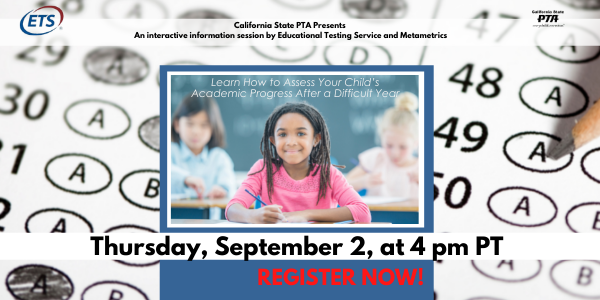
Register Now!

California State PTA Presents:
A Zoom presentation by Educational Testing Service and Metametrics
September 2, 2021 – 4-5pm


We often think of test scores as the ending point of a student’s learning, a “final score.” But test results can actually be the start of learning. In this presentation you’ll learn how to use the results of state testing to find just the right tools for continuing your child’s progress in reading and math. 

Register here and attend on September 2 from 4:00 to 5:00 p.m.

During the presentation, which will be facilitated by California State PTA President Carol Green, experts from ETS and Metametrics will explain the Lexile and Quantile Framework. If you look at the 2021 Student Score Report, based on tests most students took at the end of last school year, you’ll see Lexile and Quantile measures. (You’ll find them on page 5 of this sample Student Score Report.)

You can use your child’s Lexile and Quantile measures to find their reading and math levels. The California Department of Education has arranged for all parents to have access to a set of free family-friendly tools, including Find-A-Book and Math@Home, that enable you to match learning resources and activities to your child’s learning levels in both reading and math. 

These two parent guides will give you the basics.

Lexile: https://lexile.com/wp-content/uploads/2019/12/Lexile-Parent-Guide.pdf

Quantile: https://www.quantiles.com/wp-content/uploads/2019/12/Quantile-Parent-Guide-1.pdf


But even better, register for and attend our September 2 presentation.