Job #1 for the New Year: Getting Ready for PTA Elections

by California State PTA Leadership Services Commission

January may seem early for thinking about your PTA officers for next year, but it’s time! Keep on schedule with these three vital tasks and ensure leadership continuity for your PTA going forward.
Task #1: Make sure your nominating committee has been elected and is making progress.
Check in with your nominating committee today to determine their progress in identifying nominees for the next term. Or use these tips to get your nominating committee formed if you haven’t done so already.
Task #2: Publish the notice of your annual meeting and the nominated slate of officers. 
As specified in  PTA bylaws, the date of the annual meeting announcement (notice) must be published 30 days in advance of the meeting, while the slate must be shared with members 28 days in advance. 
Task #3: Review the guidance from the California State PTA on chairing your election.Review the blog article “Make Sure You’re Prepared for Your PTA’s Annual Meeting” and information in the California State PTA Toolkit, Running Your PTA section, to look like the meeting pro that you are! 

Use our step-by-step guides to help you and your leadership team sail through these tasks and keep your PTA strong.  

PTA Membership: An Opportunity to Serve

by California State PTA Membership Services Commission

Today, January 16th, is MLK Jr. Day, A Day of Service. We’re Grateful for Your Service.

Membership Monday - January 16, 2022


Martin Luther King Jr. Day is now often observed as a Day of Service

As a part of this day and observance, we would like to thank YOU, our PTA volunteers, who give great service to your communities. The King Center writes that “Dr. King is widely regarded as America’s preeminent advocate of nonviolence and one of the greatest nonviolent leaders in world history.” We hope you will find a way to help your community gather and serve on this special day.

Learn More About Local Events In California or Create and Add Yours!

New Year, Means New Membership Theme Ideas

Check out this great page with ideas on what new theme ideas you can implement in your Spring Membership Drives in 2023. Remember, membership is a year round activity! Your work is just getting started for 2023! Learn More

California State PTA has Visual Identity and PTA Logo Resources to make your life easier.

Visual clues are often the easiest way for people to recognize a product or organization that they trust. Think about the brands you regularly buy. Whenever you purchase clothing, food or toys, the company’s logo on the package represents all that you may like or dislike about the products you buy. An organization’s logo does the same thing.

PTA has established guidelines for the proper use of the PTA name, logo, and tagline (everychild.onevoice).  When used properly, PTA’s logo and tagline create a consistent message, help unify all PTAs, and sets PTA apart from the competition. Learn More

Stay On Track for the Membership Incentives & Challenges in 2023

You are doing amazing things for Membership! And we are seeing it across the state! There are still opportunities for you to be recognized and to win. The first two with upcoming dates are below! Learn More

5. Founders’ Day Membership Challenge

PTA Founders’ Day is February 17. Any unit that submits 17 new memberships for the month of February will earn a certificate and recognition on California State PTA social media platforms. No application is required. Date: 2/28/23. 

6. Best in 5 Award*

Any PTA unit, council, or district with a membership total on or before the deadline that is higher than the largest year-end total since the 2018-2019 membership year will be awarded a certificate of recognition and entered into a drawing to receive a $500 cash award. All units, councils, and districts that qualify for the Best in 5 Award will receive a recognition ribbon at the 2023 California State PTA Convention. No application is required. Due Date: 3/31/23.

e-Membership/Totem Tip of the Week!

Get comfortable with your Online Totem Reports, this will help you provide up-to-date membership lists for the Nominating Committee and to your board for General Association Meetings! Leaders have access to a variety of reports. Leaders may see different available reports depending on the features the association has enabled the leaders’ and permission levels within the organization, for example, a District PTA would see Councils and Units but a Unit PTA would only see their own report.  You can access the list of available reports from the leader Reports menu.

California State PTA Convention Commission and You


ConventionCommissionEach year, PTA members and leaders from every corner of California gather for our association’s annual convention. It’s an important opportunity to meet and learn from each other, come together to conduct the vital business of our association, and be inspired to continue the work we each do. 

The Convention Commission works with the California State PTA Board of Directors and staff on every facet of the event – from registration to evaluation, from setting up the venue to clean-up, and from creating the schedule to seeing that every session goes smoothly. 

Convention is somewhat different each year, but it always includes: 

  • Workshops and trainings for both new and experienced PTA leaders
  • Inspirational keynote speakers
  • An exhibit of the student work recognized in our Reflections Art Program
  • Booths featuring exhibitors that provide programs and services to local PTAs
  • The chance to meet your counterparts from other parts of the state
  • And much, much more.

Watch the California State PTA Convention page and social media for more information.

The Convention Commission for the 2021-23 term consists of the Vice President and 10 members of the California State PTA Board of Managers.

The Family Engagement Commission helps build strong family-school partnerships

Healthy family–school partnerships benefit students, parents, teachers, schools, and the community. Developing these partnerships is essential for student success and crucial to PTA’s work to positively impact the lives of children and families. 

The Family Engagement Commission is dedicated to building inclusive, equity-based family engagement practices among PTA units, councils, and districts to improve educational excellence throughout California. We seek to motivate PTA leaders and empower PTA members to take action to meet the specific needs of their own children and support the comprehensive needs of all children. To achieve success for students, parents (and all adult caregivers) should work with schools as full partners, with inherent rights and responsibilities and acknowledging that there is expertise among both educators and families about what’s right for kids. 

True family engagement isn’t about simply checking a box for compliance purposes; it signifies a shared effort between teams of adults working in partnership to make each child’s potential a reality.

Helping You Build Strong Local Family Engagement

The California State PTA Family Engagement Commission (composed of volunteers from across the state) supports local PTAs and promotes meaningful family engagement efforts through statewide programs and policy advocacy. 

Some of our work includes: 

  • Promoting collaboration and engagement of families and educators in the education of children and youth; 
  • Encouraging participation in decision-making through appropriate input into each Local Education Agency’s Local Control and Accountability Plan (LCAP).
  • Writing articles for PTA publications, including regular “Family Engagement Friday” blog posts (read them here).
  • Making recommendations to the California State PTA Legislation Action Committee on legislation about issues such as before-/after-school programs; child care; early childhood education; family engagement policies; financial literacy; literacy; parent education/skills development; and some issues related to foster families, family planning, and undocumented immigrants.
  • Participating in state-level task forces and special committees that address parent involvement and family engagement issues.  
  • Reviewing PTA position statements pertaining to Family Engagement for continued relevance, for the purposes of advocacy and informing policy makers, the public, PTA members, and the media. 

The Family Engagement Commission supports local engagement efforts in many ways; from educating local PTA leaders and educators about practices that work to taking part in state level activities that raise the visibility of those practices everywhere in California. We help our local PTAs build the ability and willingness of school employees and parents to join forces in making the best decisions for children. (Click here for more information.)

Commission Members

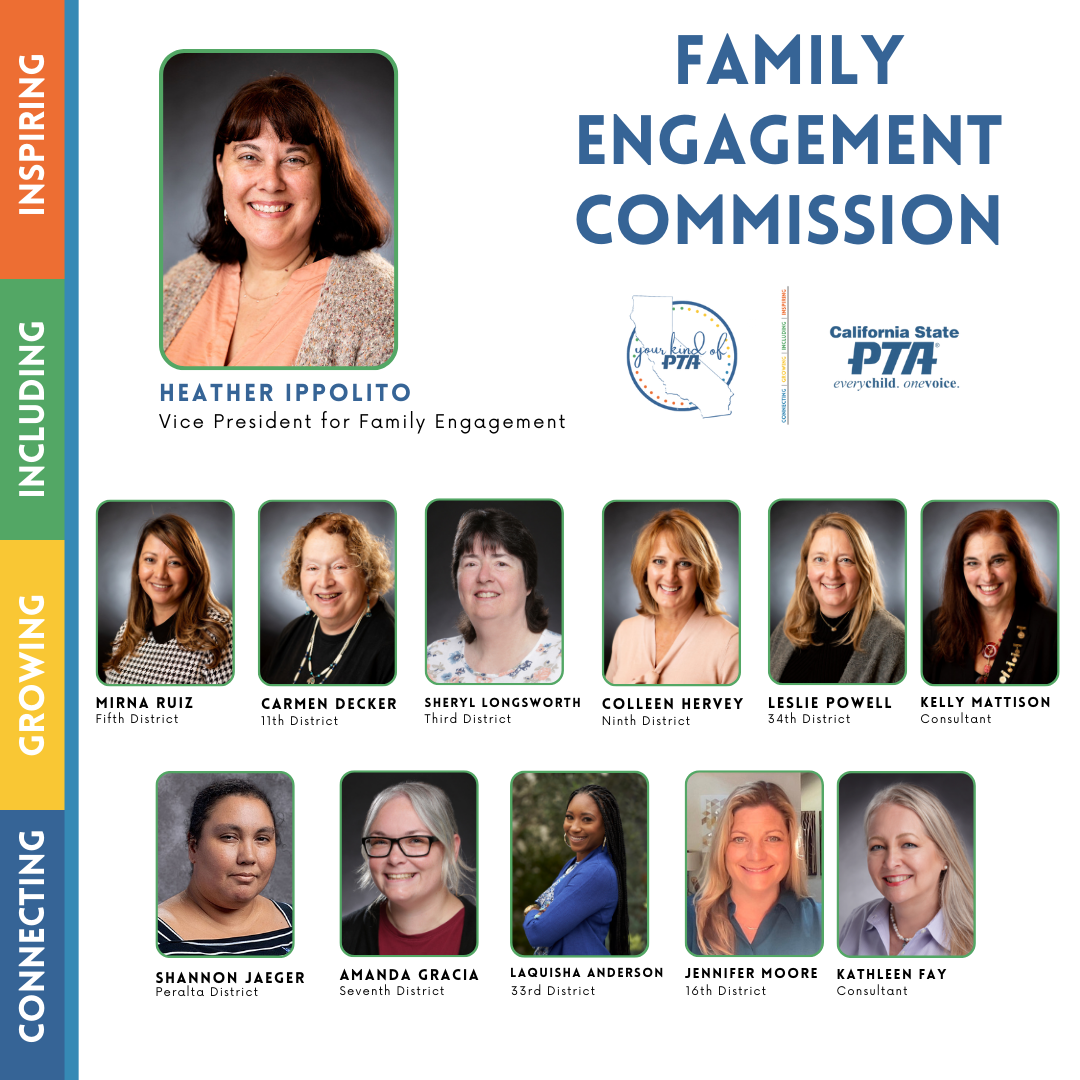
The Family Engagement Commission for the 2021-23 term consists of the Vice President, nine members of the California State PTA Board of Managers, and two consultants. This dedicated and diverse group of PTA leaders brings considerable experience and a wide range of expertise to our efforts this term.

California State PTA Legislation Team and You

Legislation Team Commission

PTA began, in 1897, as an advocacy organization with a nationwide campaign to eliminate threats that endangered children. Today, one of the important roles of the California State PTA is to advocate for policies and laws that improve the lives of all California children, youth and families. PTA continues to highlight critical education funding issues and to ensure the importance of family engagement in public schools. In addition, California State PTA supports policies and legislation that help youth and families meet their essential needs.

The California State PTA Legislation Team — composed of volunteers from across the state — works to support the organization’s advocacy goals, which are as follows:

  • Advocate to achieve justice for all children, youth and families to have their essential needs met. 
  • Advocate for shared power and belonging for all children, youth and families to address the impacts of systemic and institutionalized injustice. 
  • Advocate for a full and culturally responsive curriculum to meet the diverse needs of our student population. 
  • Elevate the student voice to create an inclusive, positive and supportive school climate. 
  • Promote physical and mental wellness beginning in early childhood. 
  • Advocate for stable and sustainable public school resources to bring California within the top 10 states in per-pupil funding.

Some of our work includes: 

  • Researching and voting to take positions on bills brought by advocates in the areas of community concerns, health, education, family engagement, budget, and federal legislation.
  • Informing local members and leaders about California State PTA positions through monthly legislation calls, monthly legislative updates, blog posts and articles in PTA Connects.
  • Explaining the use of California State PTA resolutions and position statements as authorities for taking positions on bills or ballot measures. 
  • Updating and reviewing the legislation platform, and California PTA legislation policies.
  • Studying, taking positions on and coordinating advocacy for statewide ballot measures and referendums.
  • Serving as a resource for local members and leaders.

Advocacy at the state level enables California State PTA to support youth and families across the state. Local members and leaders may use California State PTA’s positions on legislation to engage in local advocacy in their own communities. The Legislation Team provides support and is a resource for local PTAs as they conduct studies or effect change in their own communities . 

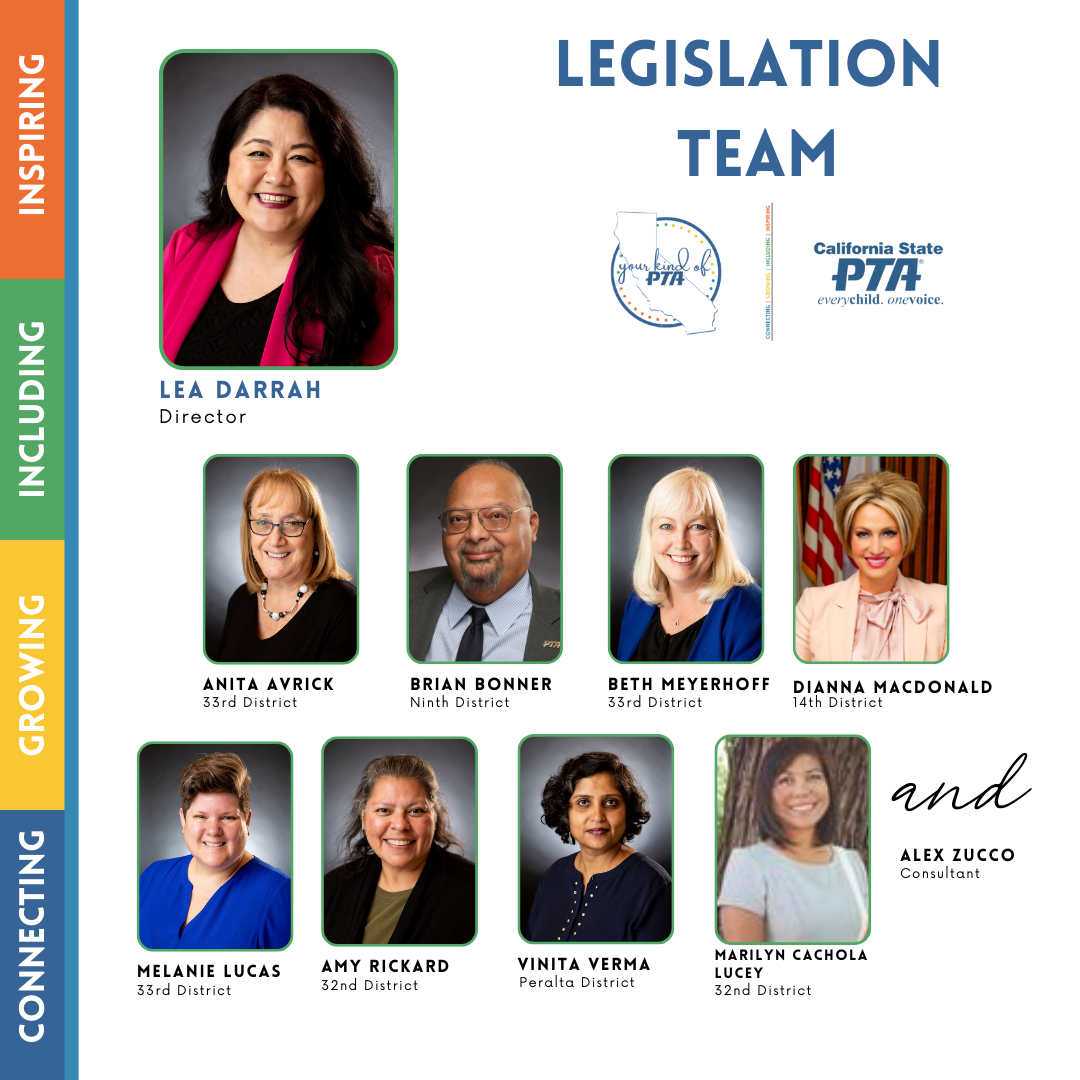
The Legislation Team for the 2021-23 term consists of the Director of Legislation and eight members of the California State PTA Board of Managers. Our Legislation Team reflects the diversity found in California with team members representing geographic, racial, socioeconomic, languages spoken and age diversity. Our team members have children of all ages which gives them insight into the varying issues facing today’s youth.  In addition to their PTA roles the advocates are engaged in a variety of career fields and other community involvement. 

Meet the Membership Services Commission

California State PTA is a membership-based, nonprofit impact organization. Membership is the foundation upon which the entire organization rests. Members are vital to the advocacy work PTA does on behalf of children and families. Policy makers pay attention when you have strong membership numbers. 

The Membership Services Commission and several committees work to provide programs that serve local PTAs and members. Scholarships and Grants honor and support the outstanding work of PTA volunteers. The National PTA Reflections Art program gives student artists an opportunity to participate in the arts and reminds local communities of PTA’s commitment to the arts. 

The California State PTA Membership Services Commission composed of volunteers from across the state works to build the foundation of our association by growing our membership and bringing programs that enrich the lives of all children in California.

Some of our work includes: 

  • Providing resources, guidance and training to unit, council and district leaders to increase PTA membership
  • Scholarships and Grants
  • Reflections
  • Honorary Service Awards
  • Producing the annual Welcome Packet
  • Reviewing and revising the California State PTA Toolkit

Local PTA leaders benefit from our work as they set their membership goals, access state membership resources and marketing plans, and utilize Totem, our free electronic membership offering to all units, councils, and districts. Local leaders also grow the support of their members when they put on programs like Reflections, encourage student involvement through state-offered scholarships, and use state programs to reward continued learning for teachers, volunteers, and healthcare professionals.

The Membership Services Commission for the 2021-23 term consists of the Vice President for Membership and 11 members of the California State PTA Board of Managers. The Membership Services Commission has had amazing talks this term about equity, about celebrating our units for their outstanding membership efforts, and focusing on making programs and Totem easier to adopt and use for our local leaders.

Our focus is to GROW membership! Everyone should be a member of PTA! That is why we focus on the “Why PTA” look at our amazing 125-year history. Just as PTA tackled child labor laws, juvenile justice, and the school lunch program, we want  to inspire our members to take on the next challenge. It’s time to continue making everything better for all children with our one voice.

Continue to tell us why YOU PTA by sending your thoughts to membership@capta.org ! So we can continue to share this message loud and proud! Many of us shared that at the Annual Convention on stage. We all come from different backgrounds and different areas, but PTA unites us in our mission to positively impact the lives of all children and families.

Communication Tips for PTA Leaders Over the Holidays and Beyond

by California State PTA Leadership Services Commission

PTA Communications keep your members, school and community informed and engaged. The California State PTA Leadership Services Commission has worked with the state Communications Commission to share tips and best practices to ensure that your PTA doesn’t fall behind on your communication efforts, even when your leaders need a break. These ideas are particularly valuable at times, like the holiday season when your team may be particularly busy or not as focused on school and PTA.

WHY DOES IT MATTER IF OUR PTA JUST GOES SILENT FOR A FEW WEEKS?

Your PTA can act as the glue that connects your entire school community. Regular communications keep schools and families connected to your PTA. If you consistently post important, helpful information – people will know they can rely on your PTA, and social media algorithms will reward your PTA account with better organic reach. 

Steady communications remind people of your PTAs important role and make sure everyone knows about upcoming meetings and events. And it never hurts to repeat those reminders more than once. Particularly during the holidays, folks are busy, they don’t always see a message the first time. 

Tip: Include meeting/event schedules in the first two weeks of January as everyone returns from winter break and may require extra promotion. Many people do year-long planning in January too.

HOW CAN WE PLAN AHEAD FOR SOCIAL MEDIA?

You can take advantage of tools that let you schedule posts in advance and only require monitoring. For example, Facebook, Instagram, Twitter, and Canva all have native, free scheduling tools to make your job easier. 

Tip: When you schedule ahead, be sure to plan to review comments and posts regularly. 

WHAT SHOULD WE POST AND WHEN? 

Some planning ahead and your association-approved calendar, school calendar and community events are the basic ingredients for creating a solid communications calendar that will clarify decisions about what to post and when. Once you have a plan, the PTA leaders in charge of communication can identify dates for releasing messages to members and the larger school community. 

Tip: For announcing association and executive board meeting dates, look to your bylaws. The critical required meeting notice is at least 10 days in advance of the meeting. Mark the meeting dates and the 10-day notice dates on your calendar. Sending out messages on additional dates will boost attendance and your association’s visibility. Messaging can and should occur: 

  • in advance of the 10-day requirement, 
  • 10 days before your meeting date, 
  • at least once or twice during the next ten days, and
  • on the day of the meeting. 

Keep your PTA visible and valuable by communicating about more than meetings – include special events and fundraising in your posts. Fun observances like New Years, Cinco de Mayo, St Patrick’s Day, Valentine’s Day, and Flag Day will gain your PTA attention and goodwill. The same is true for local events of interest to families. Some PTAs chose one predictable day of the week for this kind of update messaging.

Tip: Keep in mind PTAs’ non-commercial and non-partisan policies. Be thoughtful in word choice with your online thanks to sponsors and local elected officials. 

Take advantage of National and California State PTA content.  You’ll find plenty of informative items ready for you to share and retweet directly by looking at the websites and social media channels of the California State PTA and the National PTA.

HOW DO WE KEEP PTA COMMUNICATIONS INCLUSIVE DURING THE HOLIDAYS?

  • Remember, PTA is nonsectarian – which means not affiliated with a particular religious group. Be mindful and respectful of varied family traditions during winter break and throughout the school year. 
  • Use various student, family, and event photos, including many new faces, from your fall and winter programs (with photo permission releases). 
  • Words in a graphic cannot be translated by online translation services. If the image you’re using has words, you may need to create graphics in multiple languages to connect with everyone.
  • Include descriptive “Alt Text” with all photos posted online (websites, social media, digital fliers) to improve accessibility and search engine optimization.

For more on these topics, attend one of the Communications Commission Monthly Member Calls or their workshops at the annual California State PTA Convention. And check out these Toolkit resources:

Note: External/non-capta.org links to social media and digital apps were current as of the December 2022 publication date for this blog post. External links can change without notice. We recommend a topic search on the web to find the most current tutorials and information.


Community Service and Your PTA

by Family Engagement Commission Consultant, Kelly MattinsonNovember 2022 Family Engagement

Volunteering in your local community can be fulfilling. 

Think about all the things we do to make our community, ours. How can PTAs and PTSAs encourage children and families to be good citizens and help neighbors and friends?

Here are some ideas for your PTA to share that will help create and support local community service activities:  

  • School Beautification Projects.  When local school district building funds are tight, a little elbow grease and teamwork goes a long way. As a bonus, participants get to meet other families and create a nicer place to learn and work. Think of the impact you and your PTA can help make and the ways it can teach, by example, how to be a good citizen. Be sure to check with your school district before beautifying. 
  • Charities and Donations. Do you remember Pennies For Patients? The premise of this Leukemia Lymphoma Society program was to get EVERY child involved. Not everyone can donate a lot of money, but most kids can find a few pennies. The key to the campaign was that it wasn’t about the total dollars but the total participation. Your PTA can create inclusive participation opportunities for a local cause and provide valuable experience in giving back and charity that stays with kids their entire life.  
  • Encourage Creative Generosity. I took my daughter and her friend to the PTA convention in downtown Los Angeles. After our District dinner, the girls asked the server for boxes for all the leftovers with disposable utensils and napkins. They then distributed the meals to the homeless men and women we passed on our way back to the hotel. I was so impressed. These 8th graders had just taught me an incredible lesson in generosity and kindness.

As we head into Thanksgiving and the winter school break, consider devoting time to Community Service this school year. PTAs can help families get involved and encourage a community-service mindset among  students in their school.  It is a wonderful way to spend time as a family, teach kids core values, and make a difference in the community. You can also make a brainstorming session about community needs part of your next PTA agenda.


Support For Adult Mental Health – Part 2

by Colleen Hervey, CA State PTA Family Engagement Commissioner, Derby Pattengill, CA State PTA Health and Community Concerns Vice-President, and Justine Fischer, Community Director for CalHope Schools Initiative Partnership

As parents and/or caregivers, we want what’s best for our kids. We want them to be happy, healthy, loved, nourished, protected, educated, inspired, curious, and to have the tools they need to reach their potential. Children can bring us such joy, but also such worry. Often, we are unprepared to navigate the toll and stress our worry and our own parental anxiety causes us. In our effort to make sure all is well for them, we often neglect our own mental health needs. 

Parents/caregivers sometimes need assurances that self-care isn’t selfish! Taking care of ourselves gives us the bandwidth, strength and resilience to be positive influences in the lives of our families and those around us. 

PTAs can support the families they serve by helping them access the wealth of free resources available for adults. One example is the no-cost, evidenced-based set of resources available through the CalHOPE Schools Initiative. As described in a prior post, this initiative is a partnership of three organizations; All it Takes, iMPACTFUL, and Z-Cares. The resources provided include films that spark conversations about mental health, curriculum and support materials for educators and parents, and programming that supports social-emotional learning.

One of the most useful tools for parents are the 5 Adult Social and Emotional Learning Muscles mentioned in the All it Takes Building Trusted Spaces professional development. These are strategies for creating trusting relationships with young people while maintaining your authority and credibility.  

  • Quit Taking It Personal (QTIP) – offering the benefit of the doubt when interactions feel hurtful.
  • Communicating With I-Statements 
  • Ask vs Tell – recognizing and asking for what you need, rather than telling what’s wrong 
  • Storytelling – telling stories to rely feelings, rather than using them to make a point 
  • Walk The Talk – modeling in words, actions and attitudes what you expect from them 

These are valuable tools to use when interacting with your children at home or at school. For more information about them, visit https://www.calhopeschools.org/atrustedspace  

Other helpful resources for parental/caregiver mental health

National PTA provides resources for both parents and PTA leaders in its Healthy Lifestyles section titled Healthy Minds. California State PTA also provides additional insights and resources.

In our online world, there are many resources available to help families cope with stress and protect their mental well-being, from this short animated video about stress to a whole library of calming strategies provided by the Sacramento City Unified School District. 

As a reminder for all adults, when you fly you are instructed to put your own oxygen mask on first, if needed, before helping others. That’s because we are best able to serve others when we are at our best, modeling expected behavior and managing our own stress and anxiety. 


Hybrid PTA Meetings Are a Giant Step Forward

by California State PTA Leadership Services Commission

PTAs learned a few things during the pandemic. Teleconferencing and video-conference meetings are now utilized by PTAs frequently.  Three years ago the term “hybrid meeting” was pretty much unknown and now it’s become more commonplace. There are questions and best practices, so leader guidance continues to evolve as we all gain experience. 

PTA bylaws now allow teleconferencing (video and/or audio conference meetings), as long as all members are able to hear each other, debate and vote. Teleconferencing allows members to cast their votes themselves. PTA bylaws allow teleconferencing (as long as it is not crossed out) but they do not allow proxy votes or email voting.  During the conference meeting, you can use an electronic voting tool or a google form to collect ballots. The normal rules of holding a meeting still apply to teleconferenced meetings. Attendees should be able to debate and vote and should be treated and treat others with respect and courtesy.

HOW ONE PTA USES HYBRID MEETINGSAn elementary PTA in the San Francisco Bay Area schedules its association meetings right after school lets out on Wednesdays. The outdoor in-person location is at the school’s lunch tables under the solar panels where parents can easily observe their children on the playground. Members can and do also attend virtually. Timely advance notices are sent out repeatedly using social media platforms. A funny video clip from the president is anticipated and typically included in the final media push. It all works for this PTA! 

Here are tips for both setting up, and using conferencing technologies for your meetings whether you have just a few members attending remotely or everyone is. As with every tool, practice is essential. 

Getting Started

  • Find a platform/app for hosting the meeting and set up an account. (Zoom and Google Meet are two popular examples.) The platform should be available and accessible to everyone.
  • Hybrid meetings may require everyone to use a phone or computer with headsets to avoid feedback. 
  • Schedule a practice meeting with your executive board before having one with your general association.

Before the Meeting

  • Establish the ground rules for the teleconferencing, video-conferencing, or hybrid meeting.
  • Prepare the agenda, financial reports, minutes from the last association meeting. Ensure that reports, minutes and agenda are provided to everyone.
  •  As always, provide at least 10 days notice of the meeting. Use a registration link to establish a list of potential attendees. Email the reports, agenda and ground rules for the meeting to the verified members who indicate they will be on the call.
  • Update the membership list and provide the secretary with a copy.
  • Identify an officer to assist with maintaining a speaker list to assist the chair.

During the Meeting

  • Conduct the meeting as you normally would. (Record the time the meeting begins and is adjourned in the minutes.)
  • Set the call ground rules and verify every participant can hear and be heard.
  • Remind people to “mute” themselves to reduce outside noise (and avoid feedback if the meeting has attendees both together in a room and virtually).
  • Establish the quorum 
  • Ask someone to monitor the chat and help count votes (often this is a parliamentarian) 

Meeting Notice

  • Email your membership list directly, announcing the meeting and agenda.
  • Use social media platforms and website to announce meeting details and include a registration link.
  • Ask your principal to post the meeting notice on the school website and social media platforms.
  • Encourage board members and members to share meeting information on their personal pages. 

Interpretation Tips for Hybrid Meetings

It is very important to make sure all members of your school community feel included. Determine if the conferencing tool has an interpretation option and pre-test it. Reach out to see if someone from the school, community or council PTA can assist with translation. The translator(s) should be on the actual call, translating in real time. Prior to the meeting, make sure the translator is familiar with the agenda and discuss how the translation process will work during the call.

Resources for Local PTAs

Click here for instructions on how to make a Google ballot form, which is helpful for voting during hybrid meetings.