Celebrating Black History Month

black history month

February is Black History Month, and we know that you want to celebrate with your children. Our Diversity, Equity and Inclusion Committee have given us some great resources to help you in your school, home, and community. 

  • This four-part series helps schools teach about black history by giving them resources that focus on aspects of black history and culture that aren’t centered on violence, trauma and struggle: 
  • This beautiful coloring and activity book called “What We Believe” is a free download from Black Lives Matter at School. 
  • Here is a teacher’s resource guide to teaching Black History Month.
  • Here is a list of 100 books by or about African Americans for children in Kindergarten through 8th grade
  • National PTA has some resources to engage African American families on your school campus– this would be a great month to try one of the activities!

We would love to hear about your ideas for celebrating Black History Month! Please email them to communications@capta.org

Click here to return to the blog homepage.

The Benefits of Phenomenon-Based Science Learning

“Why are some days cloudy?”

“Why can a cactus survive without water when a willow tree can’t?”

“Why does the light on the ceiling go on when I flip the switch on the wall?”

Our kids’ “why” questions provide near-constant reminders of their curiosity about the world. California’s new approach to science instruction, called the Next Generation Science Standards (NGSS) recognizes and encourages that natural curiosity. Research shows that doing so can ignite students’ interest in science and engineering, especially if science in school is introduced at an early age.

When teachers start with a question like “Why can a cactus survive without water?” they are using a technique called phenomenon-based instruction. The lesson starts with a question about something students can observe. Teachers then build one or many lessons to take students from that simple question into serious scientific inquiry. Our cactus question, for example, forms the basis for various student activities in a first grade classroom, including:

  • Examining cactus needles and discussing how they might provide shade and protection for the plant.
  • Thinking about and listing the different parts of plants more generally (roots, stems, leaves, flowers, fruits) and using examples to understand how they help plants survive and grow.
  • Comparing a willow tree and a teddy bear cholla cactus to discover how their different parts help them survive and grow in very different environments.
  • Creating a picture that illustrates how a cactus’ spines and water-storing stems help it survive in the desert.

Coincidentally (or maybe not) this is an example from a free first-grade lesson available through the California Education and the Environment Initiative. You’ll find it here: https://www.californiaeei.org/curriculum/unit?unitid=4. The initiative provides a wealth of ideas for how teachers can start with questions about the environment and use them to help students explore questions of science, engineering and much more.

As a parent, you can use the same kind of question-based approach to explore science and environmental topics with your kids, even if none of you think of yourselves as scientists. The lessons on the EEI website, which cover a wealth of topics and grade levels, can give you some ideas. There is a full list at https://www.californiaeei.org/curriculum/.

As a parent leader, you can ask district officials or your school principal what is happening around science instruction and environmental education, and whether teachers are working with the new standards. And how can that best be shared with parents? Could teachers present a sample lesson to parents or make science instruction a special feature of the school’s next open house? If your school has a science fair, should the new standards be reflected in student projects?

Want to learn more about Next Gen Science as a first step? Try this page on CAPTA.org: https://capta.org/focus-areas/education/next-gen-science/

Click here to return to the blog homepage.

Why Wednesday? 1/22/2020: What Happens at the State Convention and Why Should I Attend?

This year leaders from across California will come together in Riverside for the 121st annual California State PTA Convention. For three days in May we convene to do the business of the association, attend workshops and network. If you have never been to our convention before, here are some things you can look forward to, and if you have attended before, here are a few things you don’t want to miss!

General Meetings: We have four general meetings where we do the business of the association. We are motivated by Celia Jaffe, our State President; we learn about the state of our association from Sherry Griffith, our Executive Director; and we are inspired by the successes of our Reflections winners. We vote on resolutions, position statements, bylaw revisions, and in odd-numbered years we elect our Board of Directors. There is also time in our meetings to hear from the state Teacher of the Year or other experts who share their passion for working with children and families. It is hugely important to attend all of the general meetings so you can be there to debate, discuss, and cast your vote on the business of the association.

Workshops: Every day there is a wide variety of workshops to attend. We always have training for core officers including president, secretary, and the finance officers, but we offer so much more than that! We have workshops on membership strategies, family engagement, important topics in health, education, and parenting, advocacy, communications and so much more. Some workshops are presented by PTA leaders, while others have experts from around the state as featured speakers. We also have two different formats for our workshops: presentations and table talks. Both formats offer unique opportunities to learn from experts, PTA leaders, and convention goers — you won’t want to miss a single session!

Vendor Hall: This year we will have two vendor halls full of businesses who want to help support your PTA. There will be yearbook companies, fundraising programs, book fair providers, and lots more. There are also booths for PTAez, TOTEM, and AIM Insurance, where you can ask your questions directly to the reps from the companies. Many of the vendors will have giveaways, opportunity drawings, and information to share that you can take back to your unit. Be sure to bring a bag to carry things and your camera, as there are lots of good photo opportunities in the vendor hall.

Your participation in convention allows you to help guide the direction of California State PTA for years to come. Your vote on resolutions, bylaw changes and in elections shapes the advocacy and leadership efforts of our organization. You also strengthen your unit by bringing back new vendors, new ideas, and new resources to share with your board and the families at your site. We all know that training makes for a more successful year for your board as well, and we provide that for you at convention.

There are so many benefits to attending convention, but one of the most important is that you realize that you are not alone. You get to spend three days learning from leaders just like you across the state who face the same challenges and believe in the same mission. You are able to network with unit, council, district, and state leaders who are working hard in our schools, creating a better experience for our students just like you. Convention is a time to get re-inspired and revitalized, so make sure you are there!!!

We will be sharing lots more about convention in the coming weeks and months on our Facebook, Twitter, and Instagram accounts. While registration for convention doesn’t open until March, you can stay up-to-date on convention news by visiting https://capta.org/programs-events/convention/.

We will see you in Riverside from May 15-17, 2020!

Click here to return to the blog homepage.

Parent Involvement and Your Child’s Long-Term Success

Parent involvement in a child’s education is likely to have a positive impact on a child’s long-term success. Students with involved parents are more likely to have higher grades and test scores, have better social skills, show improved behavior, attend school regularly, and graduate from high school and attend post-secondary education.

But everyone is busy and has limited time. However, the range of opportunities for involvement allows even the busiest parent to make a meaningful contribution. For example, meeting your child’s teacher and friends and attending school programs is a way to show your kids that you care about their education. And if you are able to help at school events, it shows kids the importance of volunteering at school and in the community. Simply joining your local PTA demonstrates your willingness to positively impact your child.

One of the most important ways that you can support your student is to attend parent-student conferences. During the conference, you can ask important questions that will give you a solid understanding of how your child is performing so that you can be invested in your child’s academic year. Learning Heroes suggests asking questions like:

  • Is my child reading at grade level?
  • What are my child’s learning goals?
  • Is my child making progress?
  • What is my child doing well?
  • What skills does my child need to focus on?
  • What can I do to support my student at home?
  • How can I help with homework?

Another way to support your student is to reach out to your student’s teacher and ask what help they need. Teachers usually welcome assistance in the classroom, or with a school event. Being a part of any event on the school campus will give parents a better understanding of your student’s daily life.

PTAs offers parents many ways to increase involvement by providing resources and volunteer opportunities. Attending PTA meetings offers a valuable opportunity to interact with other parents, hear from a school teacher or principal, and learn up-to-date information. Parents can ask questions and start to build relationships with parents, teachers and school administrators. Many PTAs offer speakers to help support student success, addressing such critical issues as vaping and mental health. Even attending one or two PTA meetings can make a difference.

Parents who cannot attend PTA meetings may still increase involvement by accessing on-line resources. CAPTA.org and PTA.org provide helpful information to assist parents become better informed, such as how to access the Dashboard or the National PTA’s The Parents’ Guides to Student Success.

PTAs also provide a framework for parents to help with events and participate in programs. When our kids see us weeding in the school garden on weekends or collecting cans for a food drive, they see us supporting our schools and community. By attending events that take place on school campuses, our students see parent involvement.

There are opportunities for every parent to be involved to the extent that time or resources allow. By focusing your time and energy on your student and their classroom experience, you are building the framework for a lifetime of success.

For the complete article referenced in this piece, please visit: How Parent Involvement Leads to Student Success at www.waterford.org.

For more parent engagement ideas, be sure to read the latest issue of PTA in California, which features this article.

To return to the blog homepage, click here.

PTA: A Place for Everyone!

PTA is an inclusive organization. Although you want everyone on your campus to participate in PTA events, often times certain groups are unintentionally forgotten during event planning.

For example, individuals with disabilities. Some disabilities are obvious, like those that require a wheelchair or crutches. But some people have “hidden” disabilities such as mental health issues, autism, cognitive and learning disabilities.

As you begin to plan your activities this year, here are some things to keep in mind so that you are fully inclusive:

  • Are we being culturally inclusive? Think about food, music, entertainment — are all cultures on your campus included?
  • Are we linguistically inclusive? Are you translating your advertising, the posters that point the way to various activities, and do you have native speakers on hand to help make everyone feel welcome?
  • Are we being accessible to those with mobility needs? Is your event held on a grass field that limits participation, or upstairs in a building without an elevator or easy ramp access?
  • Did we provide areas/activities to include those with sensory issues (noise, light, touch)? Is it possible to open the activity early without loud music or large crowds to accommodate students or families with sensory issues?

California State PTA welcomes all!

We welcome:

  • All races and ethnicities
  • All religions and creeds
  • All gender identities
  • All countries of origin
  • All sexual orientations
  • All immigrants and refugees
  • All abilities and disabilities
  • All spoken and signed languages
  • All ages

EVERYONE!!

Click here to return to the blog homepage.

The Importance of Inclusive Education

Below is an excerpt from Marilyn Cachola Lucey’s blog post “Schools Should Include Everyone,” on Ed100.org. Click here to read the full post.

When students with disabilities are educated alongside their peers without disabilities, outcomes improve for students both with and without disabilities. This approach to education is known as inclusive education.

The term inclusion captures, in one word, an all-embracing societal ideology. It is a mindset that drives actions to demonstrate all people are to be valued, appreciated, and included.

By law, students are to be educated in the least restrictive environment in which they can meaningfully benefit from their education, and for most that is the general education classroom.

In California, we like to think that we are a state of innovators, creative thinkers, and the most progressive and accepting state. When it comes to inclusive education, we are not. According to a 2015 report from a Statewide Special Education Task Force Report, we have “a failure in schools and classrooms to consistently use the very evidence-based practices that are being used successfully in other parts of the country.”

Why Include Students With Disabilities in a Class If the Academic Content Isn’t At Their Level?

There are measures of success and educational values other than academic levels.

For students whose disability impacts their social, communication, attention, or regulation skills, segregating them into a class of students, with the same difficulties, robs them of positive and appropriate peer models. Placing them away from their peer community segregates them and sends a message to the larger community that it is acceptable to exclude them. The underlying message is ‘You don’t belong in here with us’ or ‘I can’t handle your difference’ and just like that, they become second class students.

Currently, exclusion exists in the very institution charged with teaching our children. Imagine if inclusion was rule of the day in schools, and our children learned to naturally expect inclusivity in college, career, and community because it was what they experienced in their PreK – 12 school.

Education is intended to develop the whole child and, by law, students can receive supports and services for functional and academic needs in a general education class.

Click here to read the rest of this blog post on Ed100.org.

Click here to return to the CAPTA blog homepage.

November 2019 Updates

Welcome to November! There are lots of exciting things happening in the PTA world this month. Here are a few:

  • The Legislative Conference early bird deadline is November 15th, so make sure you register in time to get the lowest price.
  • Elections for Nominating Committees begin for many units (check your bylaws). You want to give your nominating committee the time they need to recruit the best leaders for your unit. Electing them in November or December at your association meeting gives them enough time to find the right volunteers for the many jobs in our PTA.
  • If your fiscal year ends June 30, then tax and government forms are due by November 15th. This is important to stay in compliance, so don’t forget this deadline. Tax filing support can be found at our online tax filing support center.
  • Holidays including Veteran’s Day and Thanksgiving happen in November. Remember that school attendance is still a priority, so we need to remind our families to try to keep additional absences at a minimum.
  • Reflections entries are often due to councils and districts this month. Make sure you check with your local leadership for the exact dates.

Click here to go back to the blog homepage.

Resources for Safe Usage of the Internet

Today is National Internet Day! California State PTA has some great resources on our website to ensure you and your family to have a positive and safe experience using the internet.

This article lets you learn more about the benefits, risks and tips for internet use. My favorite tip is to have an internet safety contract that you and your child both sign. That way they will understand your expectations for internet use and the consequences if they violate those expectations.

This issue of The Pulse from February 2018 also addresses issues of cyber safety. One best practice suggested is to instruct your child to never use their real name, address, or other personal information in their email or on internet games/chats.

This article gives concrete examples of ways to practice cyber citizenship on social media channels including Facebook, Instagram and Twitter.

Cyber bullying is becoming more and more of an issue among teens. This article gives parents and teens some suggestions of things to do if they are being bullied online, including blocking the bully, telling a trusted adult, and not responding to or retaliating against an online bully, which often just makes things worse.

We hope you and your family use these resources to have a safer online experience.

Nine Things You Need to Know About Vaping

Vaping and e-cigarettes are something all parents need to be aware of. As we hear on the news, these devices are small, easy to hide, and can lead to severe health issues. Here are nine commonly asked questions about vaping and e-cigarettes with links to the answers.

1. Did you know that the specific chemical exposure(s) causing lung injuries associated with e-cigarette use, or vaping, remains unknown at this time?

2. Did you know that there is no safe tobacco product? All tobacco products, including e-cigarettes, carry a risk.

3. Did you know that using e-cigarettes or vaping products is unsafe for all ages, including youth and young adults? Nicotine is highly addictive and can harm adolescent brain development, which continues into the early to mid-20s.

4. Did you know that e-cigarettes can contain other harmful substances besides nicotine?

5. Did you know that young people who use e-cigarettes may be more likely to smoke cigarettes in the future?

6. Did you that e-cigarettes produce an aerosol by heating a liquid that usually contains nicotine, flavorings, and other chemicals that help to make the aerosol?

7. Did you know about the reports of widespread use of JUUL by students in schools, including classrooms and bathrooms, and that approximately two-thirds of JUUL users aged 15-24 do not know that JUUL always contains nicotine?

8. Did you know that high school students use e-cigarettes more than regular cigarettes?

9. Did you know that e-cigarette use can be linked to alcohol use and other substance use, such as marijuana? Certain e-cigarette products can also be used to deliver substances besides nicotine, such as marijuana.

How Well is Your School Preparing Kids for Democracy?

Schools play a critical role in educating children for democracy. In fact, a core purpose of public education is to teach children how to be good citizens.

There are lots of ways schools can prepare our children. In fact, there are actually six proven research-based practices that schools should be using.

So here is a quick quiz. How many of the strategies below is your school using to help students be good citizens? Does your school:

  • Incorporate current issues and events in the classroom, particularly those that young people view as important to their lives?
  • Provide instruction in government, history, law, and democracy – beyond dry listings of facts and events?
  • Give students opportunities to apply what they learn through community service that is linked to the formal curriculum and classroom instruction?
  • Offer extracurricular activities that give opportunities for young people to get involved in their schools or communities?
  • Encourage student participation in school governance?
  • Encourage student participation in simulations of democratic processes and procedures (i.e. mock trials and elections)?

How’d your school do? Here is why I ask.

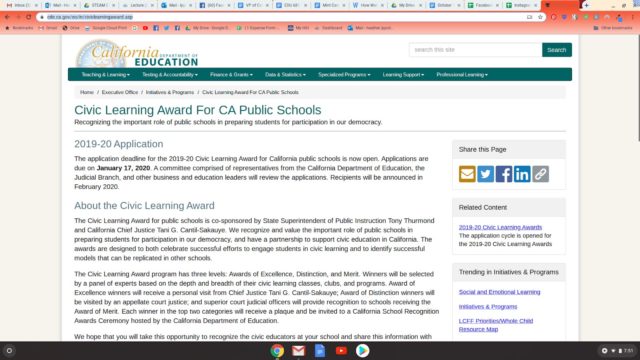
These six proven strategies are measured by the California Civic Learning Award program. Schools that win this award are celebrated and recognized for their efforts to engage students in civic learning. Co-sponsored by the Chief Justice of the California Supreme Court and the California State Superintendent of Public Instruction, the program also identifies models that can be replicated in other schools.

Here’s a nudge. Ask your school to apply. It’s a great way to see how your school measures up. Applications are due January 17, 2020.

Want more ideas on what your school can do? Read Learning to Vote in the Ed100.org blog.