PTA Program Grants & Scholarships

California State PTA is pleased to offer these grant & scholarship opportunities to you and your PTA. The application deadline is October 15, 2023. Don’t miss out! Here’s a quick rundown.

PTA Program Grants:
California State PTA grant funds are available for PTAs to develop and implement programs and projects at the unit, council, and district PTA levels.
We offer the following grants: Cultural Arts, Outreach Translation, Healthy Lifestyles, and Parent Education. The PTA must be in good standing. To get more information or to download the application, visit: https://capta.org/programs-events/scholarships/grants-awards/.

Continuing Education Scholarships:
To help you continue on your educational path, California State PTA is proud to offer continuing education scholarships for school professionals and volunteers. Scholarship opportunities are available for teachers, counselors, nurses, school staff, and PTA volunteers.

For Teachers, Counselors, Nurses, and School Staff
Credentialed teachers, counselors, nurses, and school staff who have a minimum of three years of experience in a California public school are eligible to apply for the $500 Continuing Education Scholarship. You must be employed in a California public school during the preceding year and plan to continue working in a California school.

For PTA Volunteers
PTA volunteers with at least three years of service are eligible to apply for the $500 Continuing Education Scholarship. Your scholarship must be used for advanced studies at accredited California colleges, universities, trade, and technical schools.

All program grant and continuing education scholarship applications are due to the California State PTA office by October 15, 2023. Follow this link to apply online.

2024 Graduating High School Seniors Scholarships
California State PTA is offering Class of 2024 Graduating High School Senior Scholarships.

The 2024 scholarship application period is now open.

Apply Online Now

Deadline for the submitting the completed application and all attachments is February 23, 2024 at 11:59 p.m. (PST).

Summer Tips to Stay on Track for College & Career Planning

Sponsored by College Board

As summer arrives, rising seniors might have extra time to think and plan for life after high school. Families are making big decisions that starts with planning for what happens after high school graduation and choosing what career path their graduates pursue. There are many options that graduating seniors can explore ranging from trade schools and vocational programs, to taking a gap year, or applying to college and this big decision requires thoughtful consideration. The good news is that you know your strengths and interests better than anyone.

For those choosing to apply to college, College Board has several tools to help with college and career planning – no matter where you are in your journey. One resource is BigFuture.org, a one-stop shop for all student and parent planning needs. It’s more than just a college search website – it can help students discover what type of college to apply to, how to apply, financial planning resources, and provide scholarship search opportunities and career exploration tools.  

Remember, when planning for the future, what makes you happy and what you’re passionate about are very important. Finding colleges and careers that are right for you doesn’t have to be stressful. Start your planning process by setting clear priorities for what you want to achieve in the next few years. 

As you spend the next few months catching up with friends and family, the summer can also be a time to think about your opportunities after high school.

One of the greatest things about visiting BigFuture.org, is the chance to connect to the BigFuture Scholarships. This is an opportunity to earn scholarships for college, just by taking the steps you are already making in planning your journey after high school.  You can earn scholarship opportunities just for doing things like creating a college list on BigFuture, exploring scholarships, and applying to colleges.  Scholarships are awarded on a monthly basis and range from $500 to $40,000!

No matter what point you are at in your college and career planning process, BigFuture has something for everyone:

California State PTA is a nonprofit and non-commercial volunteer organization and does not endorse any product, publication or business associated with sponsorship partners.

Making Media Literacy Happen

By Mary Perry, California State PTA Communications Commission

The phrase “media literacy” can raise different issues for different people. One parent  might point to the cacophony of different advice regarding the pandemic. Another parent might put their concerns about social media exposure and student mental health at the top of their list. A local school board member might lament the recent media uproar related to curriculum choices.

In each of those examples, people agree that both adults and students need to better manage the flood of media messages the internet delivers to us all – every hour of every day. At the same time, having a world of information at our fingertips has become a way of life and we want our kids to have the tools they need to function well in that world. Ultimately, our democracy and our quality of life depend on it.

If our kids are going to be educated about media literacy, educators and families all have a part to play. Unfortunately, the approach to media literacy education is fragmented at best and completely missing at worst. PTAs can make an impact – below are some ideas to get started.

Agree locally on some basic definitions

Confusing terminology is one challenge in starting the conversation. We use the term media literacy here, but some organizations use information literacy, digital citizenship, or news literacy. While the precise definitions can vary, the basic intent is pretty much the same.

One of the first organizations to call attention to the need for media literacy education was the Center for Media Literacy (CML). This California-based nonprofit organization provides a comprehensive definition that is often quoted:

Media Literacy is a 21st century approach to education. It provides a framework to access, analyze, evaluate, create and participate using messages in a variety of forms—from print to video to the internet. Media literacy builds an understanding of the role of media in society as well as essential skills of inquiry and self-expression necessary for citizens of a democracy.

To build support and take action, it’s important to work through any confusion caused by the jargon.

Make sure the adults – in both families and schools – understand basic media literacy concepts

Before we can teach media literacy to kids, we need to learn about it ourselves. If only there were a class for adults!

Unfortunately, resources to support parents who want to improve their understanding and skills in media literacy are much more limited than the available curriculum for students (and thus for teachers). That said, some good ones do exist.

CML has developed a short online course, called the Global On-Ramp to Media Literacy, that provides a concrete definition of media literacy and its importance, and has some food for thought regarding how we each approach media as consumers and as creators.

The News Literacy Project has developed several free resources for the public, such as an e-learning platform, shareable tips, and an annual news literacy event. You can share them to raise awareness and give your parent community some ways to educate themselves. You could also use them as the basis for a PTA meeting or workshop devoted to the topic.

The Family Online Safety Institute, an organization supported by the major internet and media corporations, has a robust section devoted to digital parenting generally. Among the many articles is one that provides a clear, accessible presentation about what they call Information Literacy. It’s worth a few minutes of your time and might also be a good discussion starter at your next PTA meeting.

Learn what your local schools are doing to make media literacy part of the curriculum

Experts increasingly agree about what high-quality media literacy education looks like and their work can help guide schools and families.

RAND, a non-profit research organization, has been among the leading voices calling attention to the need for media literacy education. They recently published curriculum guidance that educators can use to plan, implement, and evaluate their efforts. It’s a fairly dense “how to” that most parents/caregivers won’t find helpful. However, it does include a six-step framework you can use to ask about your local schools’ efforts, including questions like these: 

  • Have school and/or district staff developed a shared vision about media literacy education, including agreeing on standards to inform what is taught?
  • How have any discussions of media literacy been informed by our local context, including community needs and possibilities for community support?
  • What is the plan for implementing media literacy instruction? Are there classrooms or schools teaching this now or is there a timeline? Is there an intent to build on current efforts to get to a district level implementation?
  • What, if any, instructional resources have teachers, schools, or the district selected? How were they chosen?
  • What plans are there, or could there be, for sharing media literacy information with families?
  • How does the school and/or district plan to measure students’ competency in media literacy?

Make Media Literacy a focus in your PTA, school, and community

In our series of posts on the topic of media literacy, we have:

So, what is a logical next step? Of course, it depends on your local situation but help and a wealth of good ideas abound. For example, Media Literacy Now is a national organization working to ensure essential media literacy skills are taught in every classroom, in every subject. 

You can also start by accessing these organizations, all of which support media literacy and have plenty of free resources to share.

PTA members with questions about this or other Communications topics can send them to communications@capta.org.
Make PTA Planning Part of Your Summer. You’ll Be Glad You Did.

By Leadership Services Commission 

Summer is certainly a time to relax and take a breath. For PTA leaders it’s also the ideal time to get a head start on the next PTA term. When things begin to get busier with the start of school, you and your team will be ready to hit the ground running. That’s particularly valuable if you are a new PTA president or if you have new people on your board.

Take Advantage of Others’ Experience and Advice  

Start by becoming familiar with your local PTA’s recent history. 

  • Review print and electronic materials from the previous year including calendar, minutes, officer and chair reports, and financial reviews. 
  • Listen to outgoing officers and chairs as they share insights to their successes and challenges.
  • Make sure you know what PTA district you’re in and if your unit is part of a PTA council – know the council.  This is important because districts and councils can have their own deadlines, meetings and training to support your PTA.

Take advantage of the information you get from California State PTA and National PTA and make sure you open the emails and other communications you get. You can start by downloading the California State PTA Running Your PTA guide. (If you’re the PTA president, you’ll get a mailing as well.) Review and share the content with the other members of your PTA board. 

Watch for emails and communications from your PTA district and council, if your unit is in a council. Distribute the information and delegate responsibility to your executive board team members. You’ll want to consult with your PTA council, if in council, and PTA district to identify their meeting dates, and the due dates for submitting membership, tax filing, and historian annual reports. Identify who will represent your PTA at these required meetings.

Build A Strong Board Team

A PTA president can’t do this job alone. That’s why every PTA has a board and why California State PTA has a Toolkit to help board members do their work. The more your governance team understands the work required of the entire team, the more effective the team will be. Here are some important steps to take.

  • The president should review and distribute to board members the bylaws, relevant Toolkit sections and Job Descriptions for Officers and Chairs
  • Plan an executive board retreat so everyone can get acquainted, clarify their responsibilities, and start working together.
  • Review and make sure the entire executive board, but particularly the president, treasurer and secretary, understand the fiduciary responsibility to the association, including: budgets, timely release of funds, payment authorizations/reimbursements, contracts, payment ratification, financial reviews and tax agency filings.
  • Fill officer vacancies and appoint committee chairs and committee members. 

Plan Your Calendar for the Coming Year

Develop the year’s calendar of PTA meetings, programs, and fundraising events. It’s important to:

  • Consult with the school principal and office manager to reduce schedule conflicts, observe school district policies, find out about current protocols for volunteers on campus, complete Civic Center Use Permits, etc. 
  • Remember to include monthly executive board meetings, per the bylaws. If there is no business, just cancel the meeting. 
  • Calendar the Annual Association Meeting, per bylaws, and note the meeting for the nominating committee election and date of slate notification to members.

Get Your Financial House in Order

Several actions need to be taken at the start of the term to make sure your PTA’s finances are in order.

  • If a preliminary budget was adopted before June 30, the budget committee including the treasurer, fundraising, and program chairs should review it to determine if changes need to be made. 
  • The executive board approves any budget amendments at its first meeting, and recommends approval at the first association meeting of the year.
  • Consult with the PTA insurance provider to verify planned events are covered by insurance.  
  • Confirm the outgoing financial reviewer is ready to begin the financial review, and the treasurer has prepared the financial reports for the review. If there is no outgoing financial reviewer, then work with the outgoing president and board members to identify a financial reviewer. Contact your PTA council or district for assistance.
  • Per the bank requirements, update the signatures on the PTA’s bank accounts according to the bylaws. Obtain user names and passwords for online bank accounts, and any PTA websites, social media accounts, subscriptions, electronic cloud storage, etc. 

Start Reaching Out to Your School Community

Don’t wait for the start of school to begin building your membership. You can launch your membership campaign in July. Consider sending out a school community survey to identify program interests and volunteers at the same time. Remember, you can also use the survey to educate families and teachers about recent work accomplished by the PTA and potential for what can be accomplished. 

Be sure to publish the results of the survey to show you value member input and inform people about how you’re responding.

Develop your PTA’s communication tools and calendar to effectively inform and engage members. The summer is the perfect time to update your PTA’s information on the school website and your PTA’s website or Facebook page.

A Little Advance Work Pays Big Dividends

Spending a little time now will build a solid foundation for your PTA year and ensure your board is functioning well. Remember your state PTA leaders are always available to assist you. Contacting your local District PTA president is a good place to start. You’ll find a District PTA directory here.

California PTA Program Grant Helps Dunsmore Elementary Present Anti-Racism Series

By Colleen Hervey, Family Engagement Commission Member and Chair of Scholarship and Grants Committee

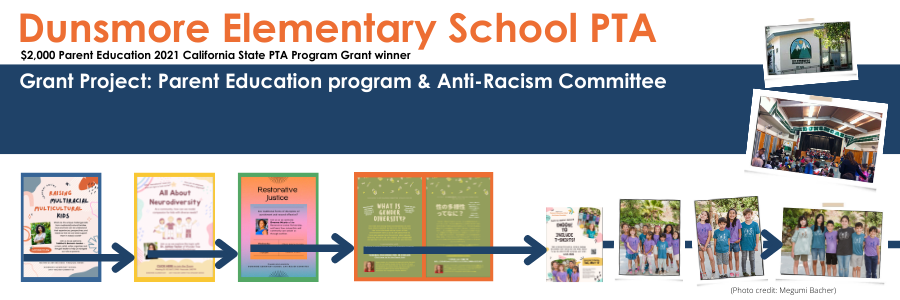
This week, we’re highlighting Dunsmore Elementary School PTA which received a $2,000 Parent Education program grant from California State PTA in fall 2021. 


After the racial reckoning in 2020, parents, caregivers, and teachers at Dunsmore Elementary realized that they needed the language to be able to talk to their children about important discrimination issues. PTA helped make it happen.

Dunsmore Elementary, with a student population of more than 500, offers both a traditional track and a Japanese Dual-Immersion program. It is located in the Glendale School District, First District PTA. In an effort to help parents gain more understanding and compassion for others’ perspectives, teachers and families formed an Anti-Racism Committee (ARC) at the school and presented a speaker series. The ARC and the school PTA joined forces and applied to California State PTA for a $2,000 parent engagement program grant to help make their vision possible.

The school’s experiences provide inspiration and practical advice for other PTAs.

Azusa Oda, ARC founding member and chair of the PTA Family Engagement Committee, and Becky French, ARC founding member and PTA VP of Volunteers, described how the program was developed and what they’ve learned in the process. Becky shared the mission statement of the ARC: “to engage and educate our school community to recognize racism and discrimination in all forms (including, but not limited to gender, sexuality, culture, class, religion, and ability) and possess the tools and confidence to confront it productively.” She added, ”If you’re not talking about it, someone else is.”

The committee used the grant money to sponsor its speaker series designed to inform and engage the diverse population at their school. The ARC researched and selected experienced and knowledgeable speakers on the following topics (click to see their flier for each event):

These events have been held over Zoom and the attendance has been high, ranging from 20 to 85 attendees. Holding the series virtually allows Dunsmore Elementary PTA access to speakers outside their geographic location and provides a way for more parents to join the events. The result has been more meaningful and productive conversations, more understanding and compassion, and more tools to help parents and teachers advocate for those who are marginalized. 

 Valuable tips for other PTAs who would like to follow Dunsmore Elementary’s lead:

  • When forming a new committee or program, understand that it takes a while to build trust even when parents have similar passions and ideas. Don’t expect that the energy and trust will happen right from the start, it needs to be a safe space for everyone.
  • Talk to people about their interests (survey).
  • Be flexible. Change of plans is inevitable!
  • Have a deep pool of speakers to draw from.
  • Establish a set of expectations or group norms. (A trained staff member assisted the committee in developing norms for the group as well as for post-presentation discussions and then the group voted on them.) 

Dunsmore Elementary Established Norms for their Difficult Discussions

   Group Norms:

    • Value Differences
    • Be Honest and Open
    • Expect Discomfort
    • Assume Good Intentions
    • Listen for Understanding
    • Respect One Another

   Discussion Norms:

    • Step Up and Step Back
    • Speak Only for Yourself and Your Experiences
  • Don’t be afraid to invite difficult conversations.
  • Work with school and/or district administration.
  • Understand that there will most likely be a need to dive deeper into the topics. It’s unrealistic to cover everything at once. Affinity groups might form with those who share particular needs or interests.

We’d like to thank Dunsmore Elementary PTA for sharing their ideas and feedback with us and congratulate them on a job well done! The fliers from their events a re linked above. For more information or questions contact the Dunsmore ARC at dunsmorearc@gmail.com.

More info on California State PTA Program Grants:

Golden State PTA memberships and the Honorary Service Awards program help fund California State PTA program grants and scholarships. In 2022, with your donations, we were able to award $115,406 to provide amazing PTA programs and help members and volunteers further their education. 

If your unit, council, or district PTA has a great idea for a program and you are looking for additional funds to support it, please consider applying for a California State PTA program grant. Grants are available in the areas of Cultural Arts, Healthy Lifestyles, Translation Outreach, and Parent Education and the due date for applications is October 15, 2022. For more information https://capta.org/pta-leaders/programs/grants-awards/

Understanding Annual Statewide Test Scores

Sponsored by ETS

Beginning in June, parents should be on the lookout for their child’s Student Score Report on the California Assessment of Student Performance and Progress (CAASPP). The California Department of Education in partnership with the state’s assessment developer, ETS, provides a variety of resources to help parents/caregivers understand their child’s performance on the statewide assessment. While test scores provide a common yardstick to measure student progress, it is important to remember that they provide only one measure of performance and should be considered along with the rest of a child’s learning experience.

Information on the child’s score report will help identify their academic strengths as well as where they might need a little more help. This information, along with their schoolwork and teachers’ feedback, will provide a broad picture of how a child is progressing in their academic career.

Parents can familiarize themselves with student score reports by visiting Starting Smarter where they can view a sample report that identifies each performance area and what the scores mean. For example, if a student is identified at, “Level 3 Standard Met,” that means they are performing at about grade level. The score report also shows how the child performed compared to the school and school district average. This information helps parents/caregivers and educators better understand what support the child needs to be successful in their academic journey.

Resources to Support Your Child’s Academic Progress

Now that you understand what their scores mean and have identified areas where a child might need a little more help and areas where they have excelled, there are free resources provided by the state in partnership with MetaMetrics to help them grow in reading and math. These resources can be accessed year-round.

In addition to a child’s score on the statewide assessments, the student score report will also provide a Lexile (reading) and Quantile (mathematics) measure. This information is based on the child’s reading and math ability and helps parents and educators find texts, books, and materials that are appropriately challenging to a child. Parents can access the Lexile and Quantile tools to learn more about the Lexile and Quantile measures as well as find books and materials that match their child’s comprehension level.

A Lexile (reading) measure will be shown with a number and the letter “L” at the end. Lexile measures range from below 0L for beginners to above 1600L for advanced readers. The higher the Lexile measure, the higher the students reading level. A student’s ideal choice of reading materials falls between 50L above their reported measure and 100L below their reported measure. For example, if a child has a Lexile (reading) measure of 1240L, books that fall between 1140L to 1290L are appropriate for that child. Once you’ve identified a child’s Lexile (reading) measure, you can input their Lexile range (in this case 1140L to 1290L) in the Find-a-Book tool to see suggested reading materials. For example, for a child with a Lexile range of 1140L to 1290L, books such as “Walden” by Henry David Thoreau and Herman Melville’s “Moby Dick” should be challenging enough to help them grow in reading and literature. 

The Quantile (math) Measure uses a similar process. A Quantile (math) Measure will be shown as a number with a “Q” at the end. A student’s ideal math comprehension is 50Q above and 50Q below their reported measure. For example, if a child has a Quantile measure of 500Q, their math comprehension sweet spot is between 450Q to 550Q. That means math games, worksheets, and other activities that fall within that range, which you can find using the Math@Home tool, will help them grow their math skills.

Just like test scores, Lexile and Quantile Measures provide one indicator of a child’s learning and should be considered along with their other schoolwork and teacher feedback.

Parents can also visit the CAASPP parent resources website to get access to practice and training tests as well as a technology checker that is presented in the form of a game-like tool to help identify their child’s readiness for online testing. We encourage parents to use these free resources and tools all year, and especially during summer break to help students stay engaged and continue their academic progress.

California State PTA is a nonprofit and non-commercial volunteer organization and does not endorse any product, publication or business associated with sponsorship partners.

New Resolution Gives Equitable Access with Plant-based Meals

By California State PTA Resolutions Committee and Maya Bhandari, Student Board Member, California State PTA Student Involvement Committee

We are pleased to announce that the delegates to the 2022 California State PTA Convention adopted a new resolution titled: Plant-Based Food Options at School Meals.  This new resolution will help all California State PTA members advocate for school breakfast and lunch programs that provide balanced, nutritious meals, and promote equity for all children and youth. Its primary author, California State PTA Student Board Member Maya Bhandari, tells us:

 “I believe California schools have a responsibility to equitably provide healthy meals to all children. This PTA resolution demonstrates that providing plant-based meal options improves children’s health and our environmental footprint while reducing costs.”

Our state Resolutions Committee Chair, Beth Graves Meyerhoff interviewed Bhandari. Here is a summary of their conversation: 

Meyerhoff: How did the issues addressed in this resolution come to your attention? 

Bhandari: After talking to students in my community and statewide online about the lack of plant-based meals in schools, I brought the idea to California State PTA’s Student Involvement Committee. Together we wrote the resolution and it received approval from the Board of Managers to submit it to the delegates at the 2022 California State PTA convention. It gives both local and state PTAs authority to advocate for a plant-based meal option to be offered as a regular part of all school meals. This resolution, entitled Plant-Based Food Options at School Meals, offers three primary benefits: (1) equitable access to nutritious meals, (2) a decrease in detrimental health effects on children, and (3)  reducing the environmental impact of the food schools provide. 

Meyerhoff: Why is this resolution needed now? 

Bhandari: Food allergies and dietary restrictions that are common among non-European people have largely been overlooked when it comes to school meals. In addition, students who have religious or moral objections to having animal protein should not be discriminated against. Plant-based meals are the most universally accepted foods for the diversity of cultures, religions, and food allergies with which students identify. 

Plus, plant-based meals will also have material environmental benefits. Meat production is one of the most significant contributors to environmental problems, including waste, energy use, water consumption, biodiversity loss, and greenhouse gas emissions according to a report by the Food and Agriculture Organization of the United Nations.  Another report documents that plant-based food production is significantly more sustainable. 

Meyerhoff: Can you share some examples of how the lack of plant-based meals impacts students? 

Bhandari:  Sure! California students share stories about their food choices and challenges online: 

“Every time my tribes-people and I have a lot of dairy and meat, we become ill,” said Henry, a Mojave Native American student from Springville, CA, and a friend of mine. “But, we depend on free school lunch and food stamps. So, we have to choose between going hungry or eating food that physically makes us sick.”  

“I feel marginalized at school because my beliefs are not mainstream,” said Asha, an Indian-American senior at Mission San Jose High School. “My Jain principles forbid me from having animal protein. My school does not offer any viable options, so I have to forgo free school lunches that everyone else gets. Instead, I have to make and bring in my own food every day.” 

“I had a malignant ovarian tumor removed that was caused by my animal protein consumption,” said Sophia, a Honduran-American senior at Salinas High School in Salinas. “Since I am trying to spare my other ovary, I cannot eat school lunches, since they do not provide non-animal protein options.” 

Meyerhoff: How will the change to plant-based meals impact local schools and school districts? 

Bhandari: The cost of serving plant-based meals is potentially lower. A two-year pilot at Oakland Unified School District serving more plant-based meals resulted in $42,000 in cost savings annually while achieving a 14% reduction in carbon footprint and 6% reduction in water use. 

Meyerhoff: How can local PTA/PTSAs and PTA members use this new authority? 

Bhandari:  This resolution will give all PTA members authority to support all students including students like Henry, Asha, and Sophia. PTA members can advocate locally in their schools and on legislation at the state and federal levels. We all need to advocate that healthy and universally accepted plant-based meals be offered in schools.

Apply now: California’s Parent Advisory Council

By California State PTA Family Engagement Commission

The California Department of Education is looking for parents and guardians of public-school students in Pre-K through 12th grade from a variety of communities throughout California, to serve on the new California Parent Advisory Council. Please share this opportunity with families, caregivers, and your extended school community so that the parent/guardian voice can be included in the conversation for equitable change in California education. (Applications are due by May 5, 2022.)

The Parent Advisory Council’s mission is to advise the State Superintendent of Public Instruction on issues of concern to families of public school students. Members are also expected to help organize and conduct community meetings, attend occasional meetings with the State Superintendent, and participate in parent outreach activities. This is a paid, two-year volunteer position.

The Parent Advisory Council works to: 

  • Actively conduct outreach to communicate with families across the state, to understand and represent parent perspectives about school programs, students’ services, and other policy issues
  • Present recommendations to California’s Superintendent of Public Instruction to support academics, social emotional learning, and family engagement among all public-school children.
  • Ensure that the Superintendent of Public Instruction’s policy decisions are informed by the voices of parents and guardians who reflect California’s student populations

Eligibility: To be eligible for the Parent Advisory Council, you must be the parent or guardian of a student enrolled in a California public school, including Early Education pre-kindergarten schools.

Membership Requirements: Members of the PAC are expected to attend quarterly Parent Advisory Council meetings.

More information can be found on the CDE website and on the Application form.

8 Tips for Families with Young Children 

By California State PTA Family Engagement Commission

Did you know that during the first three years of life, brain development is especially rapid, with more than 700 neural connections created each second? This means that more is learned — at a faster rate — than at any other time in a child’s life. That’s why parent, guardian, and caregiver interactions with infants and toddlers have long-lasting impacts on development and throughout life. As we celebrate the Week of the Young Child, April 9-15th, here are some of our favorite family engagement tips for families with young children:

  • Set up daily routines including healthy eating and sleeping habits
  • Respond to cues and clues by noticing changes in a child’s moods and habits
  • Surround a child with language by talking, reading, and singing to them
  • Encourage safe exploration, discovery, and play
  • Talk to a child about feelings and teach words to describe those feelings
  • Increase outdoor play and limit TV, video game, computer, and screen time
  • Communicate with daycare providers or preschool teachers about how your child is doing
  • Recognize that each child is unique

For more information on early childhood development, including how to select the best preschool for your child, visit our website.

Family Engagement Opportunities at the 2022 Convention


By California State PTA Family Engagement Commission

The Family Engagement Commission is excited to meet you at our upcoming state convention on April 29-May 1 in Ontario! We have been planning workshops to help you take your PTA family engagement to the next level. Bonus: these workshops are also full of information that is valuable to you as a parent. 

Expanding your Engagement is our foundational course in family engagement. Learn more about the National Standards for Family Engagement including ways to use them to evaluate the programs at your school and how to move your school towards being even more inclusive to all families. Our commissioners will share suggestions and resources to engage families at the elementary, middle, and high school levels. This workshop is being presented twice, once in Spanish and once in English.

Family Engagement: Learn, Share, Grow is an interactive, member led table talk where we get to learn from one another! Participants will be able to choose five rotations from ten different family engagement topics. Join us to share your best ideas, brainstorm with fellow PTA members throughout the state, and learn from other convention attendees. At the conclusion of the workshop, every participant will receive the complete list of proven family engagement ideas generated by attendees during the workshop.

Building CommUNITY and Cultural Capacity in PTA. Special guest speaker Jacqueline “Kiki” Bispo, a family engagement specialist from Vista Unified School District, will help participants build cultural capacity by diving into the ability to understand, appreciate and work effectively with culturally diverse groups. This is an interactive session with Spanish interpretation. When you leave this class you will be prepared to strengthen relationships and improve inclusion within your school and community.  

The Path to College/Career A Family Voyage.  During this workshop, you will hear about the college and career experience from a diverse panel of speakers: a student, a parent, an educator, and a college consultant. Topics will include how to help your child find the right college, funding opportunities/scholarships, strategies for finding the best career path for your child, and more! Bring your questions and be ready to take lots of notes during this workshop filled with practical tips and useful information. Note: this is not just for high school parents, you’ll find information and resources on preparing for college and career at all ages and grade levels. 

As an added bonus all participants attending Family Engagement workshops will receive a family engagement ribbon to add to their Convention name badges.  

There are many workshop offerings at the 2022 Convention — whether you are a Convention first-timer or a seasoned PTA leader. You can view the workshop list on our website, then register for your top workshop choices. Attendees will have access to the Convention Program Book and will find the most up-to-date information in the Convention App.

We can’t wait to see you in Ontario!