First Tasks for New PTA Officers

Getting started as a brand-new PTA officer can seem daunting at first. There’s a lot that needs to be done to get things up and running, but who does what, and in what order?

This list help you figure out when and how to schedule meetings, create calendars, and perform other tasks that will ensure that your PTA gets off to a good start!

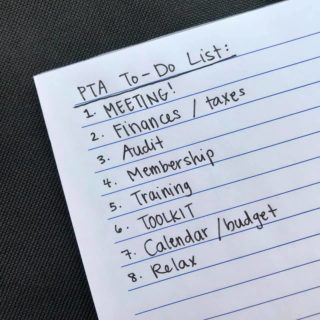
  1. The president should set up a meeting with the school principal and call meetings of the board as soon as possible.
  2. At the first of meeting, ratify appointed officers, fill any vacant offices and make plans for the coming year. Strive for a balance of experienced and new members, keeping in mind that all areas of the community should be represented.
  3. Consider a membership survey, to be returned prior to the end of the school year, where past unit activities are reviewed and suggestions for new activities are solicited.
  4. Use input from the survey for brainstorming session(s) with the board-elect to establish board goals. Set realistic goals and
    prioritize projects.
  5. Set a calendar for the upcoming year and provide membership campaign materials to the school for any summer mailings
    they may be planning.
  6. Review procedure books from past years.
  7. Become familiar with the duties of each chair by reviewing the California State PTA Toolkit. Share job descriptions and materials as noted with the chairpersons and help them to secure procedure books and materials from their predecessors. If they fail to receive procedure books, assist them in setting up their own.
  8. Consider reviewing the PTA bylaws with the entire board (even if they are newer than three years). The bylaws contain many job responsibilities and timelines/due dates. Reviewing them together gets everyone on same page with the same expectations.
  9. Encourage every board member to attend trainings.
  10. Prepare a preliminary budget and present it for adoption at your next association meeting.
  11. Verify with outgoing board that the year-end Annual Financial Report has been completed after the books are closed, that arrangements have been made for the annual year-end financial report, the year-end audit, and that documents have been compiled for ease in preparing tax filings.
  12. Update signature cards for bank accounts.
  13. Provide names and addresses of board members to council and/or district PTA for their respective directories. Make sure each of your board members knows how to contact their counterpart at district (or council) to get questions answered.

To return to the blog homepage, click here.

What is Family Engagement?

By Heather Ippolito, Vice President for Family Engagement

In PTA we often talk about family engagement, but what does it really mean and why is it so very important?  

Family engagement with schools has many definitions:  

  • The US Department of Health and Human Services: Family engagement is the process used to build genuine relationships with families. Relationships with families support overall family well-being and children’s healthy development. When families are engaged, partnerships are created that have a common focus– helping children grow and thrive.
  • In 2010 the National Family, School and Community Engagement Working Group (now the NAFSCE Policy Council) defined family engagement like this: “Family engagement is a shared responsibility in which schools and other community agencies and organizations are committed to reaching out to engage families in meaningful ways and in which families are committed to actively supporting their children’s learning and development.”
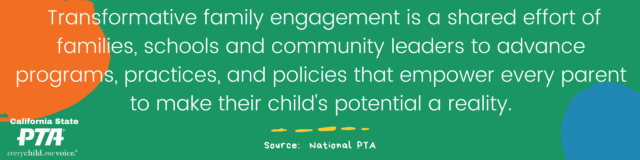
  • National PTA defines transformative family engagement as a shared effort of families, schools and community leaders to advance programs, practices, and policies that empower every parent to make their child’s potential a reality.

Research shows family engagement is a major factor in student success, with an encouraging home environment serving as a bigger factor in student achievement than a parent’s income, education level or cultural background. It also tells us that family engagement:

  • Promotes healthy development and wellness in children
  • Increases graduation rates for those students whose families are involved on campus
  • Decreases dropout rates and behavior issues in students whose families participate on campus
  • Increases a child’s academic and social skills

What does this all boil down to for our  PTA unit, council and district leaders? Family engagement is something you do daily. Your programs and events help bring families to your campus and better understand educational issues that impact their children. When you help create and foster relationships between families, the school and the greater community, the students at your school thrive.  

Our goal as the California State PTA Family Engagement Commission is to give you concrete ideas to make this task easier. Every Friday on the blog we will share family engagement tips, best practices, and resources that will help you as you plan activities on your campus. We are so excited to work alongside you this term! 

Next steps:

  • This year at your first executive board meeting set three family engagement goals. Some examples of family engagement goals are:
  • Increase involvement of fathers, grandfathers, and other male family members in PTA and school events
  • Increase parent and family participation in the Local Control Accountability Plan and Local Control Funding Formula meetings
  • Take at least three actions this year to make your existing programs more accessible for families of children with special needs. For example, open up your Fall Harvest Festival 30 minutes early for these families so they can enjoy the activities with smaller crowds and less sensory stimulation.

Share with us your goals and you might be recognized in our social media (or win a prize). Email them to familyengagement@capta.org 

  • We also want to hear about your best family engagement activities. Complete this simple form and your school may be featured here on the blog, in our social media or on our website. 

To return to the blog homepage, click here.

Thank you from PTA president Celia Jaffe

Hello PTA friends and friends of California State PTA:

The resilience, dedication, and creativity shown by PTA leaders during this challenging term has been exceptional. Through the pandemic, PTAs continued to play meaningful roles in their local communities and to influence state and national policy-making on behalf of all children. Thanks to each of you for all your efforts. You made a difference during tough times.

I want to thank you for the privilege of serving as your state president these last two years. This organization means the world to me, and I have been honored to represent you.

Carol Green begins her term as California State PTA president this week. We have worked together for many years, and I know Carol will do great things in this role.

Congratulations to Carol and the 2021-23 Board of Directors. All the best to you as you move California State PTA forward.

Yours,


Celia Jaffe
2019-21 President, California State PTA


To return to the blog homepage, click here.

Focus on Eye Health

The biggest challenge of the last year to maintaining healthy vision has been digital eye strain. With kids being forced to switch from in-person to digitally based distance learning because of the pandemic, the number of hours per week they spend staring at computer screens has increased exponentially.

Some recent studies have shown an increase in myopia due to the increased screen time this past year. Many purchased blue light glasses for protection, though blue light from screens is not harmful to the eyes. The levels are too low to do that.

What kids who struggle to see really need is a comprehensive eye exam. In addition to that, we suggest the following tips for kids to keep their eyes healthy:

  • Eat a well-balanced diet. Load up on different types of fruits and veggies, especially leafy greens like spinach, kale, and collard greens. Fish like salmon, tuna, and halibut have been shown to help your eyes, too.
  • Speak up about vision changes. Is your vision blurry? Do you squint a lot? Ever have trouble seeing things at school? Tell a parent or teacher if your eyes are bothering you or if you notice any changes in your vision.
  • Wear glasses if prescribed. Your glasses help you see better, especially when they’re clean and free of smudges. Talk to an adult about how to clean your glasses and how to store them when you’re not wearing them.
  • Wear sunglasses. Harmful blue light that can damage the eyes comes from the sun.  Wear proper UV protection when they are outside. Choose sunglasses that block 99% or 100% of both UVA and UVB radiation from the sun. And remember, never look directly at the sun.
  • Give your eyes a break. Staring at any one thing for too long can tire your eyes. Give your eyes a rest with the 20-20-20 rule: Every 20 minutes, look about 20 feet away for 20 seconds.

For more information, visit the National Eye Institute.

To return to the blog homepage, click here.

College and Career Readiness Summer Activity

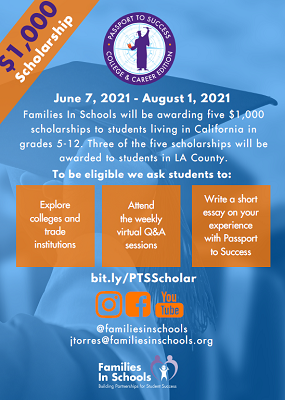
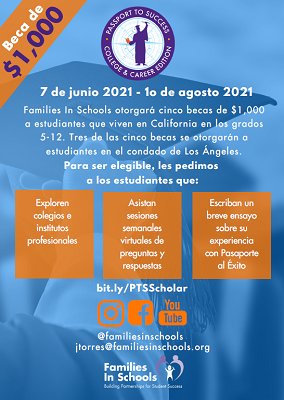
Helping our students think about college and career readiness is a great thing to do during the summer months. The Family Engagement Commission has found a really fun resource for students in grades 5-12 to use this summer AND they could win a $1,000 scholarship!

Take a few moments to learn more about this program and check out all the resources that Families in Schools has on this important topic: https://www.familiesinschools.org/passport-to-success-college-and-career-edition/


To return to the blog homepage, click here.

Advocacy Agenda for Equity 2021

California State PTA believes that all children deserve a quality education regardless of the community in which they live, the color of their skin, their language, their gender identity, or their immigration status.

But too many California students from underserved communities are deprived of an equal opportunity to learn. This year we created an equity agenda to address the needs of all of our children. The bills the California State PTA supports are listed below by category.

Poverty, Income, and Racial Inequality

PTA seeks legislation to address poverty, and the income and racial inequities that affect millions of California families.

  • AB 27 (Rivas, Luz D) Homeless children and youths and unaccompanied youths: reporting.
  • AB 57 (Gabriel D) Law enforcement: hate crimes.
  • AB 367 (Garcia, Cristina D) Menstrual products.
  • AB 408 (Quirk-Silva D) Homeless children and youths: reporting.
  • AB 742 (Calderon D) Personal income taxes: voluntary contributions: School Supplies for Homeless Children Voluntary Tax Contribution Fund.
  • AB 1006 (Rubio, Blanca D) Foster care: social worker turnover workgroup.
  • SB 17 (Pan D) Office of Racial Equity.
  • SB 100 (Hurtado D) Extended foster care program working group.
  • AB 14 (Aguiar-Curry D) Communications: broadband services: California Advanced Services Fund.
  • AB 775 (Berman D) Public postsecondary education: basic needs of students.
  • SB 4 (Gonzalez D) Communications: California Advanced Services Fund: deaf and disabled telecommunications program: surcharges.
  • SB 532 (Caballero D) Pupil instruction: high school coursework and graduation requirements: exemptions.
  • SB 682 (Rubio D) Childhood chronic health conditions: racial disparities.
  • AB 37 (Berman D) Elections: vote by mail ballots.
  • AB 546 (Maienschein D) Dependent children: documents: housing.
  • AB 656 (Carrillo D) Child welfare system: racial disparities.
  • SB 274 (Wieckowski D) Local government meetings: agenda and documents.
  • AB 34 Muratsuchi D Broadband for All Act of 2022.
  • AB 256 Kalra D Criminal procedure: discrimination.
  • SB 79 Bradford D State parks: state beaches: County of Los Angeles: Manhattan State Beach: deed restrictions.

Early Learning

PTA supports quality childcare, pre-school and early learning for all children.

  • AB 22 (McCarty D) Childcare: preschool programs and transitional kindergarten: enrollment: funding.
  • AB 92 (Reyes D) Preschool and childcare and development services: family fees.
  • AB 321 (Valladares R) Childcare services: eligibility.
  • AB 393 (Reyes D) Early Childhood Development Act of 2020.
  • AB 1361 (Rubio, Blanca D) Childcare and developmental services: preschool: expulsion and suspension: mental health services: reimbursement rates.
  • SB 50 (Limón D) Early learning and care.
  • SB 725 (Ochoa Bogh R) Early childhood education: parent participation preschool programs.

Health and Welfare

Physical, social, emotional, and mental health needs must be met before students can thrive.

  • AB 452 (Friedman D) Pupil safety: parental notification: firearm safety laws.
  • SB 260 (Wiener D) Climate Corporate Accountability Act.
  • SB 699 (Eggman D) School climate: statewide school climate indicator: surveys.
  • AB 285 (Holden D) State Department of Education: state school nurse consultant.
  • AB 967 (Frazier D) Special education: COVID-19 Special Education Fund.
  • SB 224 (Portantino D) Pupil instruction: mental health education.
  • SB 237 (Portantino D) Special education: dyslexia risk screening.
  • SB 722 (Melendez R) Interscholastic athletics: adult supervisors: cardiopulmonary resuscitation training.
  • AB 234 (Ramos D) Office of Suicide Prevention.
  • AB 270 (Ramos D) Core Behavioral Health Crisis Services System.
  • AB 309 (Gabriel D) Pupil mental health: model referral protocols.
  • AB 586 (O’Donnell D) Pupil health: health and mental health services: School Health Demonstration Project.
  • AB 988 (Bauer-Kahan D) Mental health: mobile crisis support teams: 988 crisis hotline.
  • AB 1117 (Wicks D) Pupil support services: Healthy Start: Toxic Stress and Trauma Resiliency for Children Program.
  • AB 1165 (Gipson D) Juvenile facilities: storage and use of chemical agents and facility staffing.
  • AB 1197 (Quirk-Silva D) School meals: nutritional requirements.
  • SB 14 (Portantino D) Pupil health: school employee and pupil training: excused absences: youth mental and behavioral health.
  • SB 21 (Glazer D) Specialized license plates: mental health awareness.
  • SB 217 (Dahle R) Comprehensive sexual health education and human immunodeficiency virus (HIV) prevention education.
  • SB 364 (Skinner D) Pupil meals: Free School Meals For All Act of 2021.
  • AB 48 (Gonzalez, Lorena D) Law enforcement: kinetic energy projectiles and chemical agents.

Education Funding

California’s school finance system must provide stable, sustainable, equitable, and adequate funding to meet the diverse needs of all our students, including before and after-school programs, summer school, and distance learning.

  • AB 99 (Irwin D) Statewide longitudinal data system: California Cradle-to-Career Data System: governance and support.
  • AB 1112 (Carrillo D) Before and after school programs: maximum grant amounts.
  • SB 737 (Limón D) California Student Opportunity and Access Program.
  • AB 75 (O’Donnell D) Education finance – School facilities: Kindergarten-Community Colleges Public Education Facilities Bond Act of 2022.
  • SB 22 (Glazer D) Education finance- School facilities: Public Preschool, K–12, and College Health and Safety.

Teaching

PTA supports the recruitment and development of an educator workforce that is reflective of the student population, and that all students have qualified and effective teachers delivering a full curriculum.

  • AB 312 (Seyarto R) Teacher credentialing: basic skills proficiency test: exemption.
  • AB 437 (Kalra D) Teacher credentialing: subject matter competence.
  • AB 520 (Gipson D) Teacher retention: California Diversifying the Teacher Workforce Grant Program.
  • SB 237 (Portantino D) Special education: dyslexia risk screening.

Curriculum

Instruction should be personalized, culturally relevant, and responsive.  Coursework must address racism and bias to counteract the institutional and structural biases and related traumas that often drive inequitable outcomes for students.

  • AB 101 (Medina D) Pupil instruction: high school graduation requirements: ethnic studies.
  • AB 104 (Gonzalez, Lorena D) Pupil instruction: retention, grade changes, and exemptions.
  • AB 299 (Villapudua D) Career technical education: California Apprenticeship Grant Program.
  • AB 839 (O’Donnell D) Career technical education: California Career Technical Education Incentive Grant Program.
  • ACR 49 (Choi R) Arts Education Month.
  • SB 545  (Wilk R) Pupil retention: COVID-19 impact.
  • SB 628 (Allen D) California Creative Workforce Act of 2021.
  • SB 723 (Rubio D) Pupil instruction: tutoring program: learning loss mitigation.
  • SB 70 (Rubio D) Elementary education: kindergarten.
  • AB 366 (Rubio, Blanca D) Foster youth.

To return to the blog homepage, click here.

Addressing Microaggressions to Make PTAs More Welcoming

We all want all families to feel welcome at our schools.

An active middle school PTSA was committed to including all voices in their PTSA planning. They worked with their school’s Spanish-bilingual and Chinese-bilingual family liaisons to engage the English-language learner communities at their school and to provide interpretation at their meetings. At every meeting, the Spanish-speaking and Cantonese-speaking families had interpretation and a familiar face to welcome them to the meetings. Before the meeting started, they felt included and welcome to their PTSA.

Yet, when it was time to discuss the budget and upcoming events, the PTSA Board described the events that they had planned and didn’t ask for feedback from all members at the meeting. The Spanish-speaking parents were confused. They had come with their ideas for community events and were excited to share their ideas, but, when they suggested new events or programs, the PTSA Officers asserted that they had already decided what the community events would be.

Do you think that the Spanish-speaking families returned to the next meeting?

“Welcoming All Families” is the first standard of Family Engagement in the National Standards for Family-School Partnerships. Our PTAs provide Welcome Back to School events, mentor families and many other terrific programs, strategies, and initiatives that are described in the National Standards Assessment Guide. We can make our schools even more welcoming by watching for micro-aggressions in your PTA meetings and activities.

Microaggressions are indirect, subtle or unintentional instances of discrimination against members of a marginalized group. Although they are thought of as small actions, microaggressions can have a tremendous impact. In a short PTA video, you can learn how to recognize microaggressions, respond to them and repair relationships in situations where we’ve committed them.

Continue your learning and reflection on micro-aggressions with these questions and resources.

For self-reflection:

  • Are you more often an observer, perpetrator or victim of microaggressions? What does it feel like for you in each of these roles?
  • Which of your identities (i.e., race, immigration status, language, religion, gender, sexuality, ability, household status, etc.) tend to have more “power” and could lead you to unintentionally commit a microaggression? What would it look like in those instances?
  • How does intent and impact show up in how you respond to microaggressions?
  • What has worked and has not worked when you have responded to a microaggression?

For your PTA to discuss:

  • Where have you seen microaggressions play out in your PTA? In your school community?
  • Who is affected by these microaggressions? What is the impact for these people?
  • How can you recognize, respond and repair microaggressions when they occur within your PTA?

Come to the Family Engagement Meet-up during Convention 2021 on May 14 at 4:00 p.m. to reflect on how you and your PTA may become more aware of and address microaggressions at your school.

To return to the blog homepage, click here.

Family Engagement: It’s the Law

As PTA members, we know how important family engagement is for student and school success. 

Did you know that family engagement is not just good practice? In California it’s the law! 

The California Department of Education’s Local Control Funding Formula (LCFF) gives local school districts a lot of substantial power to make local decisions that affect their communities. Every local education authority (school district) in California has to submit a plan for how it will use the LCFF funding. 

Learn more about the Local Control Funding Formula (LCFF) and the state’s required Local Control and Accountability Plan (LCAP) here.

Part of your district’s LCAP includes a description of how the district engages families in decision-making and planning. In 2018, California PTA worked with other state Family Engagement partners to pass AB 2828, which requires school districts and charter schools to describe their family engagement strategies and outcomes in specific ways in their annual Local Control and Accountability Plans (LCAP).

What does this look like in your school district?

  • Does your district make every effort to seek parent input in making decisions for your school district and your school site? 
  • How does your district plan to increase participation for students with exceptional needs?
  • What is working and not working for your district?

Learn more about measuring and reporting family engagement at “Family Engagement: It’s the Law,” a Convention 2021 presentation, live Q&A and meet-up on May 12.

Next steps:

  1. Use the National PTA checklist to measure family engagement at your own school site;
  2. Check out the National Standards for family school partnerships to get ideas; 
  3. Attend your school site or district Local Control and Accountability Plan planning meetings;
  4. Find out if your district is using the California State Self-Reflection tool; and
  5. Ask your school and your district how they will engage all families in your community.


About Kari Gray: A San Francisco resident, public school parent, arts advocate and community engagement specialist, Kari Gray currently works as the Special Projects Manager at ODC/Dance and serves on the Boards of Youth Arts Exchange, the Second District of the California State PTA, and on the Family Engagement Commission and Art Committee for the California State PTA.

To return to the blog homepage, click here.

ETS Update: Spring Assessments

This article was provided by our sponsor ETS. Read more about ETS here.

State tests are underway and like this school year when learning is  different—whether your child is in a school, learning at home, or both—the tests are also different.

We recognize that the COVID-19 pandemic that prompted sudden school closures has created a very challenging learning environment not only for students, but also for parents and teachers. We applaud the hard work, sacrifices and efforts made by families and teachers to help ensure that students continue to learn and progress in their academic career. There is no doubt that the COVID-19 closures have caused learning gaps, which is why it is more important than ever to measure student learning to understand the impact the pandemic and the different learning environments have had on students.

This year, districts have the option to give the California Assessment of Student Performance and Progress (CAASPP) either remotely or in person. The English language arts and mathematics test are shorter than in previous years to decrease stress on students and time it takes away from valuable instruction. School districts will also have more time to administer the assessments. The results of the tests are going to be used for learning only. They will not be used to rate schools but to help identify where leaning loss has occurred and provide the state, teachers, and parents with this very important data to help make decisions on how to best help student catch up.

All the test subjects, in addition to ELA and math, administered under CAASPP are available this year as well as the tests administered to English learners. Most of these tests are available remotely or in person. However, if your child qualifies for the alternate assessments, these tests will need to be given in person because these tests require one-on-one administration with students so they can better demonstrate what they know and can do.

Below is a list of available tests, who takes them, how they are administered, and timeline. Check with your child’s teacher for more information about your child’s testing schedule and which tests they need to take. Parents can also visit the CAASPP/ELPAC website for more information, including instructions and videos on how to prepare for testing at home and practice tests.

Smarter Balanced English Language Arts (ELA) and mathematics (shortened version)

Results for this test will only be used to get information on how to help students.

  • Who takes the test: All students from grades 3-8 and 11 except students participating in the California Alternate Assessments (CAAs) for ELA and mathematics and ELA only for English learners in U.S. schools less than 12 months.
  • How it’s administered: In-person or remote, depending on school district.
  • Testing period: February – July
  • When parents can expect their child’s score report: July 2021

California Alternate Assessments (CAA) in English language arts and mathematics

Results for this test will only be used to get information on how to help students.

  • Who takes the test: Students with the most significant cognitive disabilities whose active individualized education program (IEP) designates the use of an alternate assessment
  • How it’s administered: In-person only
  • Testing period: January – July
  • When parents can expect their child’s score report: September 2021

California Science Test (CAST)

Results for this test will only be used to get information on how to help students.

  • Who takes the test: All students in grades 5 and 8, and once anytime in high school, except eligible students participating in the CAA for Science
  • How it’s administered: In-person or remote, depending on school district
  • Testing period: January – July
  • When parents can expect their child’s score report: July 2021

California Alternate Assessments in Science

Results for this test will only be used to get information on how to help students.

  • Who takes the test: Students with the most significant cognitive disabilities whose active IEP designates the use of an alternate assessment, for grades 5 and 8, and once anytime in high school
  • How it’s administered: In-person only
  • Testing period: September – July
  • When parents can expect their child’s score report: TBD

English Language Proficiency Assessment for California (ELPAC) (Initial and Summative)

Results of this test are used to identify English learners and to reclassify EL status

Initial ELPAC Listening, Speaking, Reading and Writing

  • Who takes the test: K-12 students whose primary language is not English as indicated on the Home Language Survey; administered within 30 calendar days of enrollment
  • How it’s administered: In-person or remote
  • Testing period: All year
  • When parents can expect their child’s score report: As soon as the student takes the test

*Summative ELPAC Listening, Speaking, Reading and Writing

  • Who takes the test: K-12 students who have been identified as English learners and participate annually until reclassified fluent English proficient
  • How it’s administered: In-person or remote
  • Testing period: February – July
  • When parents can expect their child’s score report: June 2021

 *Students who took a locally administered alternate assessment of English proficiency will continue to receive a Summative ELPAC student score report.

California Spanish Assessment

This is an optional test for native English-speaking students who want to demonstrate proficiency in Spanish language.

  • Who takes the test: All students in grades 3-8 and high school who want to demonstrate Spanish reading and language arts
  • How it’s administered: In-person or remote
  • Testing period: January – July

When parents can expect their child’s score report: September 2021

To return to the blog homepage, click here.
Staying Connected with PTA Families in a Virtual World

How do we keep everyone connected when we can’t meet in person? The same way we did before: by communicating clearly and frequently, by hosting a variety of social and learning activities, and by building authentic relationships.

Clear and frequent communication

Every year, PTA works with school staff to establish communication processes and tools. This year, with all the changes and updates, it is even more important to reach every single person in our communities.

We need to ask:

  • How are people coping?
  • What do they need?
  • What is the best way to connect?

Effective family engagement includes all families and caregivers. To reach all families, it is vital to share information in a variety of ways: PTA and school district websites and newsletters, email, text, social media posts, and even with paper flyers and newsletters sent by mail.

Recognizing the need for a whole new way to create engagement and community, the PTA in San Francisco started “4-1-1 Wednesday” virtual gatherings for all San Francisco families. They could join by phone or computer. Topics centered on how to support families and parent groups: fundraising brainstorming, mental health and wellness strategies, and tips on creating an inclusive community. 4-1-1 Wednesdays also feature Town Halls with the District Superintendent and Department of Public Health.

These citywide meetings give parents and caregivers the opportunity to learn from each other and strengthen the entire school district community.

Share your own strategies for communicating with your community during Convention 2021 at our Family Engagement Meet-up on Tuesday, May 11 at 4:00 p.m.

About Kari Gray: A San Francisco resident, public school parent, arts advocate and community engagement specialist, Kari Gray currently works as the Special Projects Manager at ODC/Dance and serves on the Boards of Youth Arts Exchange, the Second District of the California State PTA, and on the Family Engagement Commission and Art Committee for the California State PTA.

To return to the blog homepage, click here.