Tips to Foster Educational Equity for All Students

Sponsored by College Board

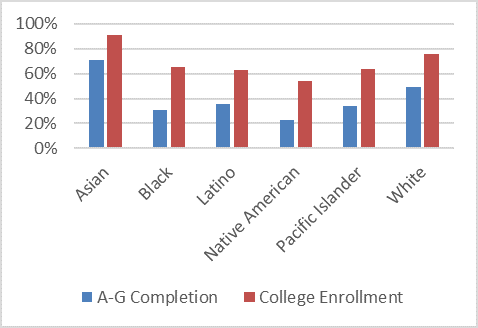
In California, college-readiness and college-going rates vary greatly by race and ethnicity. Black, Latino, Native American, and Pacific Islander students are less likely to be prepared for and enroll in college due to lack of access to resources.

A-G Completion and College Enrollment within 12 Months of Graduation (2017-18)

The best way to ensure that all students have the option to attend a public university like a California State University (CSU) or University of California (UC) school is to provide access to resources and encourage A-G course completion in high school. Currently, only 43% of 9th graders graduate high school and complete the A-G requirements. Not only does this vary by race and ethnicity, but also by socioeconomic status. Students who receive free and reduced-price lunch, or whose parents do not have a high school diploma, are half as likely as their peers to complete the A-G requirements.

We know that all parents want the best for their children. Our schools must do better, and you can help!

You can make a difference by taking these 3 steps today!

  1. Advocate for your school to offer high-quality A-G approved courses. Programs like College Board Pre-AP courses are A-G approved, and this program requires that these high-quality instructional resources be used in all classrooms, ensuring equity for all students.
  2. Encourage your school to use the latest state grant fund to offer A-G approved courses. The new A-G Completion Improvement Grant Program provides $400 million in funding to expand access to A-G courses necessary for students to attend a CSU or UC. These funds must be used to increase the number of students who graduate from high school with A-G eligibility. The funds can also be used to expand A-G course offerings and provide professional learning opportunities for administrators, teachers, and staff. Make sure your school is taking advantage of this grant to help more students be ready for college.
  3. Help students understand college requirements and the application process. Use free online resources like Big Future to help both students and parents navigate the college application process: from getting started to finding colleges, exploring careers, learning how to pay for college, applying, and finally making a decision.

Data pulled from Public Policy Institute of California: Geography of College Readiness in California
and Geography of College Enrollment in California.


Click here to learn more abut College Board. 

California State PTA is a nonprofit and non-commercial volunteer organization and does not endorse any product, publication or business associated with sponsorship partners.

Six Ways to Fix the “Everyone Welcome Sign” on Your PTA

By: California State PTA Leadership Services and Family Engagement Commissions

You’re in the PTA to do good things for all kids and families. You might think your PTA is a place where everyone feels welcome, but others could see it differently because of popular media stereotypes, hearsay, or even personal experiences. These steps can improve your welcoming and inclusive environment and might even grow your PTA and attract some more great volunteers. 

  1. Create a welcoming committee

Jennifer, a kindergarten mom, goes to a PTA meeting for the first time. No one greets her, and the officers do not acknowledge her. When the events chair gives a report, she uses acronyms and makes references to activities Jennifer has never heard of.

Why people might feel excluded: Jennifer was interested in the PTA, but at the meeting, she didn’t know who the members were or what they were talking about. Not only did she feel like an outsider; she also felt like she didn’t know how to contribute.

The way to fix it:  Form a welcome committee or assign an officer to greet newcomers at each meeting. Wear name tags. Avoid using acronyms or jargon. Follow up with new attendees after the meeting to answer any questions they have about the PTA or learn whether they have any ideas about how they can help. Welcoming everyone is the first step in the PTA Family-School Partnership toolkit – find more info on this research based family engagement resource on the California State PTA website.

  1. Recruit everyone

Several seasoned PTA volunteers are setting up at the annual back-to-school night. As they unload decorations, they walk by the playground where a new parent at the school is playing with her kids. They invite her to the event but don’t introduce themselves or ask whether she’s interested in getting involved.

Why people might feel excluded: This new parent might have been looking for ways to get involved and meet new people. By walking by and only asking her to participate without telling her what they were doing, the PTA volunteers missed an opportunity to engage and invite a new volunteer into the group.

The way to fix it: It’s not always easy to know how your PTA is perceived. But consider every meeting with a new family an opportunity to talk about what your PTA does and to invite them to get involved. Remember to ask again later, too! If someone isn’t available the first time, they may be more receptive to a repeat request for help. Find recruitment ideas, tips, templates, and resources on the California State PTA website from the state Membership Services Commission!

  1. Be available

The PTA doesn’t communicate well with parents and there’s no list of officers on a bulletin board, website, or in a newsletter. Parents don’t know who runs the PTA or how to contact them.

Why people might feel excluded: Being unavailable makes the group feel exclusive as if members don’t want to share the information because they aren’t looking for new help. If it’s too hard to get “in,” some people will just stop trying. When you give up the chance to tell your own story, folks can make their own. Remember the adage that negative news travels twice as fast as positive.

The way to fix it: Find a volunteer who can keep your website updated regularly with every officer’s contact information. Link your PTA information to the school website, and supply the school administrators with the most updated list of officers, including email addresses and phone numbers, as parents will often call the school looking for information. 

  1. Always follow up

The PTA asks parents to fill out a volunteer interest survey, but no one follows up with them. Parents who were willing to give their time assume that the PTA doesn’t need or want their help after all.

Why people might feel excluded: If someone offers to help and isn’t contacted, it feels like rejection. Rejection is key to the clique culture and breeds resentment and negativity. It can stunt further involvement by the potential volunteer (and their wider group of friends).

The way to fix it: Be diligent in following up after asking for input. Whether it’s on a fundraising survey or volunteer sign-up form, remember that parents took the time to respond to your request. You’ll be asking the same group for their help again in the future (maybe even next week!) and you’ll want their participation again. Try an online volunteer sign-up and management system; it makes following up much easier. It’s also okay to say sorry if you’ve dropped the ball but make a commitment to do better next time.

  1. Include New People in Decision Making and Leadership Roles

When the same people have been officers for years, newcomers feel like they’re not wanted or shouldn’t bother because they don’t have enough experience to take on a leadership role. When you do need to fill a volunteer position, you offer it to a friend.

Why people might feel excluded: The doors appear to be closed to new volunteers and their fresh ideas—which they might take to another organization if you don’t offer them an opportunity to get involved with your group. By not sharing information about volunteer openings, people who might want the job feel excluded.

The way to fix it: Set up a succession plan for the major roles on your PTA board. Use committees to allow volunteers to “ease into” learning about your PTA’s work and to provide places for them to engage between elections. A new leader might be interested in being an officer, so keep that in mind. Keep new volunteers informed by providing job descriptions including the time involved, so parents can choose what fits their schedules and interests best. Also, include a timeline of when new board and committee chairpeople are selected. You can find information on PTA elections, job descriptions and so much more in the “Run Your PTA” section of the California State PTA website from the Leadership Services Commission.

  1. Build diversity

You’ve held the same event for years, run by the same tight-knit group of people, and attendance has been dropping. A whole group of families have never partici­pated because they don’t feel like the event includes them.

Why people might feel excluded: When different voices aren’t included in the planning and execution of an event, the ideas get stale and only appeal to a select few. For example, Doughnuts with Dads excludes any student whose father isn’t involved in the family or one who has two Moms.

The way to fix it: The way to fix it: Invite idea-sharing and feedback from people outside the usual circle of leaders and volunteers. Take notice of parents who don’t usually get involved; talk with them and personally invite them to share opinions and join committees. Make sure you have a wide representation on your board and in your committees including parents with kids in different grades, in different activities and caregivers who might not be parents or speak different languages. Don’t be satisfied with contacting just one member of a new group; no one wants to be a token, so invite three or four new people at minimum. Ask them to invite some friends. Avoid gender specific activities or language so that all families feel included. You can find information on how to build a more diverse, equitable & inclusive PTA on National PTA’s website.

Takeaways

Getting involved in your school’s PTA should be open to everyone and feel welcome and inclusive.  It shouldn’t bring back memories of cliques, popu­lar kids, or being left out. Here’s your to-do list when you are trying to break the per­ception (or reality) of a PTA that doesn’t feel welcoming to everyone:

  • Remind officers to socialize outside of their “officer” circle at meetings and school events.
  • Have a greeter at the door of your events to make newcomers feel welcome.
  • Use name tags so that newcomers will know better who’s who.
  •  Always explain business items and acronyms even if they’re held over from previous meetings. Don’t presume everybody knows.
  • Make people raise their hands and be recognized before they speak. Otherwise, meetings can devolve into chitchat, almost always among the “regulars.”
  • Set up simple ways for everyone to get involved. Make it easy for volunteers to see what type of help is needed, along with specific time slots.
  • Include current PTA leader contact information and planned events on the about page of your website and social media accounts. Consider the addition of brief job descriptions for officers and committee chairs.

Proposed State Budget Is A Cause For Guarded Optimism

By: Beth Meyerhoff, California State PTA Legislative Advocate 

Each January in California, a new legislative year kicks off with the governor submitting a proposed state budget. This year, the Governor’s Budget proposal includes funding for many PTA priorities. Nevertheless, in a recent statement, California State PTA  noted “While this proposed budget significantly increases investments in California education, it does not address the inadequate base funding of our schools”

On January 24, 2022, more than 100 people joined the California State PTA Legislation Team virtually to learn more from School finance expert Kevin Gordon, president and a co-founding partner of the Capitol Advisors Group. Originally slated to speak during the postponed Legislative Conference, Mr. Gordon’s presentation enabled advocates across the state to participate. Watch the recording now.

Gordon noted that while California lags behind the rest of the country in education spending, the Governor’s proposed budget could close the gap for California in education spending. (See the  proposed budget by clicking here)  A major caveat for local school districts is that some of the proposed budget increase is one-time money and some is restricted. That means that not all districts/schools will see the same increases.

The budget proposal increases state funding for K-12 schools by  $16 billion over the current year, due to the Proposition 98 minimum guarantee, (Here is a basic explanation of Proposition 98 and how state funding and local property taxes are combined to fund schools.) Gordon noted that California schools have never seen this kind of investment in public education before and the nonpartisan Legislative Analyst’s Office (LAO) projects the entire budget to be $10 billion higher than Governor Newsom’s projections, Gordon expects the financial picture to be even stronger in May.

The Budget Recommends New Investments

In his presentation, Gordon identified three key policy areas in which the budget proposes new investments:

  • Funding for Early Education
  • Ongoing money for a phased-in 3-year rollout for preschool and universal Kindergarten and Transitional Kindergarten (TK).
  • $670 million this year, increasing to $2.7 billion. 
  • Investment in extended learning
  • Permanent, ongoing funding. 
  • Funding increased from $1 billion last year to almost $5 billion this year. 
  • $4.4 billion for learning and almost $1 billion in one-time funding for the arts and music. The ongoing challenge remains Covid and staffing issues. 
  • No opt-out: districts must spend this money on extended learning. 
  • Money may not be the issue in supporting extended learning – it may be an issue of capacity.
  • Funding for Universal meal programs
  • $700 million so that all students can now eat at school and no longer have to apply or qualify for free or reduced priced meals. 
  • School districts must apply for the federal program and drain down the maximum under the school meals program, then California will fund the difference.

Some Specific Funding Needs were Not Addressed

Despite the dramatic increase in funding contained in the governor’s proposal, Gordon identified several areas of opportunity that he expects will get legislative attention as the session progresses.

“The budget is not comprehensive enough around school facilities,” he said. General fund money of $3 billion is allocated for school facilities. Gordon believes a state bond of around $10-15 billion is needed to fund the necessary modernization and new construction needs. Local bonds will not raise enough funds. He noted that Assembly Bill 75 (O’Donnell) would fund $10 billion for school facilities. (Link to bill: https://ct3k1.capitoltrack.com/Bills/21Bills/asm/ab_0051-0100/ab_75_97_A_bill.pdf)

In addition, Gordon said an increase in base funding for school districts needs to continue to be a focus. “Focusing on the base makes sure that we are paying attention to all kids. Targeted funds for some do not leave sufficient funds to keep schools open for all.” He also noted that the Cost of Living Allowance (COLA) is 5.3 percent this year to cover increased costs. However, inflation is approximately 7 percent.

PTA Advocates’ Questions Answered

Q: How should supplemental and concentration grants be calculated?
A: Schools are allocated a base grant plus extra funding (supplemental) for certain categories of students plus additional funding (concentration) if the identified students exceed 55% of the student population. The number of students who count for these supplemental and concentration funds was in part determined by the number of applications for free or reduced-price lunch. California needs a new metric to calculate supplemental and concentration grants now that applications for free and reduced meals will no longer be required.

Q: What is the discussion around Average Daily Attendance (ADA) vs. Enrollment to determine local school funding?
A: Schools in California are funded based on their Average Daily Attendance (ADA). There was a drop-off in attendance for most districts in 2021-22, so the state allocated funds based on ADA from 2019-20. School districts that experienced increases in ADA have complained that this is not fair for them. 

Overall, there is long-term declining enrollment in addition to recent, multi-year enrollment declines in most districts due to Covid. Currently, school districts can be funded based on the current year’s ADA or the prior year’s ADA. The governor has proposed several funding scenarios where districts can choose: 1) the current year; 2) the prior year; 3) the average of the past 3 years. Gordon is advocating that districts be able to use enrollment in 2019-20 as an option as well.

State Senator Anthony Portantino proposes a different approach with Senate Bill 830. It would fund school districts based on enrollment, instead of ADA, and create a new categorical program. Under his bill, funding is determined by calculating ADA and then calculating enrollment and the difference is given to districts. Half of the difference is to be used permanently to address truancy. Gordon’s suggestion is to reduce the amount from 50 percent to 10 percent to be used for truancy and once truancy issues are resolved, districts can use the variance for other needs.

Q: What funding is proposed for Special Education and Mental Health?
A: The Governor’s budget proposes $500 million for special education expenses with some changes to a district-centric model rather than a Special Education Local Plan Area (SELPA) model. However, a proposal to collect the federal government’s share of special education is also necessary. 

There is good news in the Governor’s proposed budget as well as areas of opportunity. Increased funding for aging school facilities will address modernization and safety concerns. Raising the base grant for ALL students should remain a high priority in order for California to move from one of the lowest states in the country in education spending to one of the highest.

A High School Counselor Shares Tips for Families to Help Preparing Their Child for College or Career

By: Family Engagement Commission

A high school counselor shares tips on how families and counselors can work together for success after high school.  February 7-11 is National School Counseling Week. Kimberly Goller, a counselor at Canyon High School in William S. Hart Union High School District, recently shared her thoughts on the subject with the California State PTA Family Engagement Commission (FEC).  

FEC: How can families help their child prepare for college or career?

Goller: Talk about your job and the things you love about your work. Kids often have no idea what their family members do for a living and they tend to gravitate toward jobs they know. They see teachers and understand what they do, so they think about teaching. They see their doctor and begin to think about being a physician. Help them begin to think about lots of different career options simply by talking to family and friends about their jobs. There are also lots of free online resources to help families with this: 

For kids who want to aim for college, they will need your support with study skills and scheduling. About 30% of students dropout of college after their first year according to the Education Data Initiative. When we ask students why they are leaving college they often tell us that school is so hard. Many of these kids are sailing through high school AP and honors classes because school has always come easy for them. They begin college and don’t know how to take notes, plan their study schedule, and be more independent learners. Parents play a huge role in helping students develop those skills so they can be successful in college. 

Also, I suggest you begin to visit college campuses as early as possible. The idea of college and the reality are two different things — your child might be drawn to a UC school, but when they realize they might be in a class with 800 other students that might be a turn-off. Let them see what different campuses look and feel like to help them determine the best fit for them.

FEC: High school is a big transition, how can families help their children prepare for this?

Goller: One of the big issues we see at both the transition from elementary to junior high (or middle) school and then again from junior high to high school are changes in friend groups. During these transition times, friends change — kids begin to associate more with the kids from their sports team, their fellow band-mates, or their classmates.  Sometimes kids that have been friends for years, find they don’t have as much in common any more and feelings can get hurt. Families can help their children understand that this is normal. In high school, students may feel a lot of pressure and there can be perceived levels of competition. Parents can help remind their children to be kind to themselves and others. 

FEC: How can the PTA partner with the counseling office to support students and families in the community?

Goller: Our counseling door office is always open — we love to hear from families! We are here as a resource to everyone and we could offer parent education on topics including college and career readiness, parenting groups (dealing with high school kids can be challenging), or social-emotional issues like dating or friendship in secondary schools. We also need feedback from families as to what is going well and what we can do better — we want to be proactive as opposed to reactive. Sadly sometimes parent groups (and parents) don’t reach out to us because they don’t want to be judged. We are here to support you and your child. 

Looking for more information on College and Career? Or just looking for more ways your PTA can create and support family engagement in your school community? Visit our blog and search “Family Engagement” for articles and information from the California State PTA Family Engagement Commission.

National School Counseling Week is February 7-11


By: Family Engagement Commission

There are many people on a school campus that families should become acquainted with — one key person is the school counselor. The week of February 7th is National School Counseling Week. To help families understand more about the counselor’s role, commissioners from the California State PTA Family Engagement Commission (FEC) reached out to Kimberly Goller, a counselor at Canyon High School in William S. Hart Union High School District for her thoughts. 

FEC:  Tell us a little bit about your journey to counseling.

Goller:  I began as a junior high and high school teacher, teaching history, reading, Japanese, and Sign Language. Our district was opening a new school to help students who hadn’t been promoted after four years and I was so intrigued. Turns out I was the only teacher in the district who applied, so I got the job. As I was teaching there I came across a lot of kids who had serious life issues and we had no counselor to support them at our site. One day I was helping a student who had been raped —as I was helping her get the services she needed for her mental and physical health I realized that that’s what I wanted to do full-time. I went back to school to get my Masters in Counseling and have worked as a counselor in both junior high and high school ever since. I have been here at Canyon High School for thirteen years. 

FEC:  How is  counseling different  at the high school, junior high, or elementary school levels?

Goller:  Iin elementary school there are a few counselors for the entire district. They focus mainly on group counseling for things like grief and divorce, and they do very little individual work with students. However since the pandemic, funding for social emotional health of students has increased, so I’m hoping this will change. 

At the junior high and high school levels we focus more on academics with our students — helping them to be successful in their courses. In our district, the junior high school counselors do class presentations on things like college and career preparation, in addition to some group work with students. In high school we are mainly working one to one with students to help them remove barriers so they are successful in high school and beyond. 

FEC:  What are some ways that families can connect with their counselor?

Goller:  First of all, children should be encouraged to get to know their counselor. We can be a great resource for them, and we love it when they come to check in. 

In secondary schools (middle and high school), we do talk about students self-advocating and reaching out to us directly when they are in need of help— however, if your child is in need of assistance and they aren’t reaching out—we hope that parents feel that they can reach out to us as well. Sometimes parents assume that teachers are sharing information with counselors, but that isn’t always the case — so please keep your child’s counselor up-to-date if they are missing school for extended periods or if they need any kind of social, emotional, or academic support. 

We want to be proactive with our students, but often we find ourselves in reactive mode since we were late to get involved. Our counseling offices are also judgment-free zones —we know that parenting is hard (especially for high school-aged kids). If you reach out to us to ask for support, we are not judging your parenting —we simply want to help. 

FEC: What’s the best part of being a school counselor? 

Goller:  THE KIDS!!!! Without question, the best part of my job is getting to know the kids. Before I leave every day I write four summons so I know I will get to see at least four kids the next day. I only have four years with your child, so I’m going to do everything I can to move the blocks out of their way to make their future brighter.

Use National School Counselor Week as an opportunity to begin a dialog with your child’s counselor it might just make their day!

Celebrating February Holidays and Events as a Family

By: Family Engagement Commission

It’s almost February! Get ready for a month full of important holidays and events including Black History Month, Presidents’ Day, Safer Internet Day and Valentine’s Day. Schools will be focused on these events in a variety of ways. Here are some things you can do as a family to learn more about these events and acknowledge them at home. 

  • Black History Month- February 1-March 1, 2022. The theme this year is “Black Health and Wellness”
      • Attend local events celebrating Black History Month there are often concerts, parades, exhibits at museums, or book readings at your local library that highlight the contributions of African Americans.
      • Read books about important African Americans including Mae Jemison, Rosa Parks and Jackie Robinson. We can also read about important African Americans in the field of science and medicine like Dr. Patricia Bath an ophthalmologist who has done remarkable research around cataracts and blindness (The Doctor with an Eye for Eyes: The Story of Dr. Patricia Bath), learn more about biologist Ernest Everett Just (The Vast Wonder of the World: Biologist Ernest Everett Just), or read about George Washington Carver (there are loads of great children’s books about his fascinating life). 
  • Safer Internet Day Celebrations – February 7-11, 2022
  • Valentine’s Day- February 14, 2022
      • Cut out a batch of paper hearts 14 for each family member.  Each day of February leading up to Valentine’s Day write down one thing you love about each person in your family. You can either read these to each other at dinner or tape them to their bedroom door.  
      • Work together to create a family meal with heart-shaped foods. Cut your sandwiches into hearts, or make heart-shaped pizza or cookies. Not only will this be yummy, but cooking together is a great way to reinforce math skills.
  • PTA Founders’ Day- February 17, 2022
  • Presidents’ Day- February 21, 2022
      • Write a letter to the President or send them a picture your child has drawn. You can find the address at WhiteHouse.gov and sometimes you will get a response.  Here are some tips for writing your letter
      • Begin to memorize the order of the presidents. There are lots of fun ways to do this — there are songs with the order, videos on YouTube, or mnemonic devices to help you learn different chunks of information about our presidential leaders. Not only is this important information for our civic education, but it can help you in trivia competitions. 

As always, you can find more activities to do at home by searching the California State PTA’s Resource Library. You can search by the age of your child, around a specific topic (including but not limited to: “Activities you can do at home”, “Early Childhood” or “Family Engagement”), or just use a keyword in the search bar.

MEMBERSHIP TIP: Founders’ Day. Remind Your Community of the Value of PTA

By Membership Services Commission

PTA has been a fierce advocate for children and families in our schools, across the nation, and throughout California. PTA was founded on February 17, 1897, and California State PTA was chartered in 1902 and has proudly served the children and families of California throughout its history.

TIPS FOR PLANNING A FOUNDERS’ DAY EVENT
No matter how big or small an event you hold, it is important that we celebrate what PTA has done for children and families for more than a century. On February 17, you can set up a membership table and let your community know what PTA has done and ask them to join. With a little planning, you can make time for a special event, dinner, or day of service to celebrate our 125 years of Family Engagement.

FOUNDERS’ DAY RESOURCES
Click here to get a head start by exploring the Founders’ Day Resources we already have available. The next issue will be all about how to make your program great!

WHY PTA? We’re so glad you asked. Share this flier with your parents and community in six languages!

WE STAND FOR ALL CHILDREN! PTA is part of the fabric of the United States’ public-education system and a trusted partner to millions of parents, families, educators, and community members, as it advocates for the education, welfare, health, and safety of all children. PTA has been instrumental in establishing programs and services to improve children’s lives.

HISTORY OF FOUNDERS’ DAY
Founders Day is a perfect time to renew the dedication to the Purposes of the PTA that were defined by PTA’s founders more than a century ago. Each year in February, PTA honors the three founders as well as past and present PTA leaders. Through special programs and events, PTA also attempts to increase awareness among its members and the community by highlighting achievements, activities, projects, and goals.

The Founders Day observance has continued through the change of organization names, first in 1925 to the National Congress of Parents and Teachers, and then the uniting in 1970 with the National Congress of Colored Parents and Teachers, founded in 1926 by Selena Sloan Butler, to become the National PTA (A Legacy Of Change For California Children).

Issues concerning immigrants, homeless children and families, the unemployed and the uneducated, and numerous health and safety concerns still need attention. However, through PTA advocacy to enact and enforce laws, children’s health is better protected and children are better fed, housed, and educated, with parents more involved in their upbringing. The vision of PTA’s founders has been realized in many ways, and now it is up to present PTA members to continue the vision.

HONOR PTA LEADERS AT FOUNDERS’ DAY
Founders’ Day celebrates the vision and commitment of our founders and original leaders of the National PTA – Alice McLellan Birney, Phoebe Apperson Hearst, and Selena Sloan Butler. It’s a great time to announce service awards. Honor excellence and show your appreciation for dedicated volunteers, professionals, and groups with our PTA service-awards recognition program. Check out our new Outstanding Legislator/Advocate Award.

Family Engagement is a Shared Responsibility


By Heather Ippolito, Vice President for Family Engagement , California State PTA

Whose job is it to create partnerships between families and the schools that serve them? That question has driven the work of Dr. Karen Mapp, a Harvard professor and a contributing expert to the PTA National Standards for Family-School Partnerships that we have been sharing over the past few months. 

At a really basic level, her answer to that question is that both school personnel and family members are crucial to making the partnership work.

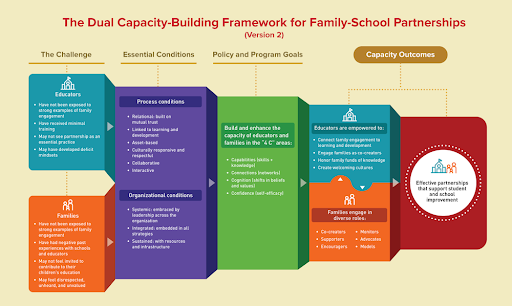
Dr. Mapp has spent her career working with educators and parents to cultivate partnerships between schools, families, and the community to support the best outcomes for our students. In 2019 she updated her Dual-Capacity Framework to better reflect the challenges faced by both educators and families and to give more direction on how we can work together in our schools.  

The framework contains four sections. Addressing all four can provide crucial support for strong family, school and community partnerships. Let’s go through each section briefly:

#1 – Challenges.  Dr. Mapp notes that before we talk about all the things that need to happen for successful partnerships we need to address the barriers and challenges that schools and parents face for family engagement.  

Barriers educators face include not having received much training in this area and, with the exception of very few, not seeing family engagement done well.  Parents’ challenges include not feeling welcomed on campus or having negative experiences with their own education that color their feelings towards a school setting.  

#2 – Essential Conditions. There are two different types of essential conditions; process and organizational conditions.  

Process conditions include things like having family engagement linked to student learning and making sure it is culturally responsive. Additionally, Dr. Mapp says that in the process category family engagement should be collaborative and interactive with a focus on building relationships. The organizational conditions that need to be met include family engagement being visible across the entire educational system meaning that family engagement needs to be supported by everyone from teachers to superintendents in order to be effective.  There must also be resources devoted to the program and it should be embedded in all aspects of education. 

#3 – Policy and Program Goals. There are “4 C” areas that Dr. Mapp feels must be met in the policy and program areas- Capabilities, Connections, Confidence, and Cognition.  

Capabilities include skills and knowledge. Schools need to understand the community they are working in and they need cultural competencies to be able to work with the families at their school. Parents need to have a better understanding of the educational system and strategies they can use at home to support learning.  

Connections are the important relationships and networks built on mutual trust and respect that need to be formed between parents and teachers, parents and parents, and the school and community.  

Both families and educators need confidence in working together. They need to have time to develop self-efficacy as they navigate this work and educators and parents of diverse backgrounds need to be encouraged to participate and be included in positions of leadership.  

Finally, cognition refers to families needing to see themselves as key partners in their child’s educational success. Schools need to be committed to working with all parents and see the value of including families in all aspects of the educational experience. 

#4 – Capacity Outcomes.  If we build up the capacity in our parents and educators then the real work of coming together to make improvements for our schools and our students can begin. Parents become supporters, advocates and co-creators at the school and educators create welcoming school cultures where families are encouraged to be co-creators and acknowledged for the skills and talents they bring to the campus. 

Our role as PTA leaders is to understand that schools and families need to work together.  We can use the Dual Capacity-Building Framework in our work with families and we can offer parent education to help parents understand how to navigate the education system or see how they can support their child at home. PTA programs can help to shift parents’ perspectives about school from negative to positive as we help them create positive interactions with teachers, administrators, and school staff at our events. 

To learn more about National PTA’s Transformative Family Engagement work, visit the Center for Family Engagement

Dr. Mapp, in collaboration with the Institute for Educational Leadership, has videos, graphics and lots of resources for anyone who is wanting to dive deeper into this. They can be accessed here:  https://www.dualcapacity.org/

Media Literacy: Should it be part of your school’s curriculum?

By Mary Perry, California State PTA Communications Commission

In the era before internet and social media news, we looked to a limited number of media sources (e.g. newspapers and magazines, TV networks, and radio broadcasts) for the facts and information that helped us understand the world. Right or wrong, for the most part we assumed those media were trustworthy. Or at least we all were familiar with the same basic set of facts. 

Young people today cannot make that assumption about their information sources, and neither can we. With hundreds of news sources available online, we as a group rarely share the same understanding of the news or even of basic facts. 

Thanks to cellphones, social media channels, and computers, the internet has become a constant part of how we work, how we play, how we connect with other people, and how we get information about the world. The same electronic media have also become  a constant part of our children’s lives. 

Experts increasingly agree that schools have a role to play in directly teaching young people about how to be literate and responsible consumers of information in this new media world. This blog is the first in a series from California State PTA that will explore how California’s education system and other organizations support teaching media literacy in schools, what more is needed, and how community members can help. 

PTA Leaders Say Media Literacy Should Be Part of Schooling

Leaders in the California State PTA Board of Managers who responded to a recent survey were nearly unanimous in saying it’s important for schools to provide specific instruction to students about media literacy and for adults to improve their media literacy as well.

Media Literacy refers to the abilities to access, analyze, evaluate, and communicate various media messages in a variety of forms. To teach those abilities in the classroom, instruction needs to cover a broad set of skills and dispositions. According to a recent research study by Common Sense Education, students should be “learning how to assess the credibility of online sources, understanding how and why media is produced, and reflecting on their responsibilities as thoughtful media creators and consumers.”

In November, 2021, the California State PTA Communications Commission surveyed our state leaders about the topic of media literacy. We received responses from 53 members of the Board of Managers and Board of Directors.

Three-quarters of those who answered said they agreed or strongly agreed with the statement: “Facts, data, and analysis are playing a diminishing role in our political and civic discourse.”

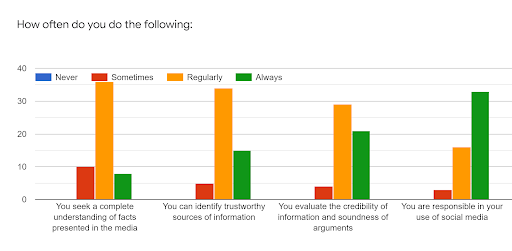
The respondents also reported on the types of media they personally use to get news. More than 80% said they regularly or always get their news from the internet. Compare that to just a third saying the same about print sources and radio, and about 40% saying they regularly or always use TV news and about 40% saying the same about social media. 

Acknowledging that this was a small survey and may not be generalizable to the state as a whole, their self-reporting on their own media habits provides some insights into how adults could strengthen their own media use of media and set an example for young people. The options on the survey were based on a project from RAND, called Truth Decay, that includes recommended standards for teaching media literacy.

|
Results of survey completed by CA State PTA Board of Managers, November 2021

Do schools teach media literacy now?

As is true with most questions about curriculum and instruction in California, the first response to that question is “it depends.” School districts, schools, and teachers differ in the importance they put on the topic of media literacy and their capacity to take up this area of instruction. Families also vary in their knowledge and capacity, but they are crucial because of the broad and deep influence they can have on media usage and expectations. 

With all of that said, in coming weeks this blog series will provide you with background and some answers to these three broad questions:

  • What state policies and expert research guide the teaching of media literacy? 
  • What resources are available to support schools, classroom teachers, and families in teaching our young people about media literacy?
  • What do we know about the extent to which this is happening in California schools and steps we can take to make it stronger?

If you, your family or your school has some answers to the media literacy challenge, or other questions you’d like to pose, drop us a line at communications@capta.org.

PTA Perspective on Federal Infrastructure Bill

By Dianna McDonald, California State PTA Advocate

New laws around Infrastructure, jobs, and climate change will impact California’s children and families. California is due to receive about $45 billion dollars from the federal Infrastructure Investment and Jobs Act, which became law in November of 2021. This will likely be for roads, bridges, and public transportation including California’s bullet train. There will also likely be several billion dollars set aside for improvements to our water system which is critical for our state.

The California State PTA urges our federal, state, and local governments to serve as role models for practices that promote energy conservation, alternative energy sources, reducing dependency on automobile travel, and encouraging sustainable practices. We believe that climate change is a children’s issue and  improving our transportation and water systems will have a long-term positive impact on the future of our children.

 A decision is still pending on the federal Build Back Better Act  which would fund a variety of services for children and families. National PTA has issued a formal statement urging passage of the measure.