Six Practical Tips on How to Advocate With Your Legislator or Elected Official

Para leer esta página en español, haga clic en el botón “Translate” en la esquina superior derecha de esta pantalla.

To view or download a PDF version of this document, click here.

1. Establish your agenda and goals.

  • Know what subject you are going to address. Don’t overload with issues – stick to no more than two or three.
  • Decide what you would like to get out of the visit, ie. a commitment to vote for your issue, leadership on the issue, or you may decide the visit is simply informational.
  • Allow time for small talk at the outset, but not too much. Remember, it’s your visit.

2. Listen well.

  • Much of lobbying is listening, looking for indications of the elected official’s views, and finding opportunities to provide good information.
  • Listening can allow you the opportunity to find areas of common ground on an issue.
  • If you are meeting with a “silent type,” draw her/him out by asking questions.
  • If you are confronted with a “long-winded type.’ Look for openings to bring her/him back to the point.

3. Be prepared, but don’t feel that you need to be an expert.

  • Most elected officials are generalists, like many of us. Do your homework, but don’t feel that you need to know every little detail of an issue. Air personal feelings and experiences where appropriate. Relate the concerns of your friends and members of the community.
  • Know when to admit “I don’t know,” and offer to follow up with the information.
  • Be open to counter-arguments, but don’t get stuck on them. Don’t be argumentative or confrontational.

4. Don’t stay too long.

  • Try to get closure on your issue. If you hear what you had hoped for, express your thanks and leave. If you reach an impasse, thank the legislator, even if disappointed, and say so. End the meeting and continue the discussion at another time.

5. Remember you are there to build a relationship.

  • If the elected official is good on an issue you’ve been involved in or has supported your position in the past, be sure to acknowledge your appreciation during the course of the visit.
  • If the opposite is true, think of the phrase, “No permanent friends, no permanent enemies.” Someday, on some issue of importance to you, they may come through. In the meantime, your visit may prevent the official from being an active opponent of your issue.

6. Follow-up is important.

  • Be sure to send a thank-you note after the visit. If commitments were made in the meeting, repeat your understanding of them. If staff members were present, write to them too. They can often be important allies.

E-Membership Webinar

Unit, Council and District leaders: California State PTA and representatives from TOTEM, our electronic membership system, hosted an informative webinar on Tuesday, January 19th, 2021 from 6:00-7:00 p.m.

Click here to watch a recording of this webinar.

As the pandemic continues, e-membership is more relevant now than ever, with most PTA functions happening virtually – including signing up new members! TOTEM makes joining PTA quick, easy and accessible to parents and families.

Please take the time to watch this webinar and learn how you can leverage all the great online features offered by TOTEM to support and grow your PTA’s membership in 2021

CHHSA Releases Master Plan for Early Learning and Care: California For All Kids

The California Health and Human Services Agency has released the Master Plan for Early Learning and Care: California For All Kids.

The Plan will help the state better understand the crisis families, children and early learning and care providers are facing amid the COVID-19 pandemic and identifies key policy goals to ensure that all California children can thrive physically, emotionally and educationally in their early years through access to high-quality early learning and care programs.

These goals include universal preschool, enhanced workforce development and equitable career pathways for educators and caregivers, and funding reforms to promote equitable access to high-quality early learning and care.

You can find get a quick overview of the plan and download the full report at https://californiaforallkids.chhs.ca.gov.

You can read the official press release here.

New English-to-Spanish Translation Feature on Website

Para leer este mensaje en español, desplácese hacia abajo en la página.

California State PTA is excited to announce that capta.org now offers English-to-Spanish translation*, using the Google Translate plug-in tool.

How to use it: Simply navigate to the page you want to translate, then click the “Translate” icon in the upper right corner and select “Spanish.” When the page automatically reloads, it will be all Spanish! No need to do this on every page you navigate to, but you can always toggle back to English if you’d like, using the same procedure.

We think this tool will make our website more accessible to the thousands of PTA members who primarily communicate in Spanish. Of course, Google Translate is not 100% perfect, but it comes pretty close!

Make sure you use the right web browser: The translation feature is only visible by navigating to capta.org using one of the following web browser versions:

  1. Microsoft Edge, Version 84.0.522.40
  2. Google Chrome, Version 84.0.4147.89
  3. Firefox, Version 7.8.0.2

* PDF documents on the website are not translated by this tool

Nueva función de traducción del inglés al español en el sitio web

La PTA del Estado de California se complace en anunciar que capta.org ahora ofrece traducción del inglés al español *, utilizando un sistema de Google Translate.

Cómo se usa: simplemente navega hasta la página que deseas traducir, luego haz clic en el ícono “Translate” en la esquina superior derecha y selecciona “Spanish”. Cuando la página se recargue automáticamente, ¡todo estará en español! No es necesario hacer esto en cada página a la que navega, pero siempre puede volver al inglés si lo desea, utilizando el mismo procedimiento.

Creemos que esta función hará que nuestro sitio web sea más accesible para aquellos de ustedes que se comunican principalmente en español. Por supuesto, Google Translate no es 100% perfecto, ¡pero se acerca bastante!

Asegúrese de usar el navegador web correcto: La función de traducción solo es visible al navegar a capta.org usando una de las siguientes versiones del navegador web:

  1. Microsoft Edge, versión 84.0.522.40
  2. Google Chrome, versión 84.0.4147.89
  3. Firefox, versión 7.8.0.2

* Esta funcion no traduce los documentos PDF del sitio web

Convention Attendees Can Now Download the App!

Stay up to date during Convention 2022 with information on: general meetings, workshops, exhibitors, convention surveys, games, and more!

Scan the QR code below to download the app.

General Instructions:

  • Click the link: https://event.crowdcompass.com/capta2022
  • You will be directed to install the CrowdCompass App
  • Search event California State PTA Convention 2022
  • Login: First name, Last name, Email
  • You will receive a verification code by text or email
  • Enter the verification code
  • Read and accept policies
  • Enter your Organization, Title, Picture and complete the download

State Board of Education Approves Shorter Standardized Tests to Give Schools Flexibility Amidst COVID-19 Uncertainties

The following November 6 press release is from the California Department of Education:

SACRAMENTO — The State Board of Education on Thursday unanimously approved the use of shorter standardized tests in English language arts and math this spring, creating a path for collecting critical student data amidst COVID-19 uncertainties.

The Board’s action also recognizes the need for innovative solutions to support students, schools and districts as they confront myriad challenges associated with the pandemic.

“Our schools and educators need flexibility, options, and ongoing support as they continue to navigate tremendous challenges and collect data across multiple measures to fully understand student learning,” said State Superintendent of Public Instruction Tony Thurmond.

Like other states, California is required by the federal Every Student Succeeds Act to assess student learning as a condition of receiving certain federal funds. In a letter to state education chiefs, the U.S. Department of Education indicated they would not currently consider a waiver and that states should prepare to administer tests in the spring.

The State Board’s approval of shorter Smarter Balanced assessments in English language arts and math for grades 3–8 and 11 reflects California’s commitment to supporting schools by providing testing options.

The shorter assessments will reduce student testing time, which now takes from seven to eight hours in total. Guidance regarding test administration will include flexible options to meet the unique contexts of each district or school.

The tests will cover all academic standards, which describe what students should know and be able to do at each grade level. Spring testing will provide the first statewide snapshot of the impact of COVID-19 on student learning.

“Because we have been supporting and encouraging districts to use formative and diagnostic assessments this fall, schools will have data to guide individual student learning. Meanwhile, a shorter summative test can provide a more manageable way to offer district and state-level information in these unpredictable times,” said State Board President Linda Darling-Hammond.

Now that the shorter tests are approved, CDE will work closely with districts and charter schools to strategize test administration, ensure student participation, and communicate with families.

Click here to read this press release on the CDE website.

Virtual School Smarts Program Launch Meeting – Nov. 20

Join us via Zoom on Friday, November 20 from 3-4:00 p.m. to learn more about the award-winning School Smarts Parent Engagement Program’s transformation to a virtual environment.

For the past 10 years School Smarts has inspired more than 10,000 parents to more deeply engage in their child’s school experience.

The seven-session School Smarts program provides training and knowledge to help parents understand how they play an integral role in their student’s educational outcomes. Each session offers opportunities for participants to share their own experiences, ask questions, and consider how they can take a more active role in their child’s education.

School Smarts graduates are able to:

  • Explain why parent involvement matters so much
  • Identify ways to prepare their child for a successful high school experience to support college and career possibilities
  • Summarize ways to learn how their child is doing in school
  • Describe how to cultivate relationships with the school board, principal, teachers and staff
  • Share how to prepare for a successful parent-teacher conference
  • State different ways to practice leadership within a school community
  • And, much, much more!

This Zoom meeting offers the opportunity to check out the School Smarts program for yourself, and find out how to bring the program to the families in your school community.

Click here to register today: https://zoom.us/meeting/register/tJ0tcuGorTopGdMZpgcZRQCfDZi0xNjGnbtO

October 29 Webinar: “Arts Education in the New Normal: Essential Resources for Right Now”

UPDATE: To watch a recording of this webinar, click here.
Join us for an interactive webinar on Thursday, October 29 at 4:30 pm in which California State PTA and our partner agencies will discuss the newest resources and essential information about arts education in the new landscape of distance learning.
Participants will be the first to access the newly revised Parent Guide to the new Arts Standards!
Featured speakers include:
  • Erin Jenks, California State PTA
  • Sarah Anderberg, California County Superintendents Educational Services Association
  • Letty Kraus, California Department of Education
  • Aaron Bryan, Fresno County Superintendents Office
  • Pat Wayne, Create CA

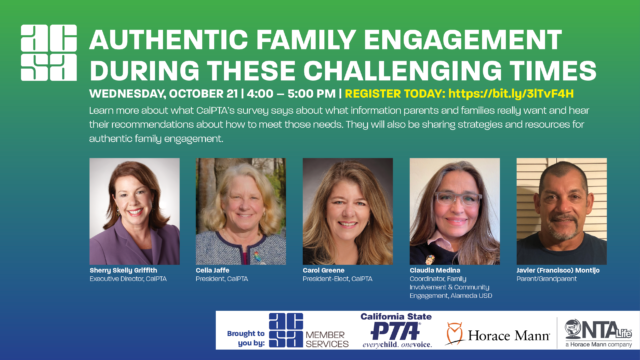
Attend the ACSA/PTA Family Engagement Webinar on October 21

Please join us on October 21 from 4:00-5:00 pm for a webinar about communication and family engagement strategies and resources during the pandemic.

This webinar is being co-hosted by California State PTA and the Association of California School Administrators (ASCA), and panelists will include:

  • Celia Jaffe, President of California State PTA
  • Carol Green, President-Elect of California State PTA
  • Javier Montijo, PTA Ninth District
  • Lisa Borrego, San Juan Unified School District
  • Claudia Medina, Alameda Unified School District

Click here to register: https://us02web.zoom.us/webinar/register/WN_SgqVDjyiQROvno0zq77CpQ

State Superintendent Launches New “Education to End Hate” Initiative to Combat Bias, Bigotry, and Racism

The following press release is from the California Department of Education:

SACRAMENTO — On September 21 State Superintendent of Public Instruction Tony Thurmond announced a new, multifaceted “Education to End Hate” initiative designed to empower educators and students to confront the hate, bigotry, and racism rising in communities across the state and nation. Under a new effort outlined during a virtual press conference, the State Superintendent said that the California Department of Education (CDE) will lead a series of strategies—including educator training grants, partnerships with community leaders, and virtual classroom sessions—that leverage the power of education to create a more just society.

“We do not need any more evidence that our country is facing two pandemics: coronavirus and hate. It feels like every day we are seeing heartbreaking examples: more anti-Semitic behavior, bullying of Asian American students because of our President’s rhetoric, Islamophobia, discrimination of our LGBTQ neighbors, and violence directed at people of color,” Thurmond said. “It’s time to double down on our efforts to combat all forms of hate, bias, and bigotry. By digging deeper into the complexities of our diverse and difficult histories—not denying or ignoring them—I believe education can provide the pathway to healing, understanding, and racial and social justice.”

The State Superintendent’s “Education to End Hate” initiative has three components:

Educator training grants: The CDE will award up to $200,000 in mini-grants to local educational agencies (LEAs) to support educator training in the areas of anti-racism and bias. The grants will be funded by contributions from an ongoing philanthropic partner, the S. D.  Bechtel, Jr. Foundation. Organizations with extensive experience in leading related educator trainings—including Equality California, the National Equity Project, and the Simon Weisenthal Center’s Museum of Tolerance— have already agreed to partner and offer professional development and resources through this program. More details on grant guidelines and the application process will be released to school districts soon.

“The Simon Wiesenthal Center is the preeminent organization fighting anti-semitism, bigotry, and hate globally. Its Museum of Tolerance (MOT) is a proud and trusted partner to schools throughout California in advancing anti-bias education, inclusion, and equity through unique professional development programs and educator resources,” said Rabbi Meyer H. Hay, Executive Director of the Simon Wiesenthal Center and Museum of Tolerance. “Committed to confronting hate and promoting human dignity and respect for all, the MOT has also adapted its experiential content for virtual programs for educators, students and parents.”

Virtual Classroom Series: Throughout the month of October, the CDE will host a series of virtual classroom sessions broadcast live throughout the state that will be designed to engage students, educators, and families in a wide-ranging dialogue about the many forms of bias young people across California face—and ways schools can lead efforts to end discrimination.

Roundtable with leaders: In the coming days, the State Superintendent will convene a public roundtable discussion among leaders from prominent racial and social justice organizations, educators, and state lawmakers to brainstorm additional ideas for ways schools can influence the change necessary to ensure a physically and emotionally safe learning environment that is inclusive for all students.

Several lawmakers, who have each worked on multiple fronts to advance equity, on Monday expressed their commitment to supporting this initiative, including:

  • Senator Connie M. Leyva (D-Chino), Chair of the Senate Education Committee
  • Senator Scott Wiener (D-San Francisco), Chair of the California Legislative LGBTQ Caucus
  • Assemblymember David Chiu (D-San Francisco), Chair of the California Asian Pacific Islander Legislative Caucus
  • Assemblymember Lorena Gonzalez (D-San Diego), Chair of the California Latino Legislative Caucus
  • Assemblymember Monique Limón (D-Santa Barbara), Vice Chair of the California Legislative Women’s Caucus

“Sometimes in our darkest hour is when we do our best work. We know that racism and hate are taught, and we know that children are born loving everyone. You learn what you live, and unfortunately racism and hate are still being taught in living rooms across the state of California and across this country,” Senator Leyva said. “If we learn about each other, the hope is that we won’t hate each other. The hope is that we will know that we have more in common than not. I want to thank State Superintendent Thurmond for always taking on these big issues.”

“In a time when President Trump is attempting to convince Americans that discussing issues like race, gender, and sexual orientation are counterproductive to American ideals, California must take a stand,” Senator Wiener said. “Education is critical in combating hate and bias against LGBTQ people. I am proud to see that California is once again leading the fight against hate.”

“The pandemic brought with it a rise in hate against Asian Americans. We have seen this happen in other moments of national crisis and that’s why I have worked on policies to address bullying and discrimination faced by our students,” Assemblymember Chiu said. “The additional resources and strategies that Superintendent Thurmond has announced today will help ensure that our schools continue to be a safe place to learn.”

“We know our children face racism and bigotry in their lives. Classrooms should serve as safe learning environments that allow students to process and understand these difficult experiences,” Assemblymember Gonzalez said. “Superintendent Thurmond’s initiative will help ensure students, parents, and teachers are prepared with the tools they need to confront racism, bigotry, and hate-based violence and to facilitate honest conversations about the realities students are facing every day.”

“Hate, bigotry, and racism should never be a part of our schools. As children continue their education during a challenging time, we must ensure their well-being is protected,” Assemblymember Limón said. “I applaud the efforts of the CDE and State Superintendent Thurmond to continue prioritizing and taking action on this issue.”

An archived broadcast of the full press conference can be viewed on the CDE’s Facebook page.

Click here to read this press release on the CDE website.