National PTA Reflections Results for 2020-21

By the Reflections Committee

A total of 13 students from California received recognition for their creative accomplishments from the National PTA Reflections program. You can see a list of all the 2020-21 California Reflections awards here.

National PTA Reflections – Outstanding Interpretation
Mark Wagner
Dance Choreography – Special Artist Division
Dana Hills High School, Fourth District PTA
“I Speak With My Dancing”

Artist Statement: I matter because I am different. I speak with my dancing.

National PTA Reflections – Award of Excellence
Hailey Johnston
Film Production – Middle School Division
Nick G. Parras Middle School, Thirty-Third District PTA
“I Matter Because I’m Me”

Artist Statement: I Matter Because is a question you ask yourself all the time but you don’t have to have a reason. You matter because you are you and THAT is what matters.

National PTA Reflections – Award of Excellence
Gabriela Korszyk
Film Production – Special Artist Division
Covina High School, First District PTA
“Meant to Be”

Artist Statement: I matter because I am worth it. God doesn’t make mistakes. I am handicapped but I’m surrounded by loving people and I’m grateful for it. I’m meant to be.
National PTA Reflections – Award of Excellence
Eva Whittemore
Literature – Primary Division
Dixie Canyon Elementary School, Thirty-First District PTA
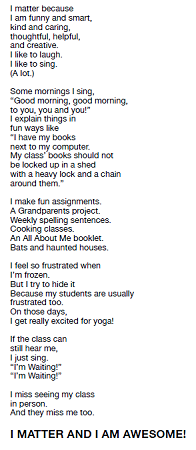
“Things My Teacher Should Tell Herself”

Artist Statement: Everybody knows that teachers matter, but teachers may not know how much they matter. I named my poem “Things My Teacher Should Tell Herself” because it’s hard to do school over zoom and some of the work is hard to do alone. My teacher should tell herself that she’s doing her best.


National PTA Reflections – Award of Excellence
Amira Olin
Literature – Middle School Division
Walter Reed Middle School, Thirty-First District PTA
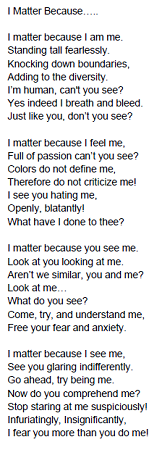
“Equity, Equality, Discord and Disunity”

Artist Statement: This poem expresses the importance of not allowing race, color, image, gender and other differences separate or hinder us individually and as a group. It urges us to speak up and standup for what is right or what we believe in. We should all strive for equality, inclusivity and equity for a better society because we are all of one world. I matter because I represent society in a world full of disparity. I matter because I exist. I matter because we matter!



National PTA Reflections – Award of Excellence
Lukas Shen
Photography – Middle School Division
Foothills Middle School, First District PTA
“Mitakuye Oyasin”

Artist Statement: Mitakuye Oyasin is a phrase from the Lakota language that my dad introduced me to. It means “we are all related”. I was looking through a photography magazine, and I saw a picture of a Native American with war paint. I created a graphic of different colored lines, each representing a different ethnicity. With a black background behind me, I projected the graphic on my face and used a remote to take this self portrait. We’re all related because all ethnicities make up the human race.

 

National PTA Reflections – Award of Excellence
Kotaro Fujita
Photography – Special Artist Division
South High School, Thirty-Third District PTA
“Because I am a Japanese American”

Artist Statement: This family photo of my parents, sister and my hand. My parents came from Japan 30 years ago. I was born in the United States. I love both America and Japan. I want to be a bridge between the two Countries.


National PTA Reflections – Award of Merit
Islelamia Bruner
Dance Choreography – Middle School Division
Mountainview Elementary School, Thirty-Fourth District PTA
“Freedom”

Artist Statement: I Matter Because this year has been a struggle for my culture. The Hate that we are given, has torn me apart. I just want this dance to let people know that we won’t go silent until our voices are heard. Let this dance give a message of where we have come from and we have always stood for Freedom. All lives do matter, but we are not added to that equation all the time. We won’t go silent.

National PTA Reflections – Award of Merit
Alice Finkelstein
Dance Choreography – High School Division
Carlmont High School, Seventeenth District PTA
“United Existence”

Artist Statement: In this piece, I express my place in this world and how I come to realize that I matter. At first, I do not understand the role that I have, but then suddenly, I become aware that everyone in this world is interconnected: we rely on each other for help and support, and everyone is capable of making others feel loved, appreciated, and significant. This is the manifestation of why I matter, and why everyone else in this world does. I matter because I have the power to make others matter. Together, we have the power to transform our world.

National PTA Reflections – Award of Merit
Namya Jha
Film Production – Primary Division
Foster City Elementary School, Seventeenth District PTA

Artist Statement: I made this movie based on the topic – “I matter because……”. It was such a fun to do it with my family (my Mom and Dad gave the voices for Mumma and Daddy Dogs 😀 ). It was pretty hard work to write story, script, dialogues and finally recording, editing, setting up background music and images but I enjoyed it a a lot.

National PTA Reflections – Award of Merit
Alexandra (Jordan) Schneider
Film Production – High School Division
Laguna Beach High School, Fourth District PTA
“Each Player Matters”

Artist Statement: The year 2020 has presented many adversities and tremendous amounts of change. My work presents that each player matters within a team. I chose to display my teammates to show that their actions impact the team significantly. Hence, their efforts have affected me for the better, helping me stay motivated despite the changes.

National PTA Reflections – Award of Merit
Sivaluxmy Sivalogeswaran
Music Composition – Primary Division
Northwood Elementary School, Sixth District PTA
“You know that I matter for everything”

Artist Statement: This year, the number of natural disasters has increased in the US. I live in San Jose, California. I experienced earthquake, wild fire, air pollution, and global warming. I am not able leave my house because of Covid-19 and smoke from the wildfire. But, staying inside my house is also not safe when there is an earthquake. I am a little girl I have lots of dreams. When I grow up I will invent new technologies to solve all these problems to make this world a safe place for all. Therefore, I matter to this world now more than ever.



National PTA Reflections – Award of Merit
Ellie Lam
Music Composition – Intermediate Division
Longden Avenue Elementary School, First District PTA
“A Ripple of Kindness”

Artist Statement: I matter because I make a difference to the world by smiling, caring for others, and showing them kindness. This is especially important during the pandemic, where a lot of people are losing their jobs and loved ones. Smiling, caring for others, and showing kindness can make a person feel better about themselves throughout the day. By showing others you care, that person will in return pay it forward to others, creating a ripple effect and making the world better. I wrote this song to dedicate it to those who lost their jobs and loved ones.

Are you feeling engaged with your school site?

Family Engagement is at the heart of what we do in PTA — but do you feel like you are running out of ideas for good programming? The Family Engagement Commission is hosting a workshop that will help you with just that at our 122nd Annual Convention. This is a great chance to hear about great practices from across the state and to share what you have done at your school with others.
Title of Presentation: Are you feeling engaged with your school site?

Brief Description: An opportunity to hear from Lisa Borrego, who works for the California Department of Education about various Family Engagement programs from different school districts across California. It will be an interactive workshop with lots of discussion and idea-sharing in the Q & As.

Three Takeaways:

  • Will have a better understanding of Family Engagement across California
  • To have insight of what is Authentic Family Engagement.
  • How to implement best practices at your school site.

Presenters: Lisa Borrego, CDE; Deborah Johnson, California State PTA Family Engagement Commission Vice-President; Nha-Nghi Nguyen, California State PTA Family Engagement Commission Vice-Chair

If you haven’t already, click here to register for Convention 2021.

To return to the blog homepage, click here.

Screenagers NEXT CHAPTER: Uncovering Skills For Stress Resilience

The Family Engagement Commission is excited to share a little teaser about its upcoming Convention workshop. You won’t want to miss the showing of the documentary “Screenagers NEXT CHAPTER,” as well as the discussion that happens afterward!

Title of Presentation: Screenagers NEXT CHAPTER: Uncovering Skills For Stress Resilience

Brief Description: An opportunity to examine the science behind teens’ emotional challenges, the interplay of social media, and most importantly, what can be done in our schools and homes to help them build crucial skills to navigate stress, anxiety, and depression in our digital age. It will be a workshop with lots of discussion in the Q & As.

Three Takeaways:

  • Will have a better understanding of teens’ social and emotional challenges
  • To have insight of can be done in our schools and homes to help build crucial skills to navigate social and emotional challenges.
  • How the interplay of social media impacts the social and emotional challenges.

Presenters: Lisa Tabb, Co-Producer “Screenagers” and “Screenagers NEXT CHAPTER: Undercovering Skills For Stress Resilience”; Deborah Johnson, California State PTA Family Engagement Commission Vice-President; Nha-Nghi Nguyen, California State PTA Family Engagement Commission Vice-Chair

If you haven’t already, click here to register for Convention 2021.

To return to the blog homepage, click here.

It’s Time for a Renewed Focus on the Old LCAP

This article was written by Kathleen Fay, member of the California State PTA Legislation Team.
A school district’s Local Control and Accountability Plan (LCAP) is an important tool that requires a district to identify goals, address priorities, allocate funds, implement actions, provide services, and measure results to improve student outcomes. The annual LCAP review should provide opportunities for robust parent involvement as a fundamental part of the planning process.  However, this LCAP process was turned on its head last year with the onset of the COVID-19 pandemic.

Quarantines and school closures necessitated changes in the usual LCAP planning process. First, an Executive Order extended LCAP deadlines, then legislation eliminated the annual LCAP update altogether. Taking its place was the Learning Continuity and Attendance Plan – by no coincidence also abbreviated as LCAP – to be used as a planning tool to address issues of distance learning, live student interactions, and attendance. The “new LCAP” included strategies to ensure a full curriculum, train staff, and address resources and technical support during the crisis. And it was all to have been put together with parent input and reported publicly.

As California now looks (hopefully) towards a post-pandemic school year, districts must return to the original LCAP model to examine how students were supported throughout the pandemic, what was done to mitigate the impact of COVID-19, and consider the effects of issues such as pupil learning loss; student and staff mental health and social-emotional well-being; pupil engagement and outreach; nutrition; learning continuity; attendance; infrastructure needs; and any ongoing response to COVID-19.

In short, it’s time for school districts to take an honest look at the results of the last year and then make practical plans on how to repair any damage. This is something that PTAs should strongly encourage members to take part in – through multiple public input opportunities. These meetings should be open to input from all parents and community members. It is up to us to speak for every child with one voice.

To return to the blog homepage, click here.

School Reopening Advocacy: What Can Your PTA Do?

This article was written by Shereen Walter, California State PTA’s Director of Legislation.

Now that the Governor and Legislature have come to agreement on the details surrounding the $2 billion to incentivize schools to reopen for in person learning, what can you as a PTA do?

First of all, remember that your PTA represents ALL parents – those who want their kids to return to school, those who are more cautious and those who are not ready for their children to return to school full time. You need to be speaking for “Every Child, One Voice.”

Stick to the PTA talking points outlined in the two California State PTA documents:

Some of the issues surrounding school reopening that you can advocate for are:

  • Parent Communication and Input – School Districts must prioritize strong two-way communication with parents as they prepare and execute reopening plans. The voices of parents representing the diversity of the community need to be included in decision making.
  • In-Person Attendance – Parents should be able to choose whether their child returns to school in-person depending on the health of the child and their family situation.
  • Mental Health Is Important – Schools must provide adequate resources to meet the mental health needs of students and staff to support their individual needs.
  • Expanded Learning and Learning Loss – Parents should be providing input into the types of programs needed to address learning loss and that also meet the social emotional needs of the whole child. School districts are developing their plans now to address learning loss caused by the pandemic, including after-school, summer, and child-care programs.
  • Realistic Timeline – Schools need to open as soon as practically possible while protecting the health and well-being of students, staff and families.
  • Technology Access – All students who continue on a hybrid or distance learning model need to have appropriate Wi-Fi and a computer or laptop so that they can adequately access remote learning.

…and now for a few cautions.

  1. Offer quotes to the media in writing. This prevents you being quoted out of context, incorrectly, or from accidentally stating your personal opinion rather than the stance of PTA.
  2. Stick to PTA talking points on the social media accounts of PTA.
  3. Opinion pieces can only be written with the approval of your executive board and must contain only PTA positions.
  4. PTA leaders can not use their PTA title or affiliation in speaking in opposition to a PTA position.

Last of all, PTA must remain neutral in a dispute arising from school employer-employee negotiations. For more detailed information, see this webpage.

To return to the blog homepage, click here.

March 31st is National Crayon Day

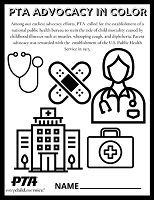
Take some time with the family today to celebrate both National Crayon Day and the end of Arts Education Month. Our Communications Commission created these coloring sheets that highlight PTA’s advocacy efforts over the years — enjoy coloring them with the family or your PTA unit.

              
PDF version                         PDF version                  PDF version                  PDF version                 PDF version                PDF version


To return to the blog homepage, click here.


Preventing School Absenteeism: What Parents Need to Know

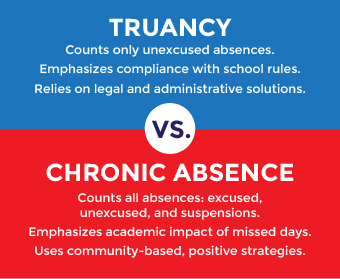
Chronic absence is defined as missing 10 percent or greater of the total number of days enrolled during the school year for any reason. It includes both excused, unexcused, out-of-school suspensions, and in-school suspensions that last more than one-half of the school day.
Chronic absenteeism means missing too much school—for any reason—excused or unexcused. Experts and a growing number of states define chronic absenteeism as missing 10% (or around 18 days) during a school year).

Students are chronically absent for many reasons. There are some reasons for absenteeism that cannot be avoided. Life happens. Common illness causing high fevers and fatigue happen. But, if your child is missing many days of school, or a few days every single month, it’s important to consider the reason for the absenteeism.

  • A nationwide study found that kids with ADHD, autism, or developmental delays are twice as likely to be chronically absent compared to kids without these conditions.
  • Children with common chronic illnesses, such as asthma and type 1 diabetes, miss more school when they are having more symptoms.
  • Mental health conditions, like anxiety or depression, are common reasons for absences.
  • Up to 5% of children have school-related anxiety and may create reasons why they should not go or outright refuse to attend school.

Add it all up, and this creates a lot of empty desks and missed school time.

Missing just two days a month of school―for any reason― can be a problem for kids in a number of ways. Children who are chronically absent in kindergarten and first grade are less likely to read on grade level by the third grade. For older students, being chronically absent is strongly associated with failing at school―even more than low grades or test scores. When absences add up, these students are more likely to be suspended and drop out of high school. Chronic absenteeism is also linked with teen substance use, as well as poor health as adults.

10 PRACTICAL TIPS TO GETTING YOUR CHILD TO SCHOOL ON TIME, EVERY DAY

  1. Set attendance goals with your child and track your child’s attendance on a calendar. Try offering small rewards for not missing any school, such as a later bedtime on weekends.
  2. Help your child get a good night’s sleep. A lack of sleep is associated with lower school achievement starting in middle school, as well as higher numbers of missed school and tardiness. Most younger children need 10-12 hours per night and adolescents (13-18 years of age) need 8-10 hours per night.
  3. Prep the night before to streamline your morning. Lay out your child’s clothes. Pack backpacks and lunches. Develop back-up plans for getting to school if something comes up like a missed bus or an early meeting. Have a family member, a neighbor, or another trusted adult on standby to take your child to school should you ever need help.
  4. Try to schedule dental or medical appointments before or after school hours. If children have to miss school for medical appointments, have them return immediately afterward so they do not miss the entire day.
  5. Schedule extended trips during school breaks. This helps your child stay caught up in school learning and sets the expectation for your child to be in school during the school year. Even in elementary school, missing a week of classes can set your child behind on learning.
  6. Don’t let your child stay home unless he or she is truly sick. Reasons to keep your child home from school include a temperature greater than 101 degrees, vomiting, diarrhea, a hacking cough, or a toothache. Keep in mind, complaints of frequent stomachaches or headaches can be a sign of anxiety and may not be a reason to stay home.
  7. Talk with your child about the reasons why he or she does not want to go to school. School-related anxiety can lead to school avoidance. Talk to your child about their symptoms and try to get them to talk about any emotional struggles they may have with issues like bullying, fear of failure, or actual physical harm. If you are concerned about your child’s mental health, talk with your pediatrician, your child’s teacher, or school counselor.
  8. If your child has a chronic health issue such as asthma, allergies, or seizures, talk with your pediatrician about developing a school action plan. Meet with and get to know the nurse at your child’s school. If you need guidance and documentation for an Individualized Education Program (IEP) or 504 Plan, ask for your pediatrician’s help accessing services at school.
  9. Follow the rules. Be sure you know what your school’s requirements are for when your child will be absent or late. If you are supposed to call, email, or provide a doctor’s note after a certain number of days out, then do it.
  10. Keep track of your child’s attendance and investigate reasons when the days missed add up. Look into why your child is absent. Think about your child’s mood. Have they been spending time by themself lately? Is their chronic condition starting to be more problematic?

For more information: https://www.healthychildren.org/English/ages-stages/gradeschool/school/Pages/School-Attendance-Truancy-Chronic-Absenteeism.aspx

National Eating Disorders Awareness Week

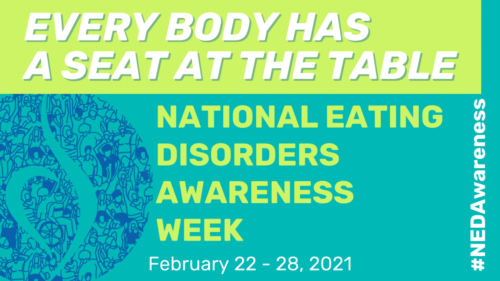
The goal of National Eating Disorders Awareness Week (#NEDAwareness) is to shine the spotlight on eating disorders by educating the public, spreading a message of hope, and putting lifesaving resources into the hands of those in need.
Every Body Has a Seat at the Table. In a field where marginalized communities continue to be underrepresented, conversations on raising awareness, challenging systemic biases, and sharing stories from all backgrounds and experiences are welcomed.

For more information and to build a movement to raise awareness and support those affected by eating disorders, visit https://www.nationaleatingdisorders.org/get-involved/nedawareness

###

What Are Eating Disorders?

Eating disorders are mental health conditions marked by an obsession with food or body shape.  They can affect anyone but are most prevalent among young women.

What Causes Eating Disorders?

Eating disorders may be caused by several factors including genetics, brain biology, personality traits, and cultural ideals.

  • One factor is genetics. Twin and adoption studies involving twins who were separated at birth and adopted by different families provide some evidence that eating disorders may be hereditary. This type of research has generally shown that if one twin develops an eating disorder, the other has a 50% likelihood of developing one too.
  • Personality traits are another cause. In particular, neuroticism, perfectionism, and impulsivity are three personality traits often linked to a higher risk of developing an eating disorder.
  • Other potential causes include perceived pressures to be thin, cultural preferences for thinness, and exposure to media promoting such ideals. Certain eating disorders appear to be mostly nonexistent in cultures that haven’t been exposed to Western ideals of thinness.
  • More recently, experts have proposed that differences in brain structure and biology may also play a role in the development of eating disorders.

Neuroticism: Defined as a tendency toward anxiety, depression, self-doubt, and other negative feelings.

Perfectionism: Defined as the need to be or appear to be perfect, or even to believe that it’s possible to achieve perfection. It is typically viewed as a positive trait rather than a flaw

Impulsivity: Defined as a tendency to act on a whim, displaying behavior characterized by little or no forethought, reflection, or consideration of the consequences.

https://www.healthline.com/nutrition/common-eating-disorders

Common Types of Eating Disorders and their Symptoms

Anorexia Nervosa

People with anorexia nervosa may limit their food intake or compensate for it through various purging behaviors. They have an intense fear of gaining weight, even when severely underweight.  Many people with anorexia are often preoccupied with constant thoughts about food, and some may obsessively collect recipes or hoard food.

Obsessive-Compulsive Disorder

Obsessive-compulsive disorder (OCD) is a chronic mental health condition characterized by obsessions which lead to compulsive behaviors. People often double check to make sure they’ve locked the front door or always wear their lucky socks on game days.  OCD goes beyond double checking something or practicing a game day ritual.  Someone diagnosed with OCD feels compelled to act out certain rituals repeatedly, even if they don’t want to — and even if it complicates their life unnecessarily.

Bulimia Nervosa

People with bulimia nervosa eat large amounts of food in short periods of time, then purge. They fear gaining weight despite being at a normal weight.  Bulimia tends to develop during adolescence and early adulthood and appears to be less common among men than women.

Binge Eating Disorder

People with binge eating disorder regularly and uncontrollably consume large amounts of food in short periods of time.  Unlike people with other eating disorders, they do not purge.

Binge eating disorder is believed to be one of the most common eating disorders, especially in the United States.  It typically begins during adolescence and early adulthood, although it can develop later on.  Individuals with this disorder have symptoms similar to those of bulimia or the binge eating subtype of anorexia.

Pica

Individuals with pica tend to crave and eat non-food substances. This disorder may particularly affect children, pregnant women, and individuals with mental disabilities.  Individuals with pica crave non-food substances, such as ice, dirt, soil, chalk, soap, paper, hair, cloth, wool, pebbles, laundry detergent, or cornstarch.  Individuals with pica may be at an increased risk of poisoning, infections, gut injuries, and nutritional deficiencies.  Depending on the substances ingested, pica may be fatal.

Rumination Disorder

Rumination disorder can affect people at all stages of life.  People with the condition generally regurgitate the food they’ve recently swallowed.  Then, they chew it again and either swallow it or spit it out.  This disorder can develop during infancy, childhood, or adulthood. In infants, it tends to develop between 3–12 months of age and often disappears on its own. Children and adults with the condition usually require therapy to resolve it.

Avoidant/Restrictive Food Intake Disorder

Avoidant/Restrictive Food Intake Disorder (ARFID) is an eating disorder that causes people to undereat.  This is either due to a lack of interest in food or an intense distaste for how certain foods look, smell, or taste.   Although ARFID generally develops during infancy or early childhood, it can persist into adulthood. What’s more, it’s equally common among men and women. Individuals with this disorder experience disturbed eating either due to a lack of interest in eating or distaste for certain smells, tastes, colors, textures, or temperatures.

Purging disorder

Individuals with purging disorder often use purging behaviors, such as vomiting, laxatives, diuretics, or excessive exercising, to control their weight or shape. However, they do not binge.

 Night eating syndrome

Individuals with this syndrome frequently eat excessively, often after awakening from sleep.

For more information on eating disorders:

https://www.healthline.com/health/ocd/social-signs#ocpd-vs-ocd

https://www.nimh.nih.gov/health/topics/eating-disorders/index.shtml

https://www.nationaleatingdisorders.org/help-support/contact-helpline

https://www.psychiatry.org/patients-families/eating-disorders/what-are-eating-disorders

Leg Con 2021 Wrap-Up: Bringing Equity to California Public Schools

This article was written by Kitty Cahalan, President of Blair School PTSA in Pasadena (First District)

“A Path to Equity” was the focus of this year’s Legislation Conference, which I attended as a local PTA leader and advocate, but also as the parent of two public high school students. Bringing equity to California public schools has long challenged our educational leaders, and the pandemic has highlighted vast inequities in the system and left millions of California students more disadvantaged than ever. From access to mental health care and meals to the widening of a vast digital divide, the conference underscored that the prospect of getting students back on track is daunting. Far from being pessimistic, however, the conference presented information and opportunities that we as parents and PTA advocates can use to disrupt ineffective old practices and bring public education into a new era in which all are included and empowered, and in which the needs of all are seen and addressed.

State Superintendent Tony Thurmond opened the conference and focused on restorative justice and increased digital access and literacy as examples of measures needed at the state level to increase inclusiveness and access for all students. President Celia Jaffe shared CAPTA’s ten recommendations for the timely and safe reopening of schools. Director of Legislation Shereen Walter shared CAPTA’s legislative agenda and the critical need for “our collective voices to influence legislation and the state budget to improve equity, access, and opportunity for all of California’s children.” Then, National PTA President-Elect Anna King shared her personal stories of witnessing how racial and economic inequities affected her own children, injustices which led directly to her involvement in PTA and her work to bring a collective voice on behalf of all children to our nation’s leaders and educational decision-makers. This was a powerful start to the conference.

Equity best practices were discussed in sessions about equity in the arts, community schools, and schools as incubators for democracy.

  • Tom DeCaigny, California Alliance for Arts Education, stated that even though the arts are shown to be effective for development of motor skills, a powerful educational tool for students with disabilities, and are mandated by the state, arts education implementation continues to fall short in districts throughout the state. DeCaigny identified PTA as a key messenger and urged coordinated messaging for the arts, especially during remote learning.
  • Michael Essien, a middle school principal, shared how adherence to the school’s North Stars – whole child, student voice, belonging and rigorous education – combined with ongoing staff training in implicit bias, as well as community partners to bring tiered interventions to students, helped the school meet students and their families where they are. When students feel healthy, safe, and included, he said, they will be ready to learn.
  • John Rogers, UCLA’s Institute for Democracy, Education, and Access (IDEA) examined mission statements and LCAPs from districts across the state, looking for indicators that districts consider themselves responsible for the civic education of their students, and found very few districts include keywords such as “democracy” and “civic participation.” Rogers encouraged participants to consider their school districts’ role in furthering democracy and to encourage students to learn how to participate in their communities’ civic lives.

Each of these speakers gave clear, actionable information for the advocates in attendance to use to further the call for equity.

The news on the budget front was encouraging, as California has an unexpected budget surplus. Budget experts discussed the state government’s priorities: addressing the digital divide, helping students who have been the most affected by the pandemic catch up, and providing for an increase in mental health services. Many of these allocations will come in the form of one-time funds and will challenge districts to rapidly deploy services to our most at-risk students. Assembly Speaker Anthony Rendon, pushing for the additional revenue to go to education, especially early childhood education. He said that PTA is best positioned among all advocacy groups to disrupt the layers of abstraction between what is decided in Sacramento and what is happening on school campuses. He challenged us to communicate specifically what is needed in schools. Brooks Allen, Education Policy Advisor to the Governor, made clear the breadth of the challenge – nearly two-thirds of the state’s students, about 3.7 million children, come from economically disadvantaged homes – and the state must focus on these students or the additional funds will not have the impact we wish to see.

The theme of equity echoed throughout the conference: access, inclusive approaches, and listening to all the voices in our communities. Our path toward equity requires that our local and state leaders share a coherent, unified message that puts the needs of the most vulnerable first. Not only was this message shared in multiple legislative meetings, but PTA participants left the conference with the tools to continue to forge this path forward for our students.

To return to the blog homepage, click here.