Celebrating Arts Education with our 2024-2025 Reflections Winners

March is Arts Education Month, a perfect time to celebrate the transformative power of creativity and the vital role of arts in our children’s education. California State PTA is thrilled to recognize the outstanding artistic achievements of students who participated in the 2024-2025 Reflections Program under the inspiring theme “Accepting Imperfection.”

For over five decades, the Reflections Program has been a cornerstone of PTA’s commitment to the arts, providing opportunities for students of all ages to unleash their creative talents, express themselves imaginatively, and experience the joy of making art. Designed to enhance, not replace, quality arts education, Reflections encourages students to tap into critical thinking skills as they respond to a chosen theme through original works in various art forms. This year’s theme, “Accepting Imperfection,” invited students to explore the beauty and growth that can arise from embracing flaws and vulnerabilities.

California State PTA proudly congratulates the talented students who have earned recognition at the state level. These exceptional artists have demonstrated remarkable creativity and thoughtful interpretation of the theme. Their work will be showcased at the California State PTA Convention, providing an opportunity for attendees to witness the incredible artistic talent within our student community.

The Reflections Program offers several levels of recognition: Outstanding Interpretation, Award of Excellence (1st Place), and Award of Merit (2nd Place). Outstanding Interpretation honorees represent truly exceptional and unique expressions of the theme. These students will be invited to the California State PTA Convention, where their entries will be displayed before moving on to the National PTA Reflections level for further review.

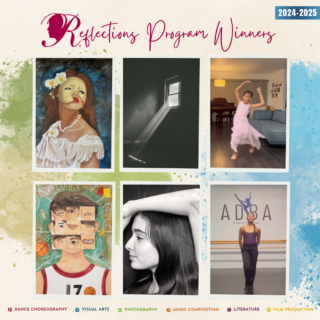
We are delighted to announce the following students who have received the Outstanding Interpretation honor:

  • Abigail Hong (Middle School/7th Grade, Oxford Academy PTSA, Fourth District) for Visual Arts.
  • Katelyn Gooneratne (High School/11th Grade, Canyon High School PTSA, Fourth District) for Photography.
  • Avni Anand (Middle School/6th Grade, Bowditch Middle School PTSA, Seventeenth District) for Literature.
  • Kai Hosein (High School/12th Grade, Eagle Rock Jr/Sr High PTSA, Tenth District) for Music Composition.
  • Rowan Zollars (Middle School/6th Grade, Sycamore Canyon School PTSA, Twelfth District) for Dance Choreography.
  • Mariah Moreno (High School/11th Grade, Santiago High School PTSA, Twenty-Third District) for Film Production.
  • Isabella Juarez-Padilla (Accessible Arts/10th Grade, Corona del Mar High School PTA, Fourth District) for Accessible Arts.

The Award of Excellence recognizes first-place entries in each category and division. These outstanding artworks will also be displayed at the California State PTA Convention and will proceed to the National PTA Reflections level for judging.

The Reflections Program also includes the Accessible Arts division, which provides modified rules and guidelines for students with disabilities. This ensures that all students have the opportunity to participate and be recognized for their creative efforts, as exemplified by Isabella Juarez-Padilla’s Outstanding Interpretation in this division.

The success of the Reflections Program highlights the crucial role of PTA in fostering arts education and providing platforms for student expression. By encouraging participation in programs like Reflections, PTAs across California contribute to increased community awareness of the importance of arts in education.

Congratulations once again to all the talented Reflections participants and award winners! Your creativity and dedication to the arts enrich our communities and inspire us all. As we celebrate Arts Education Month, let us continue to champion the arts in our schools and support programs that empower students to explore their unique talents and voices.

Visit our website at capta.org/award-of-excellence-recipients to view the award winner.
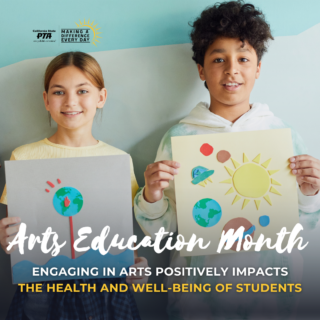
The Importance of Arts Education in the School Curriculum

Arts education has long been celebrated for fostering creativity, critical thinking, and cultural awareness. Yet, despite its proven benefits, arts education does not receive the time and attention it needs.

  1. Deepening Creative Skills

One of the most significant benefits of arts education is its opportunity for students to develop their creative abilities. Creativity is not an innate talent but a skill that grows with practice and time. To truly foster creativity, students need sustained exposure to the arts. The longer a student engages in artistic endeavors, the more their skills will evolve, enabling them to experiment with new ideas, refine techniques, and push their artistic boundaries.

  1. Cognitive and Emotional Benefits

Studies consistently show that arts education is linked to improved cognitive abilities, including enhanced problem-solving skills, memory retention, and attention to detail. Furthermore, the arts provide an emotional outlet, helping students express themselves in ways words often cannot. Extended arts education allows students to build emotional intelligence, deal with personal challenges, and develop resilience, all essential life skills.

  1. Fostering a Lifelong Appreciation for the Arts

When arts education is limited, it’s easy for students to view it as an isolated event rather than an integral part of their lives. Schools can help students develop a more profound and more lasting appreciation for the arts by offering a sustained arts education. Whether it is music, theater, painting, or dance, exposure to the arts over a longer period allows students to explore different art forms, understand their cultural significance, and find what resonates with them personally. This sustained exposure is essential for cultivating a lifelong love and respect for the arts.

  1. Building Collaboration and Communication Skills

Many arts programs, especially in disciplines like theater, music, and dance, require students to collaborate. Collaborative projects teach students how to communicate effectively, negotiate differing ideas, and support one another in achieving a common goal. These skills are vital for success in both academic and professional settings.

  1. Enhancing Academic Performance

A growing body of research suggests that involvement in the arts correlates with better academic performance. Students who participate in arts education often show improvements in subjects like mathematics, science, and language arts. This phenomenon is likely due to the fact that arts education promotes critical thinking, spatial awareness, and creativity—skills that are transferable to other academic areas. Sustained engagement in the arts leads to better academic outcomes as students begin to understand how artistic skills can be applied in other subjects.

  1. Promoting Cultural Awareness and Empathy

Art uniquely transcends boundaries and promotes understanding among diverse groups of people. Exposure to different cultural expressions through arts education helps students develop empathy and appreciation for the experiences of others. With a consistent arts education, students can explore diverse cultural histories, perspectives, and experiences in greater depth, broadening their understanding of the world.

Arts education is not a luxury but necessary to shape well-rounded, thoughtful, and creative individuals. While short-term or limited programs may offer a taste of what the arts offer, they are not enough to provide students with the depth of experience needed to reap the full range of cognitive, emotional, and social benefits. Providing multiple arts education programs gives students the time and space to develop their creativity, refine their skills, and gain a lasting appreciation for the power of the arts. 

In a world where innovation and emotional intelligence are more important than ever, we must invest in arts education as a long-term priority for all students, regardless of their background or where they live.

Recognize Community Champions with Honorary Service Awards

Honorary Service Awards enable PTA units, councils, and districts to publicly acknowledge individuals and organizations that have performed outstanding community service to children and youth. A portion of the funds local PTAs spend to purchase Honorary Service Awards are used to support the California State PTA Scholarships and Grants Program.


The Honorary Service Award program offers six distinctive awards that are professionally and beautifully designed and can be presented by your PTA Unit, Council, or District:

  • Very Special Person Award (VSP)recognizes an individual or organization for their service to PTA. An award certificate and pin are available with a contribution of $25 or more.
  • Honorary Service Award (HSA)recognizes an individual or organization for outstanding service to children and youth in your school or community, going above and beyond what is asked of them. An award certificate and pin are available with a contribution of $40.
  • Continuing Honorary Service Award (CHSA)This award recognizes an individual or organization for ongoing or long-time service to children and youth, providing support year after year. An award certificate and pin are available with a contribution of $45.
  • Outstanding Teacher Award (OTA)—This award may recognize a teacher for outstanding service to children and youth in your school or community. An award certificate and pin are available with a $40 contribution.
  • Outstanding Administrator Award (OAA)—This award may recognize an administrator for outstanding service to children and youth in your school or community. An award certificate and pin are available with a $40 contribution.
  • Elected Official Honorary Service Award (EOHSA)This award may be given to recognize an elected official for outstanding policy work and/or legislation that positively impacts the lives of children. This award may be presented at the local, state, or federal level. This award is not to be used as an endorsement of any elected official but to celebrate the work of the elected official. An award certificate and pin are available with a contribution of $40.
  • Golden Oak Service Award (GOSA)As the most prestigious of the Honorary Service Awards, this award recognizes an individual or organization that has made significant contributions to the welfare of children and youth in a school or community. An award certificate and pin are available with a contribution of $85.

Honorary Service Awards purchases help fund the following scholarships and grants:

Did you know that you can check to find out which Honorary Service Awards a person has earned in past years? Visit our PTA Award Listings and input the person’s last name to find out so you can decide which award to present at this time. 

Order your Honorary Service Awards online through our PTA Store website online. Your awards recipients will feel truly honored and you will know that your donation is helping other PTAs and individuals meet their goals.

Apply Now for our 2025-2027 Board of Managers

Written by Heather Ippolito, California State PTA President-elect

Most of us begin our PTA career chairing or volunteering at our student’s elementary school. For some that’s where our PTA service ends, but there are so many other opportunities to serve and do good things for kids.

As we begin to think ahead to the next school year and PTA term, I ask you to consider serving at the council, district, or even state level of PTA. We need strong leadership at all levels of our organization to further the mission of California State PTA: To positively impact the lives of all children and families. 

Today, I’d like to particularly encourage you to consider applying to serve on the State Board of Managers. The Board of Managers, or BOM as it’s more commonly known, is a body of around 90 volunteers from across the state. It is composed of:

  • the Board of Directors or BOD, which includes elected officers and an appointed Parliamentarian and Director of Legislation, 
  • the elected District Presidents from our 27 local PTA Districts
  • around 60 appointed members from across our state. 

Our statewide Board of Managers does so much:

  • Promotes the mission of PTA
  • Conducts the business of California State PTA between conventions
  • Develops programs and policies for the state
  • Adopts and revises the state PTA budget
  • Provides service to local units and councils upon request
  • Represents PTA on committees and coalitions at the state level
  • Informs and educates through articles and publications, and by conducting workshops and trainings

Do you have a gift or talent that would help us in our work? Have you always wanted to work with a diverse group of dedicated leaders from across our vast state? Are you driven by the mission of our organization? If so, please take a look at the application for the 2025-2027 term and consider applying. We’d love to work with you!

APPLY NOW FOR 2025-2027 BOARD OF MANAGERS

Watch our informational webinar recording below to learn more!

PTA Highlights of the Month – February 2025

“When enough people come together, then change will come and we can achieve almost anything, so instead of looking for hope – start creating it.” – Greta Thunberg

Amador Valley High School PTSA Rallies Together to Bring College Board Testing to their Campus (Peralta District)

This month, we are thrilled to highlight Amador Valley High School PTSA (AVHS) and their remarkable efforts that helped make College Board testing more accessible for their students. For many years, AVHS students experienced a difficult challenge when it came to preparing for their college journey, which was finding a College Board testing site within the East Bay region. 

Amador Valley High School PTSA leader Sangeetha Krishnamoorthy said the issue had been affecting their high school community for several years. With the nearest test site being many miles away, students and families would sacrifice hours of sleep to drive the long distance or spend additional money on hotel stays to be near the testing site. 

“Students were forced to choose test venues up to 200 miles away, which hindered their ability to take the test successfully. There may be various reasons, such as staff availability, budget constraints, or the issue being considered a low priority, that have contributed to the delay in addressing this matter,” Sangeetha said. Members of the AVHS PTSA recognized the lack of testing resources, so they decided to take action and advocate on this issue. 

On August 28, 2024, Amador Valley High School PTSA held a general association meeting that welcomed parents to share their voices. Although the school district was already looking into this issue, the PTSA helped bring the urgency of the issue to the school district and successfully brought a solution that quickly provided students with a nearby testing site.  

“Amador Valley High students can now register for the SAT at our school site, with the district ensuring that budget is allocated to have the test proctored here,” said Sangeetha. This success was a significant turning point for parents and students since this issue had been unresolved for many years.

California State PTA is incredibly proud of the AVHS PTSA community for advocating for their students’ needs. Thank you to Amador Valley High School PTSA for providing a platform for parents to engage and raise awareness about concerns affecting their children and other students.

Marguerite Hahn Elementary PTA Brings Holiday Joy with Hahn-A-Days (14th District PTA)

This past winter, Marguerite Hahn Elementary PTA started a gift fund called Hahn-A-Days! With Hahn-A-Days, their PTA’s goal was to bring a 

one-of-a-kind holiday experience for 11 Hahn Elementary families in need. The PTA started by creating a big wooden ornament board where they pinned the wish list items of each family throughout December.

After weeks of planning and collecting gifts, the PTA organizers drove through the streets of Rohnert Park with their principal, spreading holiday cheer from house to house on a decorated trailer playing festive music. With the help of the PTA members and community, they delivered Christmas trees, decorations, and a bag filled with gifts for each of the 11 families.

“The smiles and happiness from the families were priceless! It was incredible to see our community come together to help others in need,” said Zoe Aquino, a Marguerite Hahn Elementary PTA leader.

Thanks to the dedication and generosity of Marguerite Hahn Elementary PTA members for joining together to positively impact the lives of children and families in their community!

Ready to spotlight the work of your PTA? Submit a PTA Success Story Submission Form to share your PTA’s highlight so you can be included in our next PTA Highlights of the Month.

Understanding Proposition 28: What it is and Why it Matters

In November 2022, California voters overwhelmingly said YES to more arts and music in schools through the passage of Proposition 28: The Arts and Music in Schools (AMS) Funding Guarantee and Accountability Act. What is that? This legislation guarantees funding for additional arts programs. Why is that important?

  • 89% of California schools DO NOT provide the visual art, music, dance theater, and media arts
    classes mandated by law.
  • Students with access to a full arts curriculum are 5X less likely to drop out, 4X more likely to be recognized for academic achievement, 4X more likely to earn a B.A., and 30% more inclined to pursue professional careers.

Need more information? The California Department of Education (www.cde.ca.gov) has created a one page parents reference guide. This guide contains links to all the information pertaining to this legislation and its requirements and implementation. Please download and review. For more information and ways to become involved, attend the California State PTA convention and join us for our workshop on this Proposition.

Visit www.cde.ca.gov/eo/in/documents/amspgguide.pdf for a copy of the guide. 

Why Students Should Engage in Arts Activities

During times of uncertainty, art can be a powerful means for students and parents to cope with frustration, anxiety, and stress, expressing themselves when words might not be enough. Art in many forms provides outlets for difficult emotions such as fear and anguish. Studies have shown that engaging in creative activities can lower cortisol levels, a hormone associated with stress. Please encourage students to sketch, create digital art, sing, dance, create sculpt, write poems, or just doodle daily. Arts can be meditative and therapeutic. 

Engaging in creative activities helps students focus on the present moment and improves concentration. Furthermore, art can be an empowering tool for students who feel they don’t have a voice in other areas of their lives. Art also provides a medium to raise awareness about common issues in the student’s community, as well as turn their personal struggles into collective expressions and stories of hope. Students, therefore, will feel heard and connected with others sharing similar experiences. 

Completing a piece of art, regardless of skill level, can give students a sense of accomplishment which boosts self-esteem and helps them feel more in control of their emotions and life. In a world where students may often feel the pressure to succeed, art allows them to create without the expectation of perfection. Through the act of creating, students can develop emotional resilience.

In conclusion, consider these two powerful quotes: “Art is not a mirror held up to reality, but a hammer with which to shape it” and “We must accept finite disappointment, but never lose infinite hope.”

Parents Under Pressure

Excerpts from the U.S. Surgeon General’s Advisory on the Mental Health & Well-Being of Parents 

Parents often say parenting is one of the best jobs but also one of the hardest. The work of parenting is essential not only for the health of children but also for the health of society. Additionally, we know that the well-being of parents and caregivers is directly linked to the well-being of their children. The stresses parents and caregivers have today are being passed to children directly and indirectly, impacting families and communities across America.

The mission of the California State PTA is to positively impact the lives of all children and families. As the following information—adapted from a recent advisory published by the U.S. Surgeon General—makes clear, one critical part of meeting our mission is strengthening awareness of the importance of the mental health of parents and caregivers.

Approximately 63 million parents in the United States are living with children under the age of 18. There are also millions of non-parent caregivers who hold the primary responsibility of caring for children. Parents and caregivers play a critical role in providing the formative, safe, stable, and nurturing relationships and environments that children need.

Parental Stress is Real and Increasing

Parents today face new stressors that previous generations didn’t have to consider. These include the complexity of managing social media, concerns about the youth mental health crisis, and an epidemic of loneliness that disproportionately affects young people and parents, just to name a few. 

Parents across all backgrounds want to provide their kids with a foundation for happiness and success. One response to a world where success and fulfillment feel increasingly out of reach has been an intensifying culture of comparison. Often, influencers and online trends propagate unrealistic expectations around childhood milestones, parenting strategies, achievements, and status symbols that kids and parents feel they must pursue. 

Chasing these unreasonable expectations has left many families exhausted, burned out, and perpetually behind. 

During early childhood, children’s parents and caregivers often experience stress related to sleep disturbances, adjustment to new parental roles, and more work-family conflict. 

As children enter mid-childhood, parents and caregivers may encounter challenges in managing their child’s emotional, social, cognitive, and physical transitions alongside their own work and family responsibilities. 

During adolescence, teens’ parents and caregivers may face additional stressors associated with their child’s burgeoning independence, risk-taking behaviors, and peer influences. 

At all stages, parents and caregivers often face heightened stressors related to raising children, such as: 

  • financial strain and economic instability, 
  • time demands, 
  • concerns over children’s health and safety, 
  • parental isolation and loneliness, 
  • difficulty managing technology and social media, and 
  • cultural pressures.

Additionally, parenting involves significant mental labor, including balancing complex schedules, anticipating a child’s evolving needs, making countless daily decisions on behalf of a child, and monitoring progress. These concerns can limit adult working memory capacity and negatively impact attentional resources, cognitive functioning, and psychological well-being. 

Stressors related to child caregiving can also disproportionately burden some parents and caregivers, notably those with fewer resources and those who experience economic, social, political, and cultural marginalization.

Financial stress related to child care costs, health and education expenses, and employment and income insecurity is an essential contributor to parental stress. 

In particular, parents living in poverty often worry about fulfilling their children’s basic needs and the resulting stress can negatively affect their mental health, parenting capabilities, and their children‘s mental health.

While parents and caregivers are working more, they also spend more time engaging in primary child care than before. This care includes physical care, education-related activities, reading to/with children, and playing/doing hobbies with children, among other activities.

 Evidence suggests that work and child caregiving demands have come at the cost of quality time with one’s partner, sleep, and parental leisure time. 

Parents caring for aging parents or other family members face additional strain. In many instances, they are responsible for primary caretaking, providing transportation, and assisting with health needs, amongst other responsibilities for aging parents, while also dealing with the demands of caring for children. 

As advocates for children and families, PTAs are credible messengers about these issues. 

PTA Leaders Can Advocate For Policies that Support Parents’ Mental Health

Call on policymakers to do more:

  • Promote and expand funding for programs that support parents and caregivers and their families.
  • Establish a national paid family and medical leave program and ensure all workers have paid sick time.
  • Invest in social infrastructure at the local level to bring parents and caregivers together. 
  • Address the economic and social barriers that contribute to the disproportionate impact of mental health conditions for certain parents and caregivers. Priorities should encompass poverty reduction. Ensure parents and caregivers can access comprehensive and affordable high-quality mental health care. 

Push employers to adopt parent-friendly policies: 

  • Expand policies and programs that support the well-being of parents and caregivers in the workplace. 
  • Implement training for managers on stress management and work-life harmony.
  • Provide access to comprehensive and affordable high-quality mental health care.

PTAs Can Strengthen Local Awareness and Support Systems

Engage schools and community organizations in this issue: 

  • Foster open dialogue about parental stress, mental health, and well-being in culturally appropriate ways.
  • Equip parents and caregivers with resources to address parental stressors and connect to crucial support services.
  • Create opportunities to cultivate supportive social connections among parents and caregivers. 
  • Elevate the voices of parents and caregivers to shape community programs and investments. 
  • Strengthen and establish school-based support programs.

PTA Members Can be There for Each Other

As family and friends: 

  • Offer practical support. Increasing support can help reduce the impact of stress.
  • Connect with parents and caregivers in your life regularly. For example, find opportunities to include parents and caregivers in your routine by scheduling a weekly walk or planning a regular call to check in. 
  • Learn about mental health challenges parents and caregivers may face.

In our roles as parents and caregivers:

  • Remember, caring for yourself is a key part of caring for your family.
  • Nurture connections with other parents and caregivers.
  • Explore opportunities to secure comprehensive health insurance coverage for yourself and your family. 
  • Empower yourself with information about mental health care.
  • Recognize how mental health challenges manifest and seek help when needed.

Raising children is important work. It should matter to all of us. And the health and well-being of those caring for our children should also matter to us. The Surgeon General hoped that this Advisory would help catalyze and support the necessary changes to ensure all parents and caregivers can thrive and PTA can help. 

For additional information, shareable resources, and a downloadable PDF of the U.S. Surgeon General’s Advisory on the Mental Health & Well-Being of Parents, visit https://www.hhs.gov/surgeongeneral/reports-and-publications/parents/index.html

Apply Now: Graduating High School Senior Scholarship

Do you know a student who might be interested in applying for one of California State PTA’s Graduating High School Senior scholarships? Now is the time to apply; the application deadline has been extended to February 15, 2025! 
The following two types of scholarships are available. 

  • $1,000 Volunteer Service Scholarship – This scholarship recognizes graduating seniors for volunteer service in their PTAs, schools, and communities. It provides funds to enroll in courses at accredited colleges, universities, and trade or technical schools. Applicants must be PTA members graduating from a California high school between now and June 30, 2024. Seniors graduating from a non-PTA high school may still apply if they are on the board of a council or district PTA or the California State PTA Board of Managers. 
  • $500 Dr. Ralph E. White Graduating Senior Scholarship – Honoring the volunteer and public-service legacy of Dr. Ralph E. White and his wife, Eleanor, this additional scholarship provides $500 each to two successful applicants of the Volunteer Service Scholarship who intend to pursue a career in a medical field. 

Graduating seniors only need to fill out one application to apply for both scholarships. The top two student applicants entering the medical field will receive both the Dr. Ralph E. White Scholarship and the Volunteer Service Scholarship.

Be sure to include the following items in the application:

  • Proof of PTA membership must be uploaded to the application.
  • A descriptive essay which fully answers the questions asked regarding PTA volunteering and experience, service to other organizations, career plans, job experience, and any other information the student feels would be valuable to the scholarship selection committee.
  • Two completed reference forms and letters are required, written specifically for this application. The first reference is to be written by a community volunteer leader who has volunteered with the student and is unrelated to the applicant. The second reference is to be written by a high school faculty member.

Applications, reference forms/letters, and all supporting documents must be received in the California State PTA office by February 15, 2025. All applicants are notified of their application results by the end of March. Scholarship winners receive a letter of congratulations, a recognition certificate from California State PTA, and a check.

For additional information, please visit the Graduating Seniors Scholarship web page or email the California State PTA Scholarships & Grants Committee at scholarships@capta.org.

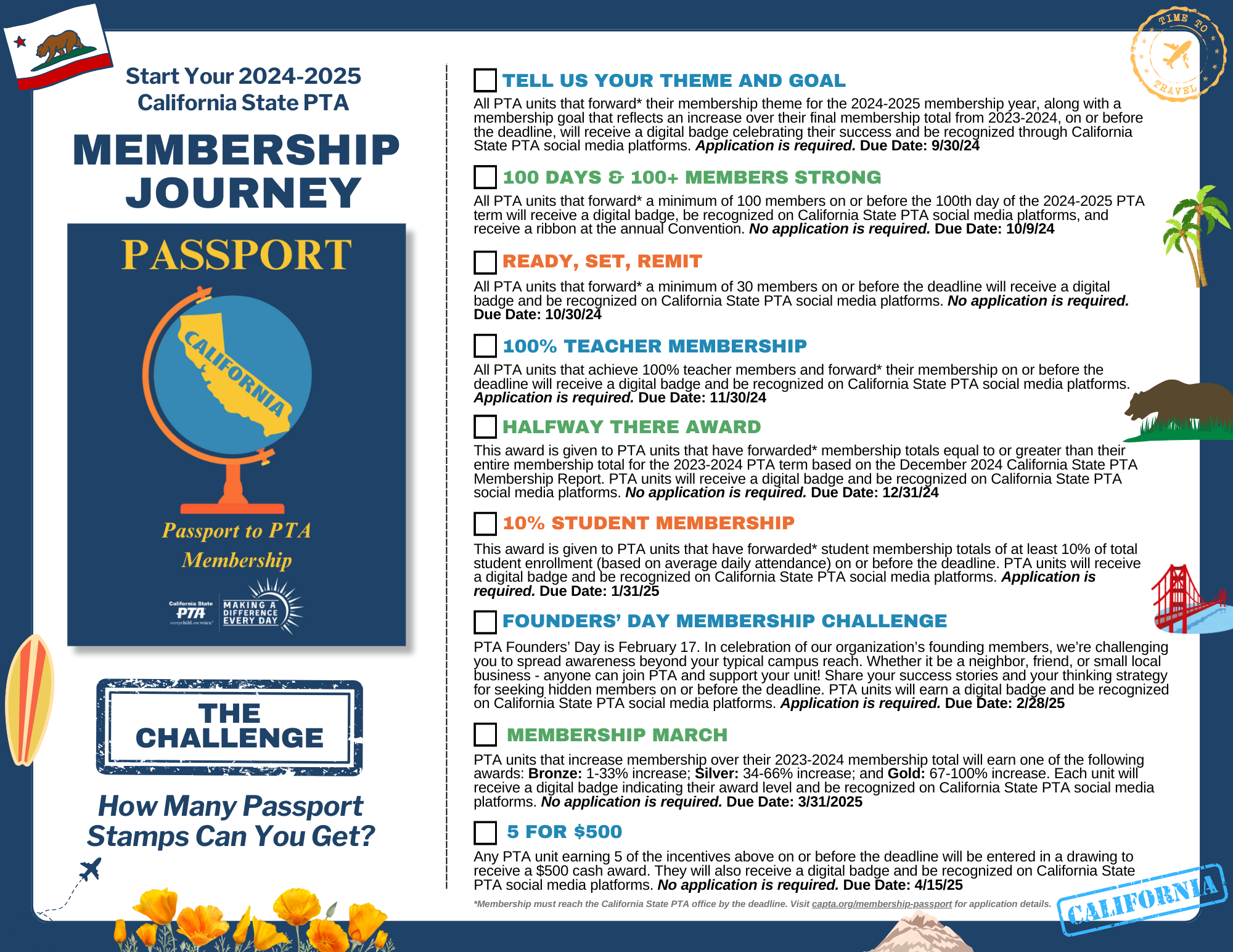
2024-2025 Membership Passport Incentive Journey

We are Halfway There!

We hope you are having a great start to 2025. The New Year is the perfect time to reignite your membership campaign!

Thank you to the hundreds of local PTAs that have already taken part in our first five Membership Passport challenges. That means you are halfway to the finish line…Yay! If you missed out on the first five challenges, have no fear. There is still time for the sixth challenge of our Journey, 10% Student Enrollment.

Any PTA unit that has forwarded student membership totals of at least 10% of their school’s total student enrollment (based on average daily attendance) on or before midnight on January 31, 2025, will receive a digital badge. You will also be recognized on California State PTA’s social media platforms. 

Click here for the application link.

And…Don’t forget to check out the rest of the challenges to complete your Membership Journey. Visit capta.org/membership-passport for more details.