
Headed to the 2026 PTA Convention in Fresno? Don’t Forget Your Membership Card!

By the California State PTA Convention Commission

The countdown is on for the 2026 PTA Convention in Fresno – and as you get ready for all the excitement, there’s one golden ticket every participant needs to join the fun in Fresno: your PTA membership card! Don’t miss out—Fres-YES is calling!

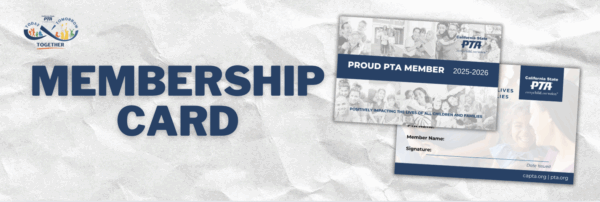
Whether you’re coming for workshops, networking, or for our keynote speakers, proof of active membership will be required during registration at the in-person kiosk.

Here’s how to be ready:

  • If your PTA uses TOTEM: You already have a digital card. Download it so you can show it on your phone or print a copy.
  • If you paid with cash or check: Ask your PTA for a physical membership card. Don’t wait – request it now!

For leaders printing cards: The California State PTA Membership Card Template is available now on the Leaders’ Website.

This year’s convention is shaping up to be one of the best yet. Don’t miss a moment because of a missing card! Pack your passion, your PTA pride, and your membership card. See you in Fresno on May 1-3, 2026!

How Families Can Use AI to Augment Student Education

By the California State PTA Health & Community Concerns Commission

We all want our children to feel competent and connected at school. Artificial Intelligence (AI) is quickly becoming a part of everyday life much like cell phones, which have become essential to most of us. Today, those who understand how to use AI effectively and ethically have a clear advantage in both academics and the workplace.

Until recently, schools largely avoided AI. Now K-12 educators are beginning to explore how to integrate AI in meaningful ways that enhance learning. As parents and caretakers, we can support our students by helping them become comfortable with these powerful tools while remembering one key principle: people always decide. AI can provide information and guidance, but it is always up to the person to verify what it has produced and make the final decision about how to use it.

Here are some ways AI can be a helpful academic tool for families: 

  • Summarize large amounts of information and highlight key points.
  • Simplify complex concepts, explain cause-and-effect relationships, and provide analogies and example models for learning.
  • Verify facts and create study guides.
  • Generate images, videos, or even music from text descriptions.
  • Act as a tutor or conversation partner in a foreign language.
  • Create quizzes or practice tests based on reading material.
  • Support test preparation by pinpointing focus areas based on results of practice quizzes.
  • Help students learn how to ask better questions (“Can you explain the mistake I made in my answer?”).
  • Inspire writers by creating character images from their story details.

Want to help your family navigate the world of technology and AI with confidence? Check out National PTA’s PTA Connected for trusted resources, tips, and conversation starters for families. For those looking for a deeper dive, the book AI Made Easy for Parents by James McConihe is a helpful guide—especially for families with younger students.

Together: Our Students Excel When They Are Present

California State PTA Education Commission

When students attend school consistently, their educational outcomes are better. Unfortunately, some students are absent 10% or more of the school year, making them chronically absent. According to the California Department of Education, research shows that students who are chronically absent are less likely to read proficiently by third grade, perform well in middle school, and graduate from high school (Balfanz and Byrnes 2012; Chang and Romero 2008). Chronic absence disproportionately impacts specific student populations, including students with disabilities, foster and homeless youth, socioeconomically disadvantaged students, English learners, and certain racial and ethnic groups (Chavez and Hough 2025). 

California State Superintendent of Public Instruction, Tony Thurmond, recently announced the release of the California Attendance Guide, an online resource that provides proven, actionable strategies for every school, district, and county office of education across the state. He stated, “Due to historic investments in student supports and family engagement, California has cut TK–12 chronic absenteeism levels by one-third, from 30% in 2022 to 20% in 2024. We are on track and committed to reduce chronic absence by 50 percent over five years. Our Community Schools approach is working: When we address the needs of the whole family, our students are able to show up to school.” Read State Superintendent Thurmond’s full statement here.

The California Attendance Guide recognizes that in order to continue to reduce chronic absenteeism, these three things need to improve: 

  • Health, well-being, and safety – Students attend school when they are physically and emotionally healthy as well as when they feel safe and supported.
  • Family engagement – Students attend school when they and their families are actively engaged as partners in advancing learning and overcoming barriers to getting to school.
  • Student connectedness – Students attend school when they are connected to a caring adult and peers, engaged in prosocial activities, and feel a sense of belonging (Attendance Works 2019, 2025).

PTA plays a vital role in supporting student attendance by actively addressing these core factors. 

California State PTA advocates for policies that ensure that children and youth feel safe, supported, and included on our school campuses. They also advocate for policies that support their mental and physical health. Many local PTAs organize health fairs, field days, and health-focused assemblies.

PTA builds strong connections between families and schools. By encouraging meaningful involvement, PTA empowers parents and caregivers to become active participants and partners in their children’s education. 

PTA-sponsored programs such as Reflections, field trips, family nights, and assemblies, foster a sense of belonging and community within schools. These experiences help students feel valued, supported, and connected to caring adults and peers. Students feel like they are part of something bigger than themselves, motivating them to show up and participate.

Together, through ongoing collaboration and a shared commitment to student well-being, we can ensure that every student not only attends school, but feels seen, supported, and ready to excel.

PTA Leadership Tools

By the California State PTA Leadership Services Commission

One of the many benefits of being a PTA member and/or leader is that PTA provides continual support for all levels with ongoing opportunities to grow, connect, and make a meaningful impact in your community. Be sure to check out the Leaders Website to access our latest tools and resources to help empower the work you do for your PTA.

Ready to level up your leadership? Check out our calendar to join our California State PTA Leadership Services Commission for our monthly leadership calls where you can receive instruction and discuss important topics that will equip you as a PTA leader. Visit capta.org/monthly-leadership-call to register.

Don’t forget to also subscribe to our Leadership Essentials monthly newsletter, which features the latest news and updates for your PTA. 

PTA is here for you!


Turn Your Passion Into Action with California State PTA Resolutions

By the California State PTA Resolutions Committee

PTA Resolutions give us the authority to advocate for every child. Recent resolutions have tackled issues like equitable literacy, inclusive education, student concussions, missing non-abducted children, cannabis and synthetic nicotine, and more.

Do you see a problem affecting children statewide? Bring it forward! Resolutions start with a vote in your association meeting and must be submitted in draft form by November 1. Resolution makers will work with a California State PTA mentor to hone your resolution for final submission by January 5th, to be considered at our 2026 PTA Convention.

For guidance, visit capta.org/resolutions to review the Resolutions Procedure Book or contact resolutions@capta.org.

Your idea could shape PTA’s advocacy for years to come! 

PTA Climate Action is Heating Up

By California State PTA Legislative Advocacy Team

A decade ago, California State PTA passed a resolution proclaiming that “Climate Change is a Children’s Issue.” Since then, our organization has taken a variety of steps to educate our members and support local action on this issue.

This term, the California State PTA Board of Directors has stepped up its attention to this issue by adding a climate advocate to the Legislation Team. The goal is to help raise state leaders’ awareness of the ways that their actions on climate affect children, families, and schools. 

California State PTA is not alone in this effort. For example, we have been a member of the Climate Ready Schools Coalition (CRSC) for several years, which includes organizations like the California Federation of Teachers, Green Schoolyards, Ten Strands, and Children Now – to name a few. CRSC began its work by publishing a Call to Action that explained the importance of supporting climate resilience in local schools in California. The Coalition was active in the 2024 effort to put Proposition 2 on the ballot and pass it, successfully providing public school facility funding that will directly benefit California students and families. 

Making climate a specific advocacy area will help PTA raise our visibility with other climate organizations. It is surprising how many of those organizations don’t necessarily see what schools and young people have to do with their climate advocacy. 

We also hope to more consistently educate and support every PTA leader and member regarding actions they can take locally. On capta.org, you will find that our Health and Community Concerns Commission has a section devoted to Climate Change.

This article from Ed100 provides a summary of both the challenges schools face and places where those local efforts can start.

We’re also interested in hearing about what you all, as local PTA leaders, have done or are doing to work with your local schools on issues of climate, environmental health, and building resilience. Have you urged your school district to install solar panels or invest in electric instead of diesel buses? Do you know if teachers include environmental literacy in their curriculum, as recommended by the state? Have you worked with your school food service to reduce waste?

Please email Mary Perry, California State PTA climate advocate, at mperry@capta.org to help us learn more about your efforts and share them with other PTAs throughout California. 

Celebrating Inclusion, Honoring Leadership: The Jan Harp Domene Diversity & Inclusion Awards

By the California State PTA Diversity, Equity & Inclusion Committee

At California State PTA, we believe every child deserves to feel seen, valued, and supported. Diversity, Equity, and Inclusion (DEI) aren’t add-ons to our work; they are at the heart of who we are as a statewide family of volunteers. That’s why we’re proud to spotlight the National PTA Jan Harp Domene Diversity & Inclusion Awards—an inspiring opportunity for PTAs across California to celebrate what’s possible when communities come together to champion every child.

Who Was Jan Harp Domene—and Why This Matters

Named in honor of Jan Harp Domene, past California State PTA President and a transformative National PTA President, these awards uplift the PTAs and leaders who are building bridges, breaking down barriers, and ensuring all families have a voice. Jan’s legacy is one of courage, compassion, and conviction—she believed PTAs thrive when every culture, language, and perspective is welcomed at the table. 

Jan Harp Domene wasn’t just a leader; she was a listener, a connector, and a relentless advocate for all children. Jan championed the importance of meaningful family engagement across cultural and linguistic differences. She modeled how to build trust with communities historically left out of decision-making and how to turn good intentions into inclusive practices that last.

What the Jan Harp Domene Awards Recognize

The awards bearing her name honor PTAs that embody values that are transforming school climates through inclusive programs, equitable policies, and authentic partnerships with families and students. 

The Jan Harp Domene Diversity & Inclusion Awards celebrate PTAs and leaders who:

  • Partner with families in culturally responsive ways (think multilingual communication, community liaisons, and welcoming spaces).
  • Increase access to programs, leadership roles, and decision-making for underrepresented parents and caregivers.
  • Create student-centered initiatives that uplift identity, belonging, and voice.
  • Build sustainable inclusion practices, not just one-time events, into PTA culture.
  • Use data, listen, and reflect to close participation gaps and improve outcomes for all students.

Why California PTAs Should Apply

California is home to one of the most diverse communities in the world. Our school families span hundreds of languages and cultures. When PTAs lead with inclusion, we don’t just increase attendance—we build belonging. Applying for the Jan Harp Domene Awards provides an opportunity to:

  • Celebrate your volunteers and community partners who make your PTA welcoming and accessible.
  • Share what’s working so other PTAs can replicate your success.
  • Earn recognition that builds credibility with school and district leaders, potential funders, and new families considering membership.
  • Inspire future leaders such as parents, caregivers, and students who will carry this work forward.

What Strong Applications Look Like

Ready to raise your hand? Here’s what strengthens an application:

  • Clear goals with measurable impact: Did multilingual outreach increase participation? Did you diversify your board? Did your program reach families who weren’t engaged before?
  • Student voice: How are students informing decisions, shaping programs, or leading initiatives?
  • Collaboration: Partner with school staff, community organizations, and cultural leaders to widen your welcome.
  • Accessibility: Transportation, childcare, translation/interpretation, hybrid events—show how you removed barriers.
  • Sustainability: Share how you’ll maintain momentum beyond a single event or school year.

Real-World Examples to Spark Ideas

  • Multilingual Welcome Series: Host a set of bilingual or trilingual “PTA 101” sessions led by parent ambassadors representing the languages spoken in your community. Provide interpretation, childcare, and food; co-create agendas based on family feedback.
  • Cultural Heritage Family Night 2.0: Go beyond performances—set up resource stations staffed by counselors, community health partners, and district reps. Invite student leaders to curate storytelling circles that affirm identity and belonging.
  • Inclusive Leadership Pathways: Create a mentorship program that pairs experienced PTA leaders with new parents and caregivers from underrepresented groups. Offer flexible roles, virtual participation options, and micro-volunteer tasks to widen access.
  • Student Belonging Projects: Support student clubs and classes to lead projects—murals, podcasts, peer mentoring—that celebrate diversity and build connections across differences.

How Your DEI Committee Can Lead the Charge

California State PTA’s DEI Committee encourages every unit, council, and district PTA to make applying for this award part of your annual planning. Here’s a simple roadmap:

  1. Audit your welcome: Where and how do families encounter your PTA? Is your language inclusive? Are your meeting times and locations accessible? Who’s missing—and why?
  2. Set two bold, measurable goals: For example, “Increase participation of Spanish – and Vietnamese-speaking families at general meetings by 30%” or “Add two new board members representing underrepresented communities.”
  3. Resource your plan: Budget for interpretation, childcare, transportation vouchers, and food. These investments matter.
  4. Document as you go: Track attendance, collect surveys in multiple languages, and capture stories from families and students.
  5. Apply and amplify: Submit your application for the Jan Harp Domene Awards and share your journey with photos, quotes, and data. 

A Living Tribute to Jan

When your PTA applies for the Jan Harp Domene Diversity & Inclusion Awards, you’re not just completing a form—you are advancing a movement Jan helped build. You’re saying to every child and family, “You belong here. Your voice matters. This PTA is your PTA.”

California PTAs lead with heart. Let’s also lead with action.

Ready to apply or learn more? Visit the National PTA page for the Jan Harp Domene Diversity and Inclusion Awards to learn more.

Membership: Why Join The PTA

By the California State PTA Membership Services Commission

The school year is off to a roaring start and there is already so much happening! From trying to get the family back into a school “groove,” to adjusting to homework coming home again, sorting through school paperwork, and all those extracurricular activities! One item that should not be overlooked and lost in the mix of it all is that invitation to join PTA. So why is it important to join PTA?

Joining the PTA is a way for parents to support their child’s education. Becoming a PTA member is a powerful way to champion your child’s education and show you care, whether or not you’re able to volunteer. School is so much more than students sitting at their desks, writing sentences, and solving math problems. It’s about the memories students make along the way. PTA brings countless fun enrichment activities that make school truly unforgettable. Examples include the Reflections art program, field trips, science night, the school talent show, and so much more! If you can volunteer, the PTA would love for you to lend your time and unique talents to help support our students. Just seeing the smile on your child’s face when they see you helping out says it all. They know you are showing up for them. Your involvement and engagement makes a real difference in your child’s learning experience.

PTA offers the unique opportunity to help build community at your child’s school. When you become a member of the PTA you join a dedicated team of parents, teachers, staff, students, and the principal, all working together to benefit children and youth. They say it takes a village to raise a child and joining the PTA is a great way to become part of that village. It opens the door for new connections and relationships. PTA helps parents connect with one another, share information, and work together for all students. This is your opportunity to get involved and help make a difference.

As a parent, you are an advocate for your child because you want what is best for them. As a member of the PTA you join the largest children’s advocacy organization. Did you know that PTA has a long history of advocating for the education, health, safety, and welfare of all children? The PTA enables parents to have a voice on issues that affect their family. Parents are also able to connect with other like-minded parents who share their interests and concerns. When you join the PTA you are standing up for your child and for all students.

Joining the PTA is easier than ever! You can scan a QR code or use a link in a school newsletter or PTA brochure. It only takes a moment to join, so keep an eye out for membership drive materials from your child’s PTA.

Positively Impacting Lives with PTA Membership

A Message from California State PTA President

I still remember the first PTA I joined. It was back in 2000 and I was a first-year teacher at Valley View Community School. I turned in my membership envelope with my check inside on the very first day of the school’s membership drive. I dutifully went to their association meetings, because PTA had the “T” for teacher in it and I wanted to be a part of that! 

Twenty-five years later and I still join a PTA each and every year. Why? Because the work done by the PTA is so important! We advocate so that every child has access to a high-quality, free public education. We help families see the importance of their engagement on their student’s school campus. We train leaders at over 3000 school sites across the state to bring much-needed programs to our schools. We have a community of half a million members who all believe in the mission of positively impacting the lives of all children and families. 

Your membership matters. It gives us a voice as we advocate in Sacramento and Washington D.C. It shows your school district that you value family engagement and the work done by your site’s executive board to bring programs into your school. Your membership also helps support PTA at all levels. Your council and district are able to provide more support and programming and it allows State and National PTA to continue to offer grants and scholarships, to offer training opportunities both online and in-person at Leg Con and Convention, and to provide amazing publications, like the one you are reading. As the oldest and largest child advocacy membership organization in the country, our members keep us strong!

Your membership also offers you some perks and benefits besides what I’ve already listed. Did you know that both California State PTA and National PTA have member perks offered on their websites?  As a member, you receive discounts on items from produce boxes to birthday parties at chain restaurants to savings on your back to school clothes shopping. Want to learn more about these special offers? Watch our Member Perks webinar to see how you and your fellow PTA members can take advantage of these amazing offers.

Finally, I’d like to ask you to help all of our schools meet their membership goals. Share their social media posts on membership to amplify their reach. Ask your friends to join a school you care about. Tell others why PTA is important to you on your social channels and ask them to join. If every current PTA member gets one more person to join, our voice would be that much stronger. Let’s do all we can to keep PTA thriving – today, tomorrow, together!

Sincerely,

Heather Ippolito
California State PTA President


A Message from California State PTA President-Elect

As a State PTA leader, I get to attend other statewide association meetings. Recently, I attended the California Association of African American Superintendents and Administrators meeting. It was exciting to be in a room of individuals who are focused on improving the lives of all students by improving the lives of those that have been traditionally underserved or marginalized – children of color. By focusing on providing support for African American and other teachers of color, our students of color can see themselves in a positive learning environment. There was also recognition of the need to support teachers of color. Here are some key messages and thoughts from our meeting:

  • If you have power, then you have the responsibility to empower others! Building and supporting others to find their voice is something we all need to support.
  • It is easy to get distracted by all the noise that is currently around us. Stay focused on the goal, providing and promoting positive learning for all children. As the old saying goes, “A rising tide floats all boats.”
  • Finally, “Education and learning is the path to freedom for everyone, so let’s support a free and public education for all.”

I walked away inspired by the commitment and desire of an organization that has and continues to overcome many obstacles, barriers, biases and lack of faith in their abilities to perform. We need to support efforts to ensure that all of our children see teachers who reflect who they are.

Sincerely,

Will Sanford
California State PTA President-Elect

California’s 2025-26 Education Budget: What Families and PTA Leaders Need to Know

By: Legislation Advocacy Team 

California schools are beginning the 2025-26 school year with stable funding despite economic uncertainties and devastating wildfires. The state budget, passed in June, allocates $114.6 billion in Proposition 98 funding to TK-12 schools and community colleges, representing a modest decrease from the previous year but maintaining essential educational services.

Key Budget Highlights

  • Early Literacy Priority: $462.5 million for reading instruction, teacher training, and literacy coaches—nearly half a billion invested during a tight budget year.
  • Expanding Early Education: $2.1 billion completes transitional kindergarten expansion to all 4-year-olds with smaller class sizes (10:1 ratios). $89.3 million for increases in child care subsidies.
  • Supporting Working Families: $526 million expands after-school and summer programs to more school districts (eligibility drops from 75% to 55% disadvantaged students). Free meals continue for all students, with $160 million for kitchen improvements.
  • Teacher Support: $464 million for recruitment and training, including new $10,000 stipends for student teachers.

What Didn’t Make the Cut

  • Ethnic Studies: No funding provided despite legislative mandate, leaving implementation to individual districts.
  • Adequate Cost Increases: A 2.3% cost-of-living adjustment won’t cover districts’ actual 4.5-5% annual cost increases.

Financial Risks and Federal Threats

State Budget Concerns:

  • The education rainy day fund is completely depleted ($405 million used)
  • $1.88 billion in payments to districts delayed
  • Heavy reliance on temporary funding for permanent programs

Federal Disruption: Since taking office in January 2025, the Trump administration has withheld $800 million in California education funding and canceled $148 million in teacher training grants. This has already forced the cancellation of 2025 summer programs and professional development events. Additionally, special education services face disruption as the Individuals with Disabilities Education Act (IDEA) oversight shifts to other agencies, potentially affecting California’s 851,000 students with disabilities who rely on these federally mandated services.

Impact on Families

What You’ll See:

  • Continued free meals
  • Better reading instruction
  • Expanded after-school programs (if federal funding stabilizes)
  • Smaller TK classes

What to Watch:

  • Program sustainability as one-time funding expires
  • Federal funding disruptions affecting special education and Title I programs
  • Potential teacher shortage worsening

PTA Leader Action Items

  • Monitor literacy program implementation
  • Advocate locally for ethnic studies
  • Support teacher recruitment amid federal grant cuts
  • Engage with districts on dual budget pressures (state and federal)
  • Contact representatives about restoring federal education funding (note: plan to attend the California State PTA and National PTA Legislation Conferences in 2026, where you can advocate in person!)

Program Expansion: Many districts will now qualify for expanded learning programs that previously weren’t eligible, creating new opportunities for family engagement and student support.

Long-term Planning: PTA leaders should prepare for potential budget challenges in future years as temporary funding expires, federal funding is uncertain and reserves remain depleted.

Looking Ahead

While California crafted a protective budget during difficult times, federal actions have added significant uncertainty. Education expert Kevin Gordon called it “a remarkable budget in a remarkably bad budget year,” noting that schools fared much better than other state programs.

The combination of depleted state reserves and federal funding threats creates a more challenging environment than anticipated when this budget was passed. The budget’s success will depend on economic recovery and avoiding deeper cuts to federal education funding. Families and PTA leaders should stay engaged with their local districts to ensure new programs are implemented effectively while preparing for potential future challenges.

Resources for additional learning: